Men’s Quartz Chronograph Watch Selection Guide
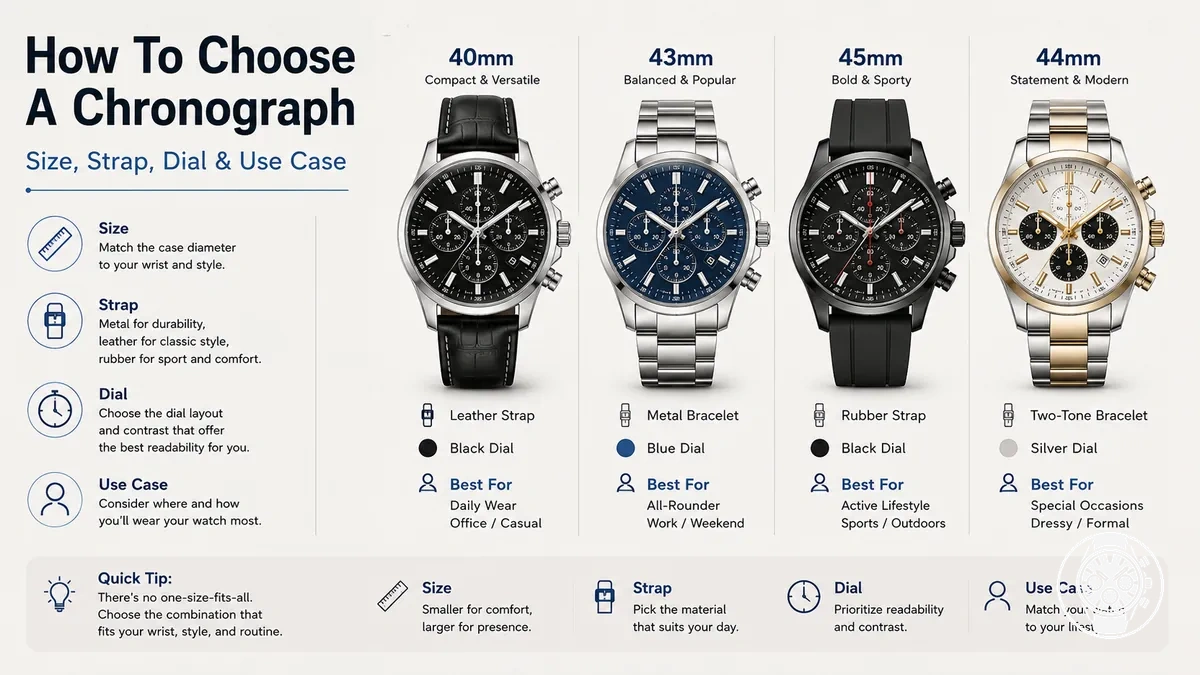
A men’s quartz chronograph watch should be selected by matching wrist fit and useful chronograph features with suitable strap material, water resistance, style, and value for the intended use, making fit, function, durability, style, and value the main decision fields.
This selection guide helps you choose within men’s quartz chronograph watches rather than compare every type of watch.
A men’s quartz chronograph watch combines a battery-powered movement with chronograph features for measuring elapsed time, while its dial, subdials, case, strap material, and stated water resistance affect how well a particular model suits its wearer and use. This selection guide helps you choose within men’s quartz chronograph watches rather than compare every type of watch.
For daily wear, prioritise comfortable wrist fit, legible chronograph features, a strap material suited to prolonged wear, and a manufacturer-stated water-resistance rating appropriate for the expected exposure; work or formal wear can shift the priority toward case proportions, dial legibility, strap material, and appearance. A limited budget makes value a trade-off between the functions and durability requirements you need and preference-based materials or styling, so the first detailed selection question is whether a quartz chronograph suits the intended use.
The final selection is model- and wearer-specific: case dimensions need to correspond with wrist size and comfort, water exposure needs to remain within the selected model’s stated water-resistance conditions, and stainless steel, leather, or another strap material should be assessed against the intended wearing context.
Table of Contents
When a Quartz Chronograph Is the Right Watch Choice
A quartz chronograph is suitable when the buyer wants battery-powered accuracy plus a stopwatch function for practical daily usability, without making mechanical operation part of the ownership goal. Quartz is the movement type, while the chronograph adds elapsed-time timing; for a current example of that combination, Seiko specifies its calibre 8T63 as quartz with accuracy of ±15 seconds per month and chronograph measurement up to 60 minutes in 1/5-second increments. The main buyer fit is therefore someone who values convenient timekeeping and usable elapsed-time measurement more than the operating character of a mechanical chronograph.
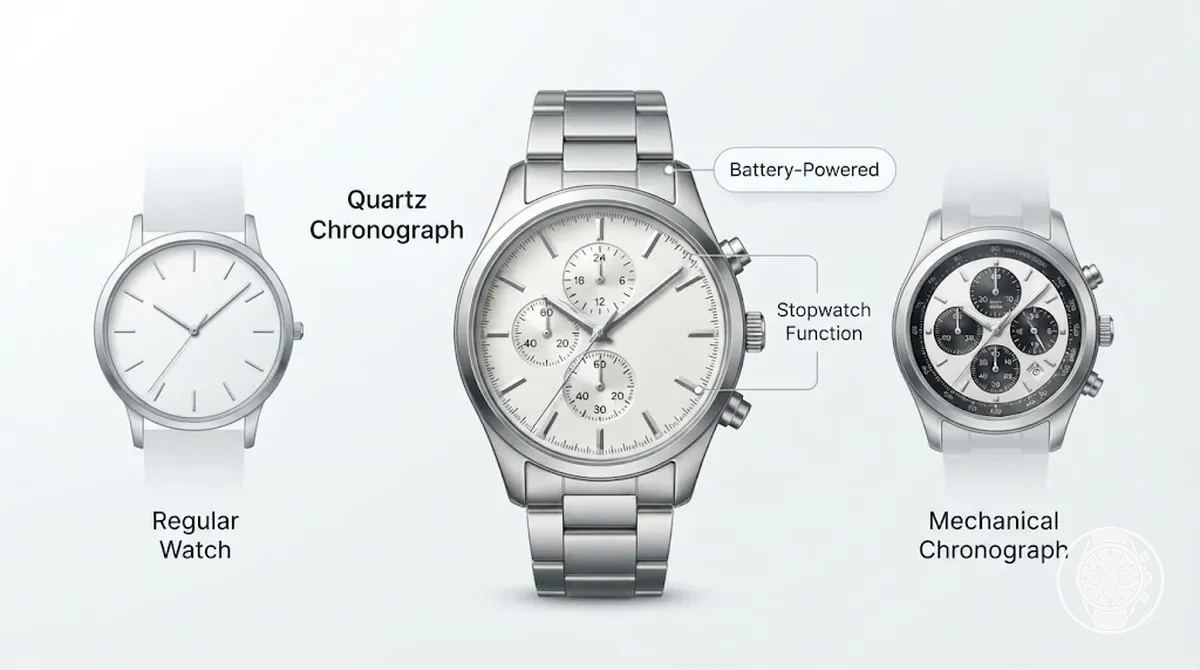
For daily use, a quartz chronograph can combine timing functions with a defined battery-service interval, while style versatility is determined by the particular case, dial, bracelet or strap rather than the quartz movement alone. Seiko specifies an approximate 3-year battery life for its 8T63 quartz chronograph models, illustrating the maintenance interval for that calibre rather than a universal interval for every quartz chronograph. When a Quartz Chronograph Is the Right Watch Choice is considered against adjacent options, the contrast below clarifies where its added timing function and battery movement fit and where a simpler or mechanically powered alternative better matches the ownership goal.
| Option | What it emphasizes | When it fits | Main limitation |
|---|---|---|---|
| Quartz chronograph | Battery-powered timekeeping plus stopwatch-style timing | The buyer wants practical daily usability and elapsed-time measurement from one watch | Its subdials and pushers add functions that are unnecessary when basic timekeeping is the only requirement |
| Regular watch | Simple timekeeping without a required stopwatch function | The buyer primarily needs hours, minutes and the other functions offered by the chosen model | It does not meet the selection need if stopwatch-style elapsed-time measurement is required |
| Mechanical chronograph | Mechanically powered timekeeping combined with elapsed-time measurement | The buyer specifically wants mechanical operation as part of the ownership experience | It does not match a preference specifically centred on battery-powered operation |
A quartz chronograph is not automatically preferable to every alternative; its advantage in this selection context is conditional on wanting battery-powered timekeeping and a stopwatch function together. A regular watch defines the simpler boundary when chronograph timing is unnecessary, while a mechanical chronograph defines the adjacent alternative when mechanical operation itself matters, leaving fit, features, durability, style and value as the criteria for choosing among quartz chronographs.
Core Selection Criteria for Men’s Quartz Chronograph Watches
The strongest selection criteria for a men’s quartz chronograph watch are the features that determine wrist fit, dial clarity, movement reliability, water resistance, durability, strap comfort, feature usefulness, and value under the intended wearing condition. Treat a criterion as a must-have when failing its required condition would make the watch unsuitable for that use; treat styling, materials, and non-essential functions as context-dependent or preference-based upgrades after those filters are satisfied.
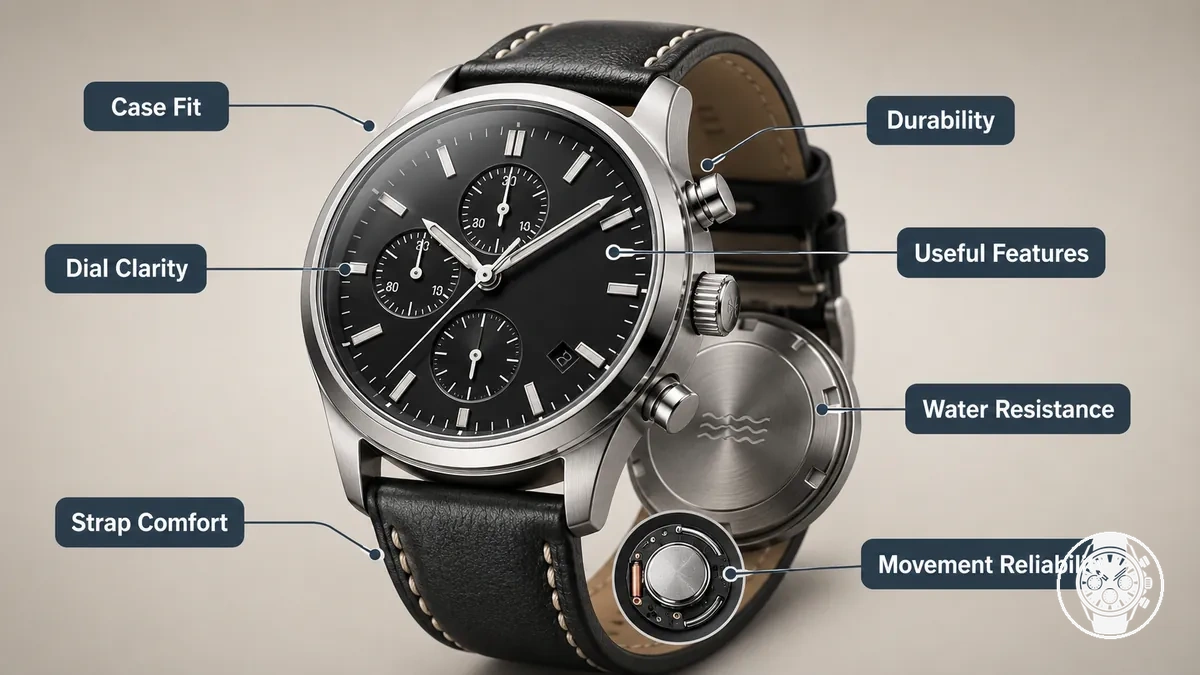
For daily, work, formal, and occasional use, the acceptable condition changes because wrist exposure, required dial clarity, strap comfort, and useful functions are not identical. A model-specific example shows how the criteria can be closed without creating universal thresholds: Seiko specifies the SSB427 quartz chronograph at ±15 seconds per month, with a 41.5 mm case diameter, 12.1 mm thickness, 46.5 mm lug-to-lug length, 10 bar water resistance, and chronograph measurement up to 60 minutes in 1/5-second increments; these specifications are selection signals for that model, while acceptable wrist fit and exposure still have to match the wearer and use. The table therefore filters each criterion by an explicit acceptable condition and its selection effect rather than ranking watches.
| Criterion | What to Check | Strong Sign | Selection Effect |
|---|---|---|---|
| Movement reliability | Manufacturer-stated quartz movement, accuracy, and maintenance information | A documented specification closes the criterion; for example, Seiko specifies ±15 seconds per month for the SSB427 | Must-have when predictable timekeeping is required; compare models against the accuracy condition needed for the intended use |
| Case fit | Case diameter, thickness, lug-to-lug length, and the wearer’s wrist | Published dimensions can be compared with the wearer’s measured wrist and checked for comfortable lug placement; the reviewed evidence does not establish one universal case-size-to-wrist threshold | Must-have because the acceptable condition is a secure, comfortable wrist fit rather than a universal case diameter |
| Dial legibility | Hand and marker contrast, subdial separation, date display, and luminous hands where needed | The required time and chronograph indications remain distinguishable under the intended viewing condition | Must-have when rapid reading is required; extra dial information is an upgrade when it does not improve the intended task |
| Water resistance | Manufacturer-stated rating and permitted exposure for the specific model | The rating covers the intended exposure; Seiko’s published guidance identifies 5 bar for swimming and 10 bar for swimming and shallow diving, while excluding scuba diving at those ratings | Must-have when water exposure is part of the wearing condition; match the stated rating to the activity rather than treating it as a universal depth guarantee |
| Strap comfort | Material, adjustment range, fastening method, and comfort over the intended wearing period | The strap remains secure without uncomfortable pressure during the intended daily, work, formal, or occasional use | Must-have for prolonged wear; material and finish become preference-based once the required comfort condition is met |
| Durability | Case and crystal materials, construction, and expected contact or moisture exposure | The manufacturer-stated construction matches the expected wearing condition without relying on an unsupported universal durability threshold | Context-dependent because greater contact or moisture exposure increases the importance of protective construction, while lower-exposure formal use can prioritise appearance |
| Useful features | Chronograph range, subdials, date display, luminous elements, and functions required for the intended task | Each required function has a defined use; for example, Seiko specifies a 60-minute chronograph in 1/5-second increments and a date display for the SSB427 | Preference-based functions add value only after required functions are present; unused functions do not create an additional must-have criterion |
Must-have selection criteria should eliminate watches that fail the required wrist fit, dial clarity, movement reliability, water resistance, durability, strap comfort, or feature usefulness condition before preference-based upgrades are compared. Once those filters are satisfied, case dimensions become the first detailed criterion to examine because they connect the watch’s physical measurements directly to wrist fit and comfort.
Movement Accuracy and Battery Expectations
A quartz movement supports dependable everyday timekeeping, but accuracy and battery life must be checked against the specific calibre, operating conditions, and chronograph use. Seiko specifies calibre 8T63 in the SSB427 at ±15 seconds per month and approximately 3 years of battery life; its 8T63 documentation limits the stated accuracy condition to 5°C to 35°C and notes that using the stopwatch for more than 1 hour per day can shorten battery life.
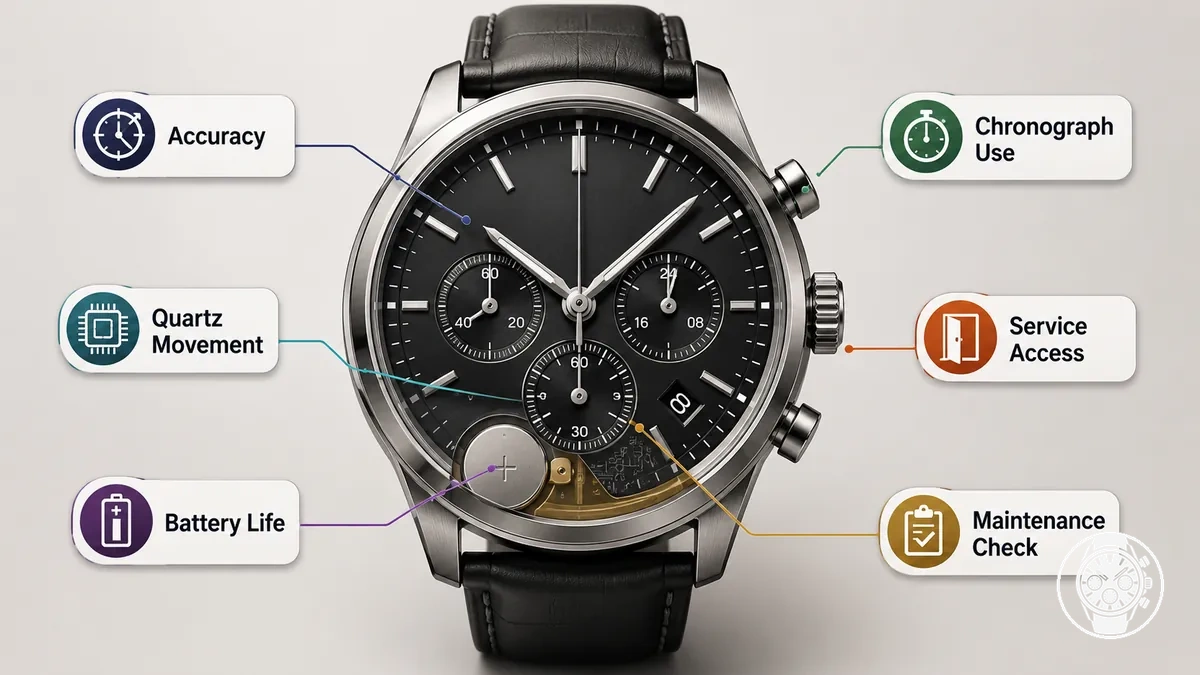
Before selection, check the quartz movement specification for stated accuracy, battery replacement information, chronograph power use, service access, and the resulting maintenance expectation rather than assuming one interval applies to every watch. In the Seiko 8T63 example, approximately 3 years is a model-specific battery expectation under the documented use conditions, while stopwatch use above 1 hour per day can reduce that duration; the practical implication is that reliability and maintenance planning should follow the calibre documentation and actual function use. Use these checks before treating a movement specification as suitable:
- Accuracy expectation: Verify the stated rate and operating condition; Seiko specifies ±15 seconds per month for calibre 8T63 at 5°C to 35°C.
- Battery access: Confirm that battery replacement and service access are documented for the selected calibre so routine maintenance has an identified service route.
- Chronograph power use: Check the documented usage condition; Seiko states that more than 1 hour of 8T63 stopwatch use per day can shorten its approximately 3-year battery expectation.
- Service information: Check the manufacturer documentation for battery and service guidance for the specific model rather than applying another calibre's maintenance interval.
- Maintenance expectation: Treat battery life as model- and use-specific, and compare the documented movement and battery life details when a more precise maintenance expectation is needed.
Case Size, Thickness, and Wrist Fit
Wrist fit for a men’s quartz chronograph depends on case size, case thickness, lug-to-lug length, watch weight, and strap geometry together rather than on case diameter alone. The acceptable value is a case profile that remains supported and comfortable on the wearer’s measured wrist circumference; the reviewed evidence does not establish a universal diameter, lug-to-lug, thickness, or weight threshold that produces the same fit for every wrist.
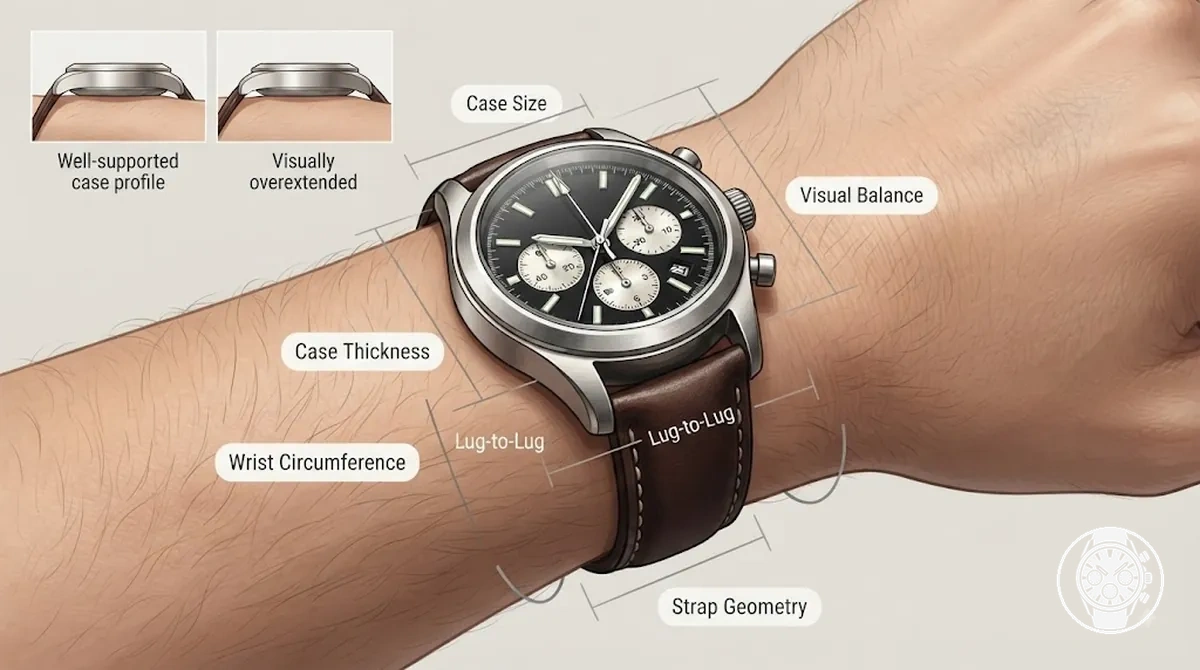
On a smaller wrist, a shorter lug-to-lug measurement or strap geometry that follows the wrist can improve support and visual balance, while a larger wrist can accommodate the same case profile differently because wrist circumference and wrist shape change the contact area. Case thickness also affects cuff fit for formal wear, and watch weight affects daily-wear comfort; as a model-specific measurement example, Seiko specifies the SSB427 quartz chronograph at 41.5 mm in diameter, 12.1 mm thick, 46.5 mm lug-to-lug, and 133 g in weight, illustrating why multiple dimensions should be checked together rather than treating 41.5 mm as a universal fit threshold.
- Diameter: Compare case diameter with wrist circumference, then check whether the resulting case size provides comfortable visual balance on the actual wrist.
- Thickness: Check the case profile against the intended cuff; for formal wear, the required outcome is sufficient cuff clearance without uncomfortable contact.
- Lug-to-lug: Check whether both lugs remain supported by the wrist rather than projecting beyond its usable top surface, with wrist shape and strap geometry determining the final wearability outcome.
- Weight: Assess the complete watch during the intended wearing period; the SSB427’s manufacturer-stated 133 g provides a model-specific comparison point, while the reviewed evidence provides no universal gram threshold for comfort or fatigue.
- Strap geometry: Check that the strap or bracelet follows the wrist and holds the case securely without concentrated pressure or an unstable fit.
- Wearing context: Evaluate daily comfort, movement, visual balance, and cuff clearance together, then use the deeper watch size and wrist fit criteria when comparing measurements for a particular wrist.
Dial Layout, Subdials, and Legibility
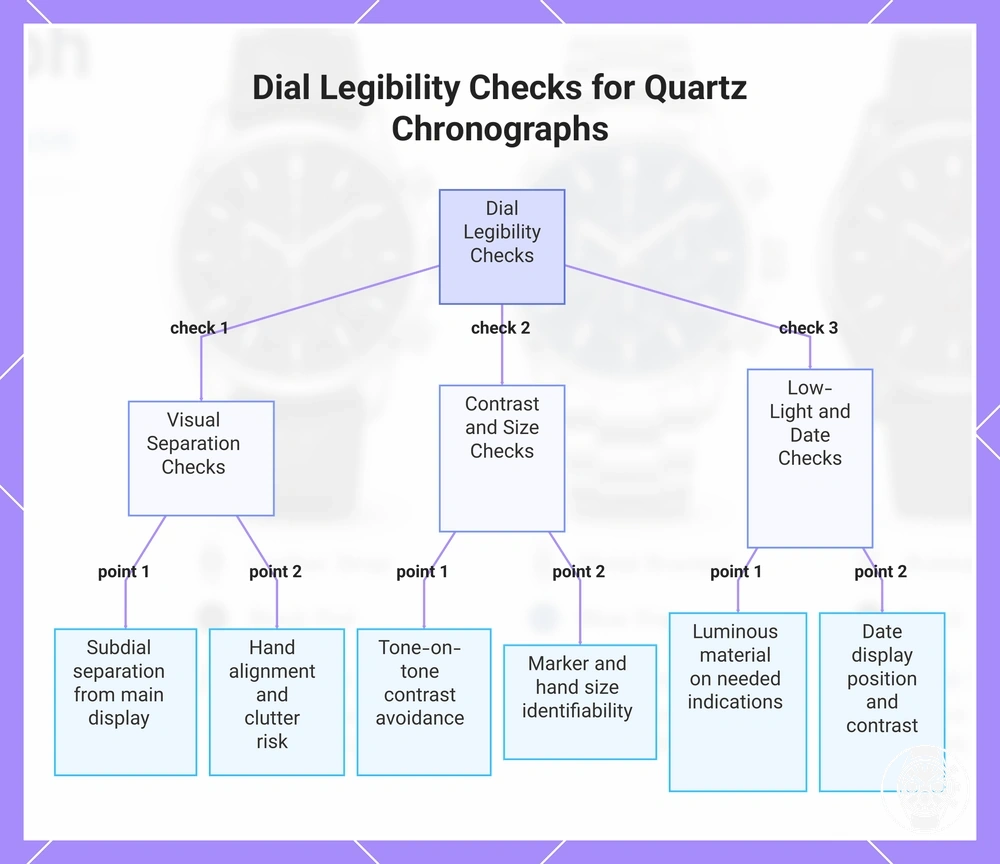
Dial layout matters when a men’s quartz chronograph needs quick reading without visual clutter: the useful condition is clear visual separation between the main time display and secondary information such as subdials and the date display. WorldTempus identifies tone-on-tone colouring, excessively small typography, and dials overloaded with indications as factors that reduce watch readability, so legibility should be judged by contrast, marker size, and information separation rather than by the number of dial elements alone.
Subdials, a date display, luminous hands, and contrasting markers can improve practical feature usefulness when each indication remains visually distinct, but the same elements can distract when they crowd or mask the primary time display. For a concrete three-subdial example, Tissot specifies the Seastar 1000 38 mm Quartz Chronograph with chronograph subdials plus luminescent hands and markers, which Tissot states provide legibility in low-light conditions; this is a model-specific design example, not a universal visibility threshold. Use these checks to distinguish an attractive busy dial from a functional dial that remains quick to read:
- Subdial arrangement: Prefer subdials that remain visually separated from the primary hour and minute indications; WorldTempus identifies overloaded indications as detrimental to readability, so added chronograph information should not obscure the main display.
- Contrast: Check that the main hands and markers are distinguishable from the dial background; WorldTempus specifically identifies tone-on-tone colouring as a readability problem.
- Marker size and hand size: Prefer markers and primary hands that remain identifiable at a normal viewing glance; WorldTempus identifies excessively small typography as a legibility problem, while the reviewed evidence establishes no universal millimetre threshold for readable marker or hand size.
- Luminous hands: For low-light visibility, verify that the selected model applies luminous material to the indications you need to read; Tissot specifies luminescent hands and markers on its 38 mm Seastar 1000 Quartz Chronograph for low-light legibility, but performance remains specific to the model and viewing conditions.
- Date display: Treat the date as a useful daily-wear feature when its position and contrast preserve quick reading of the main display; the reviewed evidence establishes no universal date-window position or size that guarantees better legibility.
- Hand alignment and clutter risk: Check the dial with the primary and chronograph hands in different positions and confirm that important markers, subdials, and the date remain distinguishable; if a hand repeatedly masks an indication, practical dial clarity decreases even though the chronograph function remains available.
This chart shows the key checks to evaluate dial legibility, focusing on visual separation, contrast, size, low-light visibility, and clutter risk.
Water Resistance and Durability Rating
A men’s quartz chronograph’s water resistance and durability rating reduce selection risk only when the stated protection matches the intended exposure; they do not establish universal protection against water, scratches, or impact. Citizen’s water-resistance table, for example, classifies 3 atmospheres for minor exposure such as rain or face washing, 5 atmospheres for swimming and general washing, and 10 or 20 atmospheres for those uses plus skin diving and marine sports, while excluding scuba diving at all three levels. Check the selected model’s specification, crown design, seals, and exposure category before relying on its rating.
The table separates these safeguards from broader durability assumptions.
The key boundary is that splash resistance, swimming suitability, and general durability are different attributes: Citizen permits minor exposure but not swimming at 3 atmospheres, while its 5-atmosphere category includes swimming; neither category by itself defines the scratch resistance of the crystal material or case material. Citizen also states that a screw-lock crown should be securely locked and that the crown or buttons should not be operated while the watch is wet, so the water resistance rating must be interpreted together with the specified crown position and exposure condition. The table separates these safeguards from broader durability assumptions.
| Attribute | What It Suggests | Check Before Choosing | Risk If Misread |
|---|---|---|---|
| Water resistance rating | An exposure category: Citizen specifies 3 atmospheres for minor exposure, 5 atmospheres for swimming and general washing, and 10 or 20 atmospheres for those uses plus skin diving and marine sports. | Match the model’s stated rating to the intended exposure; Citizen excludes scuba diving from its 3-, 5-, 10-, and 20-atmosphere standard-watch categories. | A splash-suitable rating can be mistaken for swimming suitability or protection under a different water-pressure condition. |
| Crown and seals | The closed case system supports the specified water-resistance condition; Citizen requires a screw-lock crown to be securely locked where fitted. | Verify the model’s crown design, required crown position, and stated restrictions on operating controls while wet. | An unlocked crown or operation of controls while wet creates a water-entry risk; Citizen warns that water may enter and damage components. |
| Crystal material | The specified crystal material identifies the protective transparent surface over the dial. | Verify whether the model specifies sapphire, mineral glass, or another material and whether the manufacturer states a particular scratch-resistance property. | Crystal type can be mistaken for a complete durability rating even when no universal scratch threshold is specified. |
| Case material | The specified case material identifies the watch’s external structural material. | Verify the manufacturer-stated case material and any stated surface treatment against the expected daily contact and exposure condition. | Case material can be mistaken for evidence of water resistance or scratch resistance, which are separate attributes. |
| Scratch resistance | A material- or coating-specific durability property when the manufacturer explicitly specifies it. | Check for a model-specific scratch-resistance claim for the crystal, case surface, or coating; the reviewed evidence establishes no universal numerical scratch-resistance threshold for men’s quartz chronographs. | A scratch-resistance claim for one component can be misread as protection against all wear, impact, or surface damage. |
The safe selection boundary is therefore specification-based: 3 atmospheres can indicate splash exposure without swimming suitability in Citizen’s standard-watch guidance, while material durability remains a separate check. Use the model’s stated exposure conditions and construction details when comparing water resistance and durability.
Strap Material and Wearing Comfort
Strap material changes the wearing comfort, style, durability, and wearing context of a men’s quartz chronograph because stainless steel, leather, rubber, and fabric differ in weight, moisture response, maintenance, and break-in feel. Clasp design and adjustability also determine how securely the strap fits the wrist; no universal numerical comfort, weight, sweat resistance, or break-in threshold is specified across these four material classes, so the useful value is whether the selected strap’s documented construction and adjustment range match the wearer’s wrist, climate, moisture exposure, and formality requirement.
Strap Material and Wearing Comfort should therefore be compared through comfort and wearing-context trade-offs rather than a universal material ranking.
For daily wear, strap weight, adjustability, and moisture exposure become practical comfort filters; for example, Citizen specifies its leather-strap Brycen CA0649-06X chronograph at 85.05 g total watch weight with a buckle, providing a model-specific reference rather than a universal comfort limit. Office and formal wear can place greater emphasis on formality and break-in feel, while frequent perspiration shifts attention toward sweat resistance and maintenance: Timex states that its natural leather straps soften with wear but advises against soaking leather, and its fabric-strap care guidance recommends a 10-to-30-minute soapy-water soak for its fabric straps when cleaning accumulated sweat and oils. Strap Material and Wearing Comfort should therefore be compared through comfort and wearing-context trade-offs rather than a universal material ranking.
| Strap Material | Comfort Signal | Best Use Context | Main Trade-Off |
|---|---|---|---|
| Stainless steel | Link sizing and clasp adjustment control wrist fit; no universal bracelet-weight threshold for comfort is established by the reviewed manufacturer guidance. | Daily or office wear when metal construction and its level of formality suit the setting. | Weight and adjustability are bracelet-specific, so the selected model’s clasp and link-sizing system need to provide the required wrist fit. |
| Leather strap | Break-in feel changes as leather softens with wear; Timex states that its natural leather is treated to resist water and soften over time. | Office, formal, or daily wear where leather’s appearance matches the required formality and regular wet exposure is limited. | Timex states that leather absorbs sweat and is sensitive to liquids and advises against soaking it, creating a maintenance disadvantage under frequent moisture exposure. |
| Rubber strap | Rubber provides a flexible strap type, but the reviewed evidence does not establish one numerical sweat-resistance or comfort threshold across rubber compounds. | Casual or moisture-prone use when the specific rubber strap’s documented construction matches the expected sweat or water exposure. | Sweat resistance, clasp comfort, and durability must remain material- and model-specific because a universal performance value is not specified by the reviewed evidence. |
| Fabric strap | Timex describes its fabric straps as light and comfortable for daily wear and notes that they accumulate sweat and oils during use. | Casual or daily wear where a light strap and washable construction suit the wearing context. | Fabric requires moisture and dirt maintenance; Timex specifies a 10-to-30-minute soapy-water soak for cleaning its fabric straps, followed by rinsing and air-drying. |
No strap material is universally preferable: stainless steel, a leather strap, a rubber strap, or a fabric strap is suitable when its wearing comfort, clasp, adjustability, sweat resistance, weight, break-in feel, maintenance needs, and formality correspond to the intended use. These parent-level criteria establish the basis for examining the narrower material trade-offs individually.
Leather, Stainless Steel, Rubber, and Fabric Strap Trade-Offs
For a men’s quartz chronograph, each strap material has a strap trade-off rather than a universal ranking: leather prioritises dress suitability but needs greater moisture care, stainless steel provides durable and adjustable construction with a weight compromise, rubber provides practical water tolerance with regular cleaning needs, and fabric supports breathability and casual wear but also needs cleaning after sweat and dirt accumulate. Citizen states that leather is more susceptible to moisture damage than a metal bracelet and recommends periodic cleaning for rubber or silicone exposed to perspiration, salt water, or oil; Timex identifies different cleaning procedures for leather, stainless steel, rubber, and fabric, while the reviewed manufacturer guidance specifies no universal numerical threshold for strap weight, breathability, water tolerance, or comfort across these four material families. The resulting buyer decision is therefore conditional on comfort, formality, moisture exposure, adjustment needs, and maintenance tolerance, as compared below.
| Strap Material | Comfort Signal | Style Fit | Trade-Off |
|---|---|---|---|
| Leather | Natural leather softens with wear according to Timex, but retained perspiration or water can accelerate wear according to Citizen. | Timex positions leather as a traditional option that can suit sophisticated, vintage, or casual presentation. | Dress suitability is the advantage; water tolerance is the compromise. Citizen recommends wiping leather daily and allowing a saturated strap to dry completely before reuse. |
| Stainless steel | Removable links provide size adjustment; the reviewed manufacturer guidance establishes no universal gram threshold at which a metal bracelet becomes uncomfortable. | Timex identifies metal bracelets as suitable for more formal as well as everyday presentation. | Durability and adjustment are advantages; weight is construction-specific. Citizen recommends occasional cleaning with warm soapy water when everyday dirt accumulates. |
| Rubber | Flexible construction suits active use, but Citizen states that perspiration, salt water, and oil can be absorbed and contribute to cracking. | Timex associates rubber straps with casual, outdoor, sport, and diving contexts. | Water tolerance and washability are advantages; maintenance remains necessary. Citizen recommends periodic cleaning and rinsing with clear water after salt-water exposure. |
| Fabric | Timex describes fabric straps as lightweight and breathable, while the reviewed guidance establishes no universal numerical breathability value across fabric constructions. | Timex associates fabric with casual and outdoor use. | Breathability and washability are advantages; cleaning, fading, or fraying are compromises. Timex states that fabric is washable and can fade or fray over time. |
Matching the Strap to Daily or Formal Use
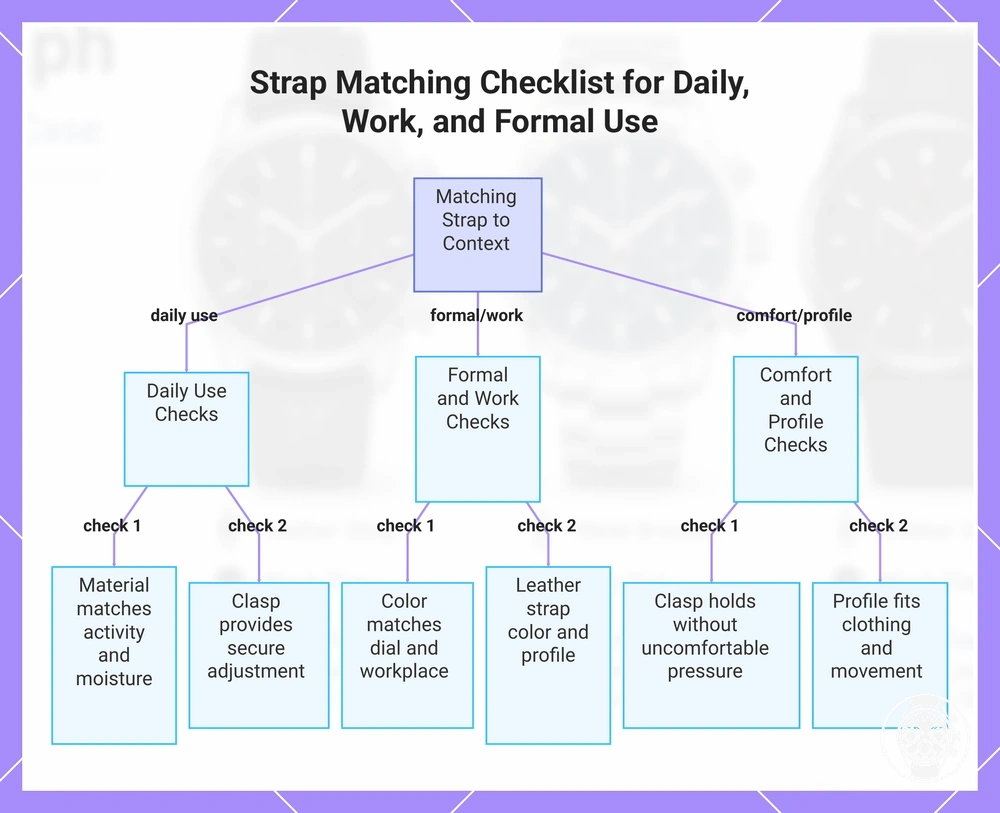
For daily use, work settings, or formal use, a men’s quartz chronograph strap should match the wearing context through strap material, strap color, clasp, profile, and comfort rather than through a fixed dress-code rule. Daily practicality favours a secure, comfortable strap that suits expected moisture and activity, while formal suitability can favour a restrained appearance and a profile that works with the intended clothing; the reviewed evidence establishes no universal numerical threshold for strap thickness, color, clasp type, or formality, making strap material and profile the practical decision point.
Use the checklist to verify whether the strap attributes support the intended daily, work, or formal context.
The right strap therefore depends on comfort, appearance, and formality expectations under the intended wearing condition. As a model-specific scale example, Citizen specifies the leather-strap Brycen CA0649-06X chronograph at 85.05 g total watch weight with a buckle; this provides a concrete watch-and-strap configuration for comparison, not a universal comfort limit for leather straps. Use the checklist to verify whether the strap attributes support the intended daily, work, or formal context.
- Daily use: Check whether the strap material matches expected activity and moisture exposure and whether the clasp or buckle provides secure adjustment; stainless steel, leather, rubber, and fabric are conditional choices rather than a universal hierarchy.
- Work settings: Check strap color against dial color and workplace expectations for visual balance; the reviewed evidence provides no authoritative color-matching threshold, so the required value is a strap-and-dial combination appropriate to the specific work setting.
- Formal use: If dress-code fit matters, check the leather strap or other selected strap for a color and profile consistent with the expected level of formality; the reviewed evidence does not establish leather as mandatory or specify a universal strap-thickness threshold for formal use.
- Clasp and comfort: Check that the clasp, buckle, or bracelet closure holds the men’s quartz chronograph securely without uncomfortable pressure during the intended wearing period; no universal clasp type or numerical tightness value is specified by the reviewed evidence.
- Profile and practicality: Check the combined watch-and-strap profile against the intended clothing and movement requirements; for dress use, the practical condition is comfortable clearance and an appropriate visual profile rather than a universal dimensional rule.
This chart shows the key checks for selecting a men's quartz chronograph strap based on wearing context, including daily practicality, formal appearance, and comfort.
Style Fit for Daily Wear, Work, and Formal Settings
Style fit for a men’s quartz chronograph depends on the main wearing environment and the combined case finish, dial tone, strap type, case thickness, visual complexity, proportions, and water-exposure specification rather than on one isolated feature. No reviewed manufacturer source establishes a universal case-thickness, dial-colour, case-finish, or strap threshold that classifies a chronograph as suitable for every wearer or occasion, so suitability should be treated as use-case specific. These whole-watch attributes distinguish the practical signals to assess for daily wear, work settings, and formal settings.
The matrix applies those attributes to the three main wearing contexts.
For example, the same functional category can combine sporty and dress-oriented signals: Tissot places the Chrono L 42 mm T1164171605201 in its Sport collection while specifying a 42 mm stainless-steel case, 10.97 mm case thickness, black dial, brown leather strap, chronograph subdials, and water resistance to 10 bar (100 m). This model-specific combination shows why a leather strap alone does not determine dress suitability; dial treatment, case finish, thickness, visual complexity, proportions, and functional specification remain part of the overall style signal. The matrix applies those attributes to the three main wearing contexts.
| Wearing Setting | Helpful Watch Signals | Watch Signals to Check | Possible Trade-Off |
|---|---|---|---|
| Daily wear | Comfortable overall proportions, a case finish suited to regular contact, readable chronograph indications, and a water-resistance specification appropriate to expected water exposure. | Check case thickness, visual complexity, strap type, durability-related construction, and the manufacturer-stated water-use conditions against the intended routine. | Greater functional emphasis through subdials, prominent controls, or water-oriented construction can support everyday practicality while producing a sportier visual character. |
| Work settings | A restrained dial tone, balanced case finish, legible subdials, and proportions that provide the required level of visual restraint for the specific workplace. | Check dial contrast, case finish, subdial prominence, strap type, and overall visual complexity against the workplace environment rather than applying a universal office-wear rule. | More prominent chronograph details can increase visual complexity, while a more restrained combination can increase versatility across different workplace environments. |
| Formal settings | A restrained dial tone, controlled visual complexity, coherent case finish, and a case-and-strap profile that provides the desired visual simplicity for the event. | Check case thickness, overall size, subdial prominence, strap type, and case finish together; the reviewed evidence provides no universal dimension or material that guarantees formal suitability. | A leather strap can contribute a dress-oriented signal, but prominent subdials, pushers, contrasting accents, or substantial proportions can preserve a sportier character. |
Versatility in a men’s quartz chronograph comes from balanced attributes: case finish, dial tone, strap type, case thickness, visual complexity, proportions, comfort, and water-exposure capability should collectively support the intended use case rather than relying on one feature to define the watch. Final style suitability remains conditional on workplace expectations, event formality, personal preference, and the proportions of the specific watch.
Price, Value, and Feature Compromises
Value in a men’s quartz chronograph depends on how its price matches useful functions, fit, case material, strap quality, crystal, movement, water rating, and durability rather than on cost alone. A higher price represents added value only when the extra specification improves the intended use; the reviewed evidence does not establish a universal cross-brand price range that guarantees good value because specification, market, availability, and condition are not equivalent across models.
The table separates value signals from acceptable compromises and avoidable weaknesses.
The main feature compromises appear when decorative features absorb more of the budget while practical requirements such as comfort, movement reliability, suitable water resistance, or durable materials remain unresolved. Treat useful durability and practical comfort as requirements first, then compare optional appearance upgrades after those requirements are satisfied. The table separates value signals from acceptable compromises and avoidable weaknesses.
| Feature or Material | Value Signal | Acceptable Compromise | Watch-Out |
|---|---|---|---|
| Case material | The specified case material and finish match the expected contact, moisture, and daily-wear conditions. | A simpler finish is reasonable when construction and comfort still meet the intended use. | Extra cost for decorative finishing without a corresponding durability or comfort benefit. |
| Crystal | The specified crystal provides the level of surface protection required for the expected wearing environment. | A less costly crystal is reasonable when expected scratch exposure is limited and its specification remains acceptable. | Treating crystal type as a complete durability measure while ignoring case construction and use conditions. |
| Strap quality | The strap material, clasp, adjustability, and moisture response support secure and comfortable daily wear. | A simpler strap is reasonable when it remains secure, adjustable, comfortable, and appropriate for the intended exposure. | Paying for appearance while accepting poor adjustment, unsuitable moisture response, or uncomfortable fit. |
| Movement | The manufacturer provides accuracy, battery expectation, and service information that meet the buyer’s reliability requirements. | Fewer secondary functions are reasonable when the omitted functions would not be used. | Assuming a higher price automatically means greater accuracy or longer battery life without checking the calibre specification. |
| Water rating | The manufacturer-stated water rating covers the intended exposure under the specified use limitations. | A lower rating is reasonable when the intended wearing condition does not require the excluded water exposure. | Paying for unused water capability or accepting a rating below the intended exposure requirement. |
| Chronograph features | The timing range, subdials, date, luminous elements, or other useful functions correspond to tasks the wearer expects to use. | Fewer functions are reasonable when they reduce visual complexity without removing a required capability. | Paying mainly for decorative features or additional functions that do not serve the intended use. |
Price becomes useful only after the must-have specifications are fixed, because feature value comes from what an additional cost actually changes. For example, suppose one suitable watch costs A$350 and another costs A$450: the illustrative A$100 difference represents value only if the second watch adds a required improvement such as a more suitable crystal, water rating, strap construction, movement specification, or genuinely useful chronograph function; otherwise the extra cost is a preference-based upgrade rather than a practical requirement.
This keeps price subordinate to the specifications that determine whether the watch fits the buyer’s actual use.
Use price and value as a criteria comparison by confirming the required case material, crystal, strap quality, movement, water rating, and useful functions before comparing additional cost. This keeps price subordinate to the specifications that determine whether the watch fits the buyer’s actual use.
Use price and value as a criteria comparison by confirming the required case material, crystal, strap quality, movement, water rating, and useful functions before comparing additional cost.
A sound value decision accepts feature compromises in decorative features or unused functions before compromising required fit, movement reliability, water-exposure suitability, strap comfort, or durability. When two watches satisfy the same must-have conditions, prefer the option whose additional cost corresponds to materials or functions the wearer will use, while treating current price and availability as model- and market-specific rather than permanent values.
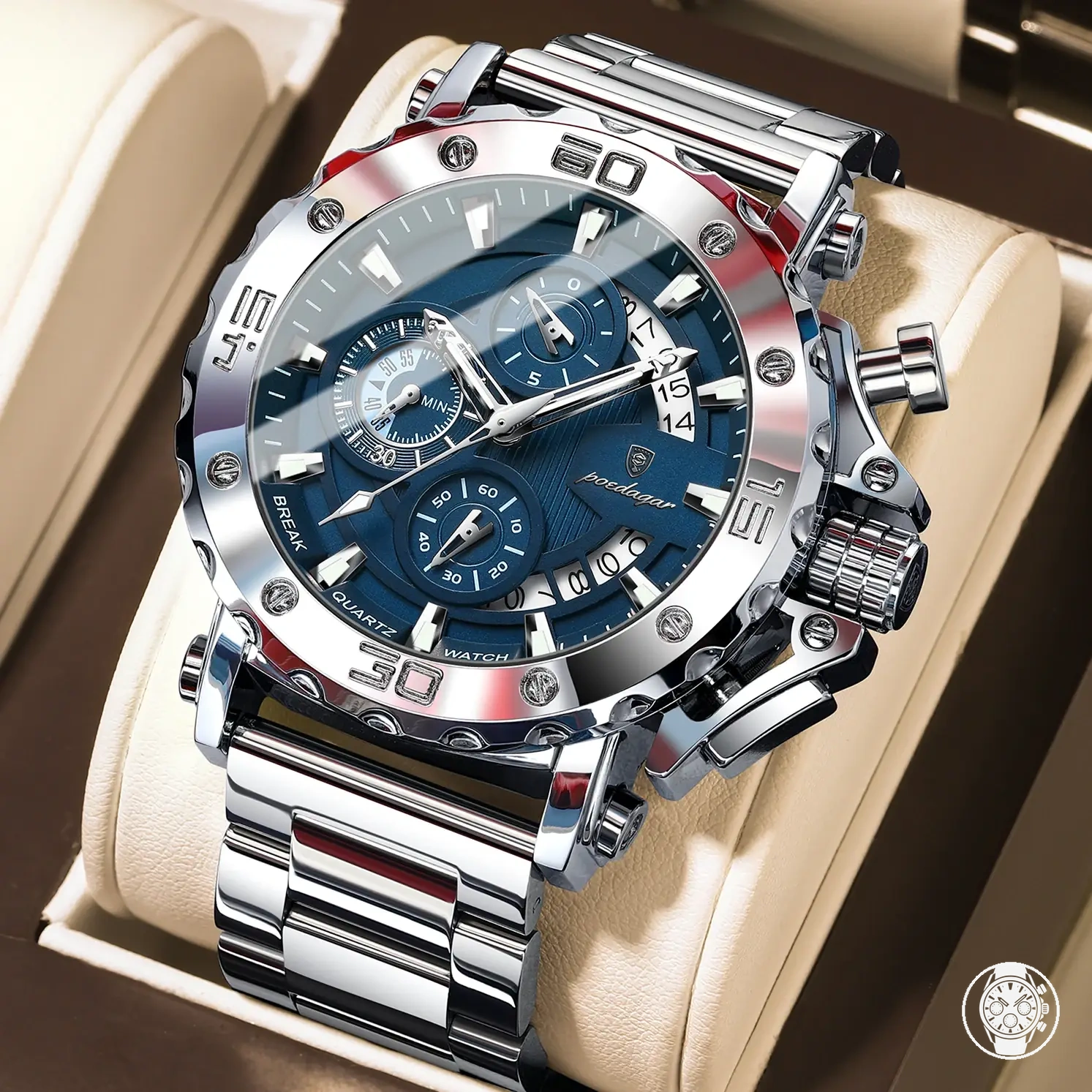
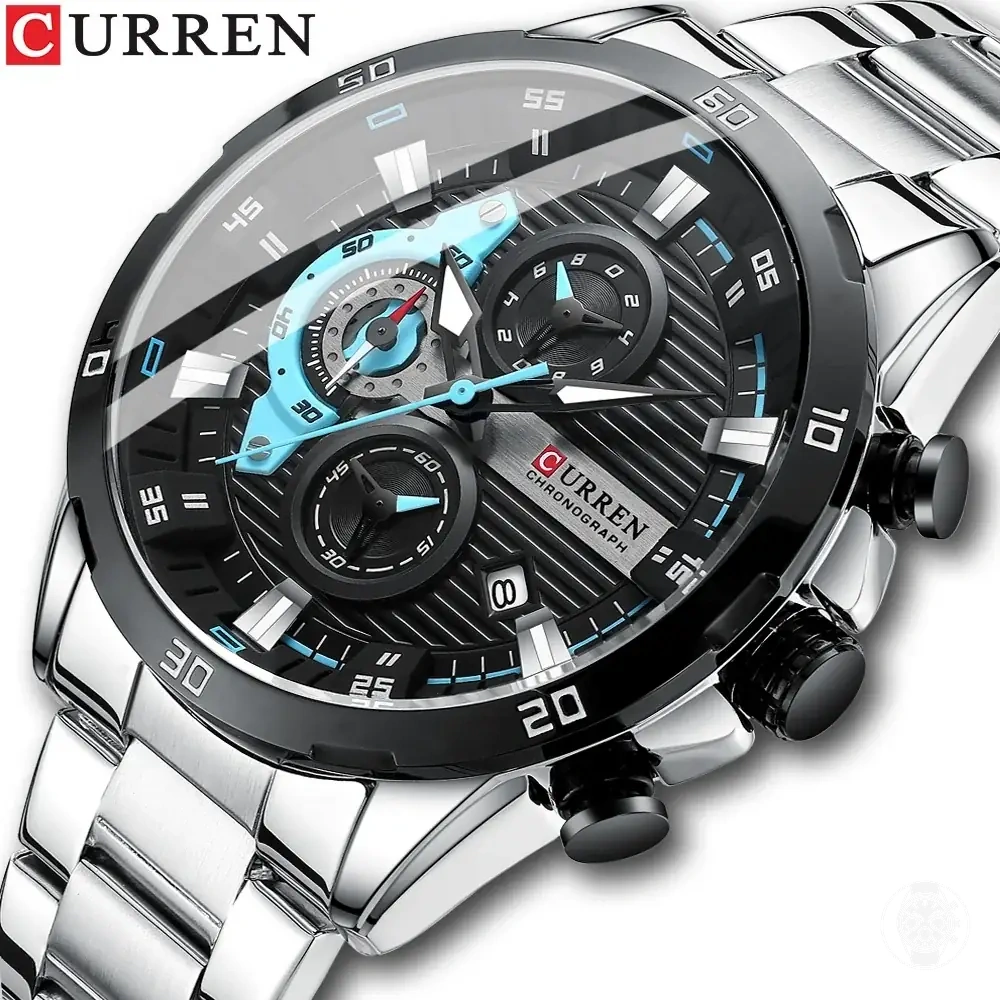
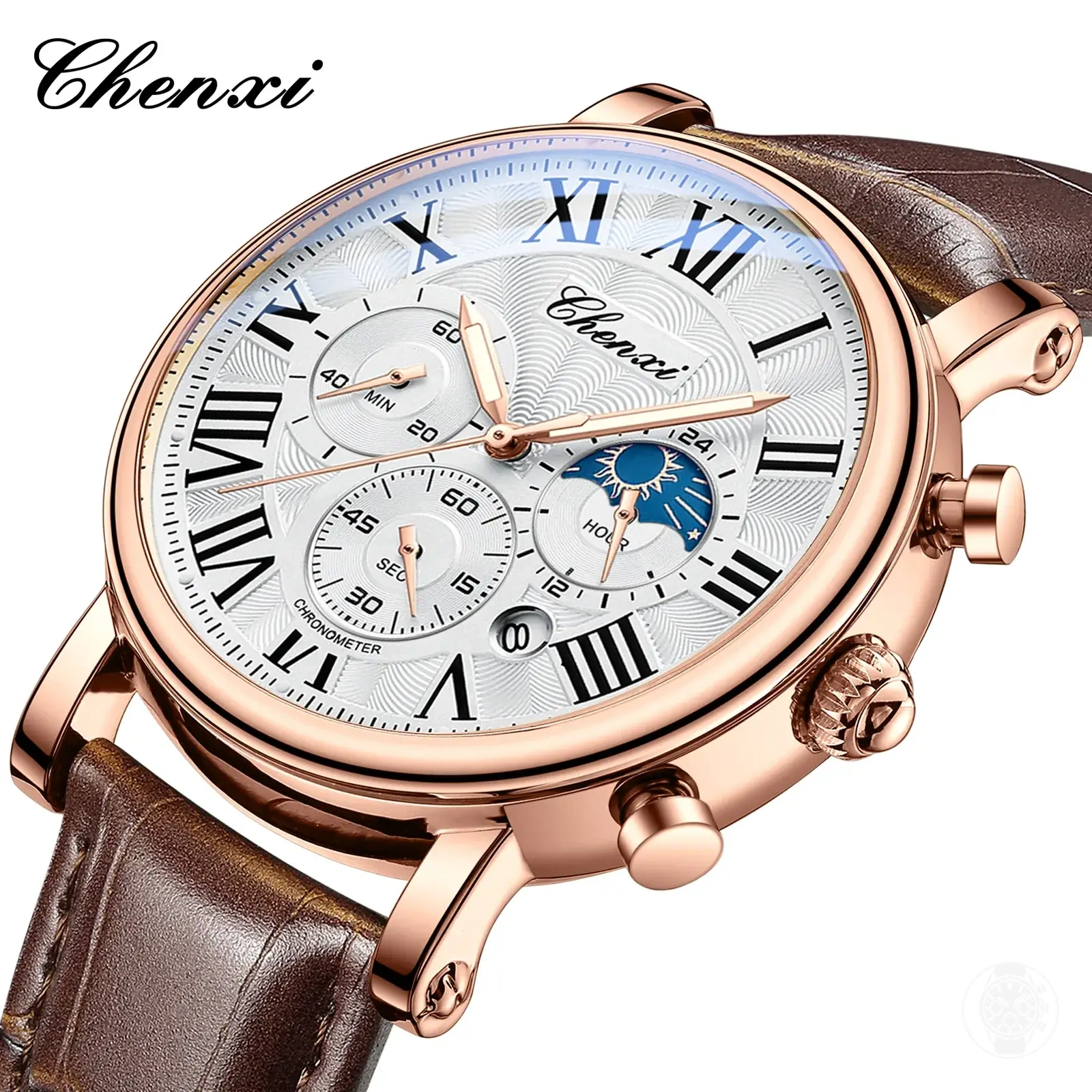
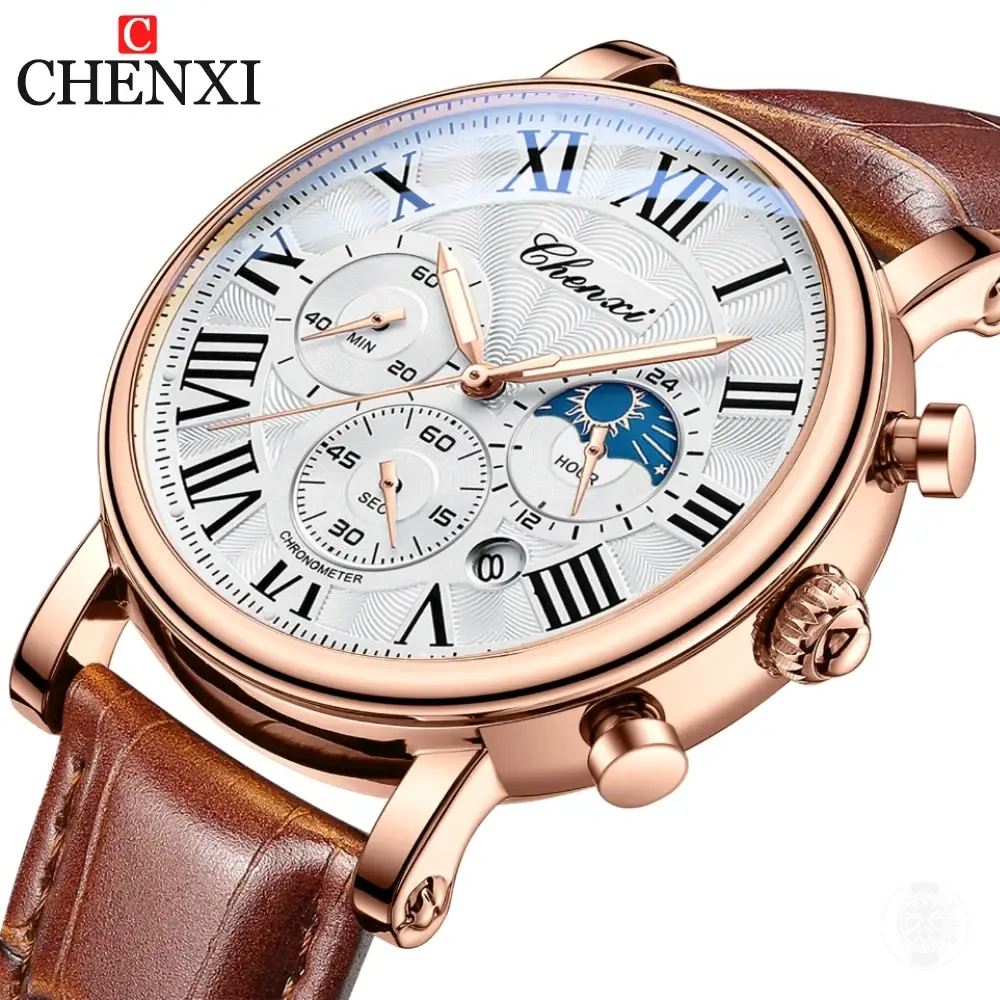
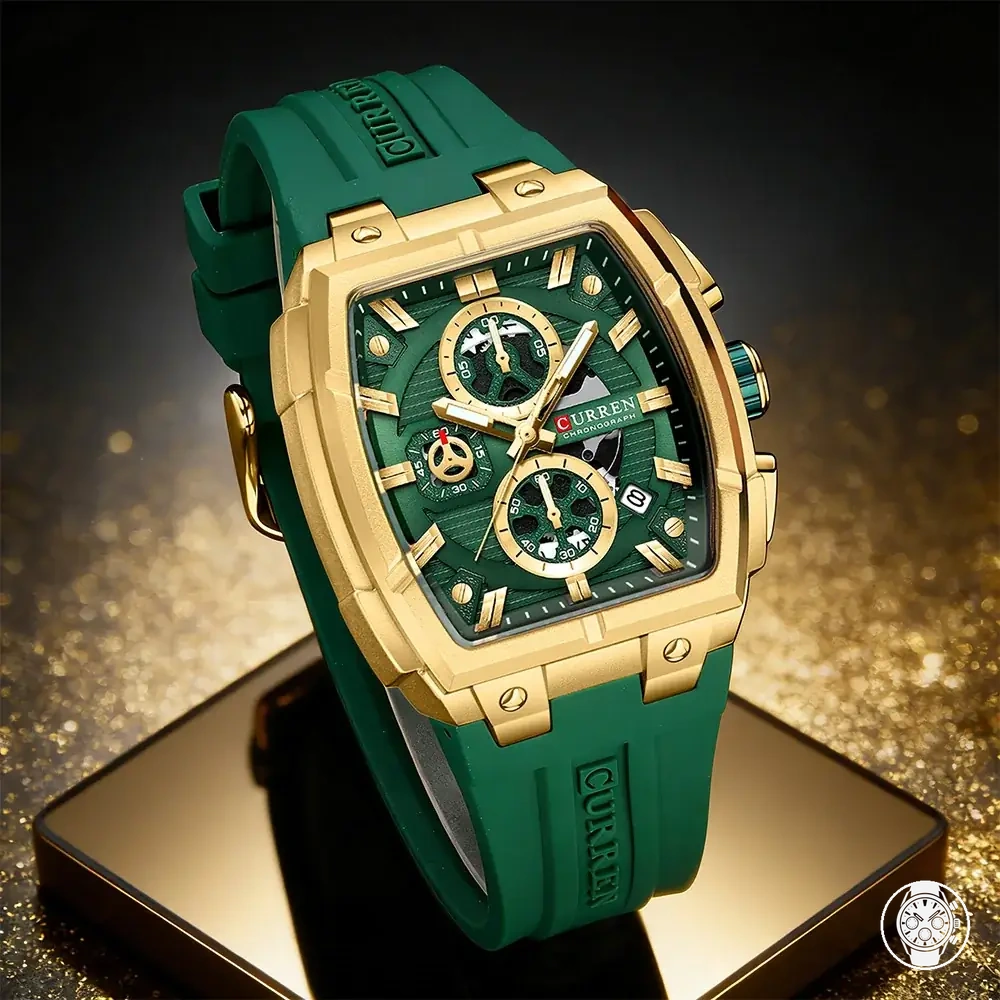
The products below are useful examples for comparing available options.
The products below are useful examples for comparing available options. Before buying, check that the compatibility criteria, key features, and product details match your needs.
Final Quality Checks Before Choosing
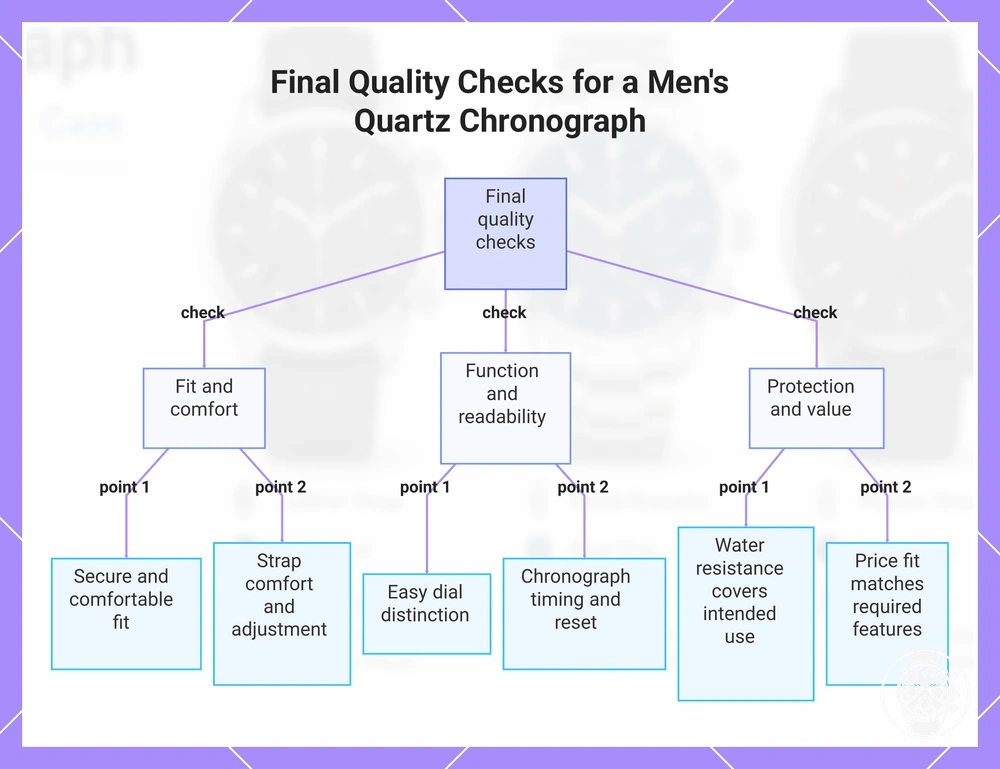
Final quality checks confirm whether a men’s quartz chronograph fits the buyer’s practical needs after the main criteria and value trade-offs are understood. Verify fit, dial clarity, chronograph function, strap comfort, water resistance, date display, luminous visibility, warranty or support information, and price fit against the intended use rather than appearance alone. Use this checklist as the final verification before deciding whether to choose, compare further, or avoid a model.
- Fit: Verify that the case sits securely and comfortably on the intended wrist without unwanted overhang, pressure, or movement; persistent discomfort means compare further or avoid that configuration.
- Dial clarity: Verify that the main hands, markers, subdials, and other required indications remain easy to distinguish in the expected viewing conditions; unclear separation is a reason to compare further.
- Chronograph function: Verify that the manufacturer-stated timing range, controls, and reset behaviour match the functions you expect to use; an unsuitable or undocumented function weakens the selection.
- Strap comfort: Verify that the strap material, adjustment range, and clasp provide secure comfort for the intended wearing period and moisture exposure; poor adjustment or discomfort supports a compare-further outcome.
- Water resistance: Verify that the manufacturer-stated rating and use conditions cover the intended exposure; if the documented limits exclude that activity, avoid the watch for that use.
- Date display: Verify that the date is readable and does not interfere with the information you need from the main dial or chronograph display; an unnecessary date function should not outweigh more useful requirements.
- Luminous visibility: If low-light reading matters, verify that the manufacturer specifies luminous treatment on the hands, markers, or other indications you need to see; missing coverage is a reason to compare further.
- Warranty or support information: Verify the applicable warranty period, coverage, exclusions, service route, and territory in the relevant manufacturer or authorised support documentation; unclear support information increases selection risk.
- Price fit: Verify that the price reflects required fit, materials, movement, water resistance, durability, and useful functions rather than decorative features alone; if additional cost does not add a required or preferred benefit, compare further.
A choose outcome is appropriate when the required checklist conditions are satisfied for the intended use and the relevant specifications are documented; compare further when an important requirement remains uncertain, and avoid a model when a confirmed specification conflicts with a required condition. These final quality checks summarise earlier evaluation rather than replacing the detailed fit, dial, water-resistance, strap, and value checks.
Use the buying checklist as the transition from individual criteria to a final model-by-model selection check.
Use the buying checklist as the transition from individual criteria to a final model-by-model selection check.
Passing the checklist narrows avoidable selection risk but does not guarantee future comfort, durability, performance, or service availability outside the documented conditions.
Decision confidence is strongest when the men’s quartz chronograph satisfies every requirement that matters for its intended use and its specifications, warranty, support information, and price fit can be verified for the relevant model and market. Passing the checklist narrows avoidable selection risk but does not guarantee future comfort, durability, performance, or service availability outside the documented conditions.
Before buying, check that the compatibility criteria, key features, and product details match your needs.
The products below are useful examples for comparing available options. Before buying, check that the compatibility criteria, key features, and product details match your needs.
This chart shows the key verification categories and specific checks to perform before finalizing a men's quartz chronograph selection.