
Men’s Quartz Chronograph Movement Performance and Battery Life
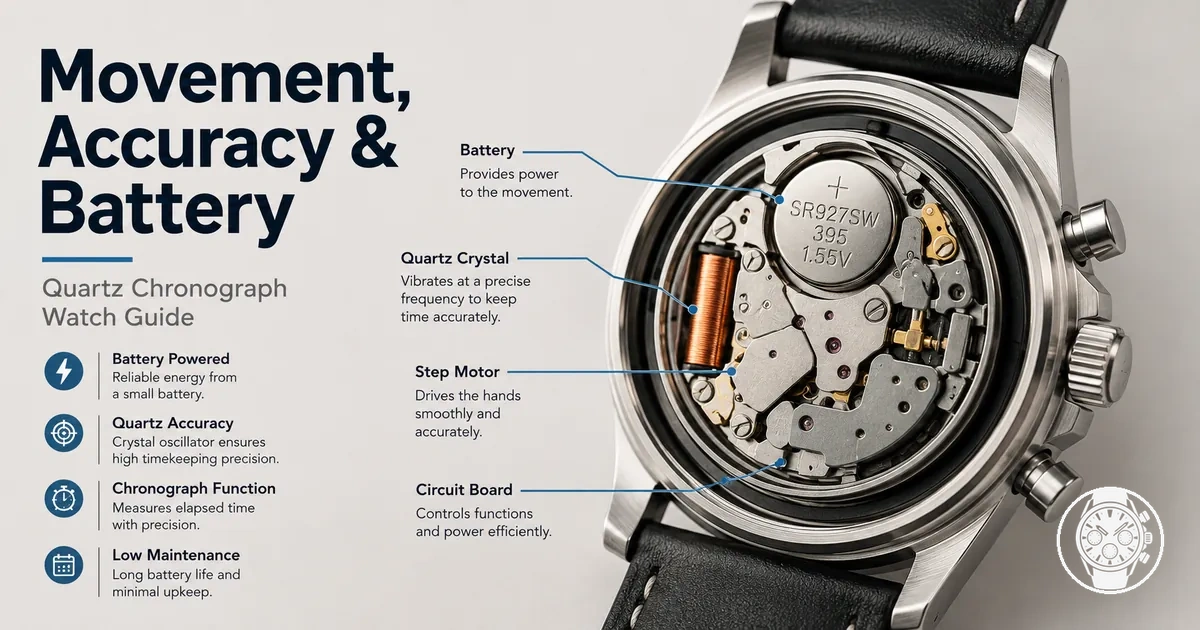
Men’s quartz chronograph movement performance combines electronic quartz regulation with a chronograph movement, so men’s quartz chronograph watches can provide regular timekeeping and a stopwatch function from an electrical power source. Grand Seiko explains that a battery supplies energy to a quartz oscillator vibrating at 32,768 cycles per second and that the movement converts this oscillation into the signal used for timekeeping, linking quartz regulation to accuracy and battery-powered operation.
A men’s quartz chronograph can achieve accuracy measured in seconds per month, while battery life or solar power reserve is specified for the individual movement calibre and operating conditions rather than by one universal figure. For example, Citizen specifies its Calibre H504 Eco-Drive chronograph at ±15 seconds per month when it is not receiving a time signal, with approximately 5 months of operation from a full charge in power-save mode and a stopwatch measuring up to 59 minutes; these model-specific values show why accuracy, power duration and chronograph capability should be checked against the movement specification rather than generalised across quartz chronographs.
During normal wear, a conventional battery-powered chronograph uses a replaceable battery, whereas solar quartz converts light into electrical energy stored in a rechargeable cell.
During normal wear, a conventional battery-powered chronograph uses a replaceable battery, whereas solar quartz converts light into electrical energy stored in a rechargeable cell. Citizen states that Eco-Drive watches can operate for more than 6 months from a full charge, although certain models provide a shorter reserve, and are designed without periodic battery replacement; movement reliability and maintenance expectations therefore remain tied to the calibre, available light, stopwatch use and watch condition rather than a single service interval for every men’s quartz chronograph.
Table of Contents
How Quartz Chronograph Movements Keep Time
A quartz chronograph movement is a battery-powered movement system in which a quartz oscillator and electronic circuit establish the timing signal, while chronograph control adds the stopwatch function. For the broader quartz chronograph meaning, the movement is the internal component system rather than the complete watch and dial. Grand Seiko explains that its quartz crystal vibrates at 32,768 Hz and that the integrated circuit processes this oscillation into the signal used to drive timekeeping, making the quartz oscillator and electronic circuit the timing base.
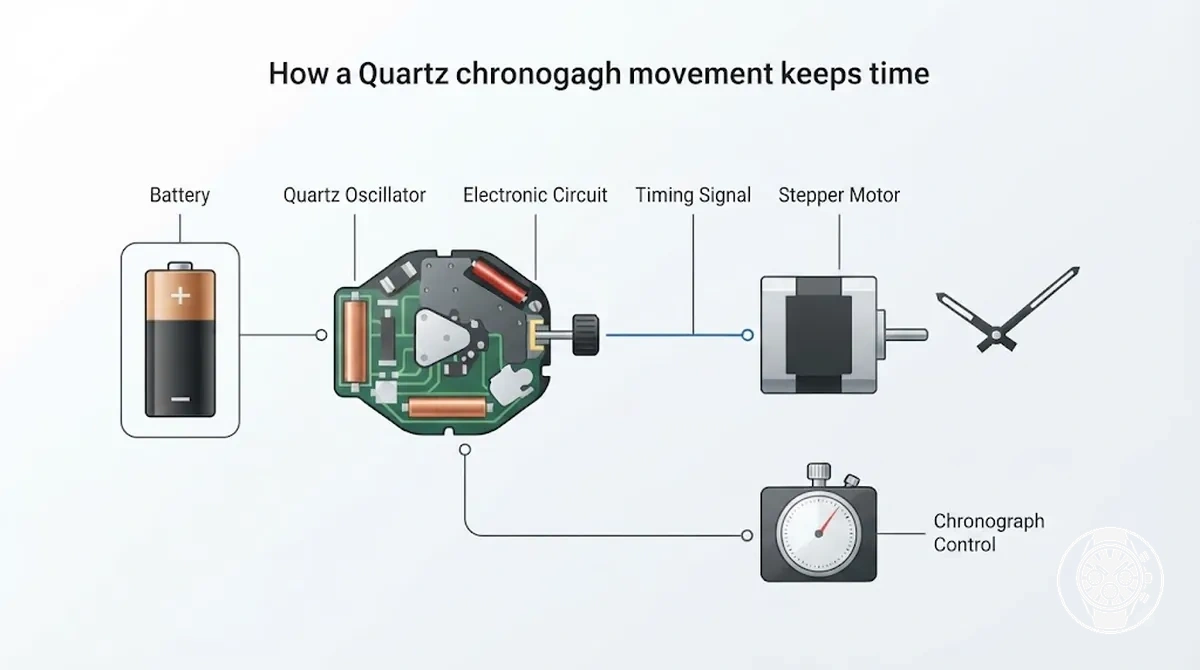
How quartz chronograph movements keep time depends on the battery, quartz oscillator, and electronic circuit working together; the diagram labels how this timing path connects with stopwatch control. The electronic circuit supplies timed electrical pulses to a stepper motor that moves the hands, while chronograph control uses the powered movement system to start, stop, and reset elapsed-time indication according to the quartz calibre's design. For example, Seiko specifies its quartz chronograph Calibre 7T84 with a 32,768 Hz crystal oscillator and four stepper motors, with its regular seconds hand advancing at 1-second intervals and its stopwatch hand at 1/5-second intervals, showing how the movement separates ordinary timekeeping from stopwatch function while using electronic quartz regulation. This section covers that internal movement behavior rather than dial reading, subdial layouts, or operating instructions.
Battery Power, Quartz Regulation, and Stopwatch Control
Battery power supplies the circuit that supports quartz regulation and stopwatch control: the circuit uses the quartz crystal as its timing reference and sends timed electrical signals to the stepper motor or motors that drive the hands and chronograph indicators. Grand Seiko describes this quartz-regulation chain with a battery powering a quartz oscillator at 32,768 Hz, an integrated circuit processing that oscillation into a timing signal, and a step motor converting the electrical signal into hand movement.
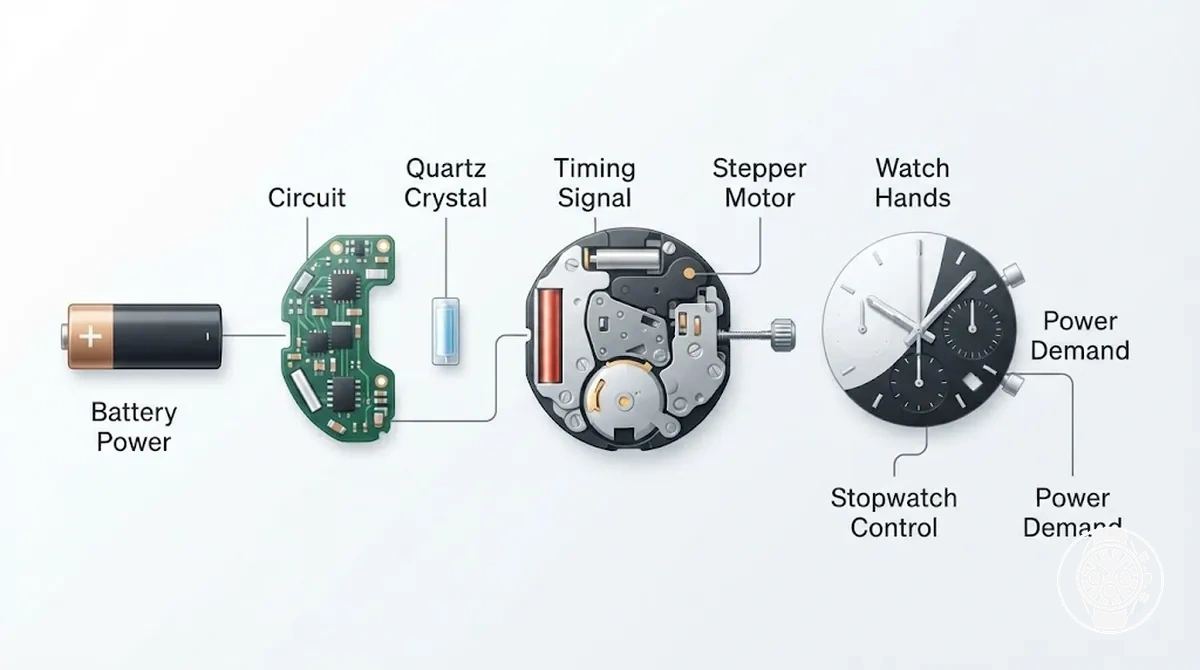
Stopwatch control can increase power demand when chronograph operation requires additional motor activity to move elapsed-time indicators, but the battery load is specific to the calibre and its functions. Seiko specifies its quartz chronograph Calibre 7T84 with four stepper motors and an SR927W battery rated for approximately 3 years when stopwatch operation is less than 60 minutes per day, alongside the calibre's stated timer and alarm usage conditions; Seiko notes that battery life can be shorter when these functions are used beyond the specified conditions. The 7T84 therefore provides a model-specific numerical example of increased functional power demand without establishing a guaranteed drain rate for other quartz chronograph movements.
Movement Reliability in Everyday Chronograph Use
Movement reliability in everyday chronograph use is usually strong, but it is not identical across quartz chronograph movements or conditions: consistent timekeeping, stable chronograph response, and low routine service demand depend on movement quality, battery condition, moisture exposure, shock, age, and use frequency. Citizen's watch-care guidance states that an expired battery should be replaced promptly because leakage can damage the watch, that water entering the case can damage internal components, and that strong shock can cause malfunction or performance deterioration; reliability is therefore condition-based rather than guaranteed.
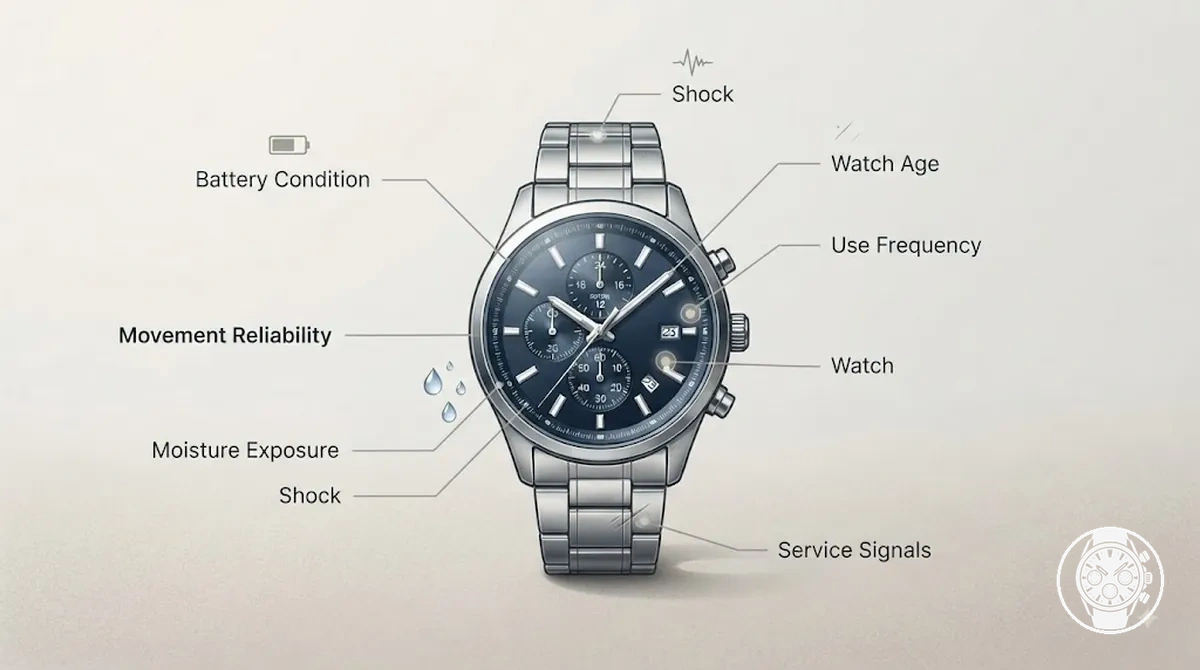
For a normal-use scenario, a quartz chronograph kept within its specified water-resistance conditions, protected from strong shock, and operated with a serviceable battery avoids three manufacturer-identified risks to dependable operation. Citizen specifies that 3-atmosphere water resistance covers minor accidental contact with water, 5 atmospheres permits swimming but not skin diving, and 10 or 20 atmospheres permits skin diving but not scuba or saturation diving; these model-specific limits show why moisture exposure must be interpreted against the individual watch's rating. Heavy stopwatch use or neglected battery care creates a different operating condition from routine everyday use, so chronograph frequency and battery state should be judged against the calibre's instructions rather than treated as universal reliability thresholds.
Movement reliability in everyday chronograph use depends on conditions, not only movement type.
Movement reliability in everyday chronograph use depends on conditions, not only movement type. The checklist organizes the conditions most likely to affect reliability and provides practical criteria when considering whether are quartz chronographs good for a particular pattern of use.
- Battery condition: A serviceable battery supports normal operation; Citizen advises prompt replacement after battery expiry because a depleted battery left in the watch can leak and damage internal components.
- Moisture exposure: Keep water contact within the watch's stated rating; the applicable condition may range from minor accidental contact at 3 atmospheres to skin diving at 10 or 20 atmospheres in Citizen's classification, while persistent internal fogging or water ingress is a service signal.
- Shock: Protect the watch from strong impacts; Citizen identifies dropping or severe shock as conditions that can cause malfunction or performance deterioration.
- Age: No universal watch-age threshold establishes quartz chronograph reliability; movement condition, seals, battery state, and the manufacturer's service guidance provide the relevant condition evidence.
- Use frequency: Stopwatch use should remain within the individual calibre's operating guidance because chronograph configuration and associated power demand are movement-specific rather than universal.
- Service signals: Battery expiry, persistent internal moisture, abnormal timekeeping, or an unstable chronograph response are practical conditions for checking the applicable manufacturer instructions or obtaining appropriate service rather than assuming one routine service interval applies to every quartz chronograph.
Accuracy Expectations for Quartz Chronograph Watches
Quartz chronograph accuracy is specification-led: two documented chronograph calibres, Seiko 8T63 and Citizen H50, are each rated at ±15 seconds per month under their stated conditions. Seiko specifies ±15 seconds per month for Calibre 8T63 between +5°C and +35°C, while Citizen specifies average watch accuracy of ±15 seconds per month for Calibre H50 over the same +5°C to +35°C normal-temperature range; real-world variation should therefore be judged against the individual calibre, its stated variance, and its specified conditions.
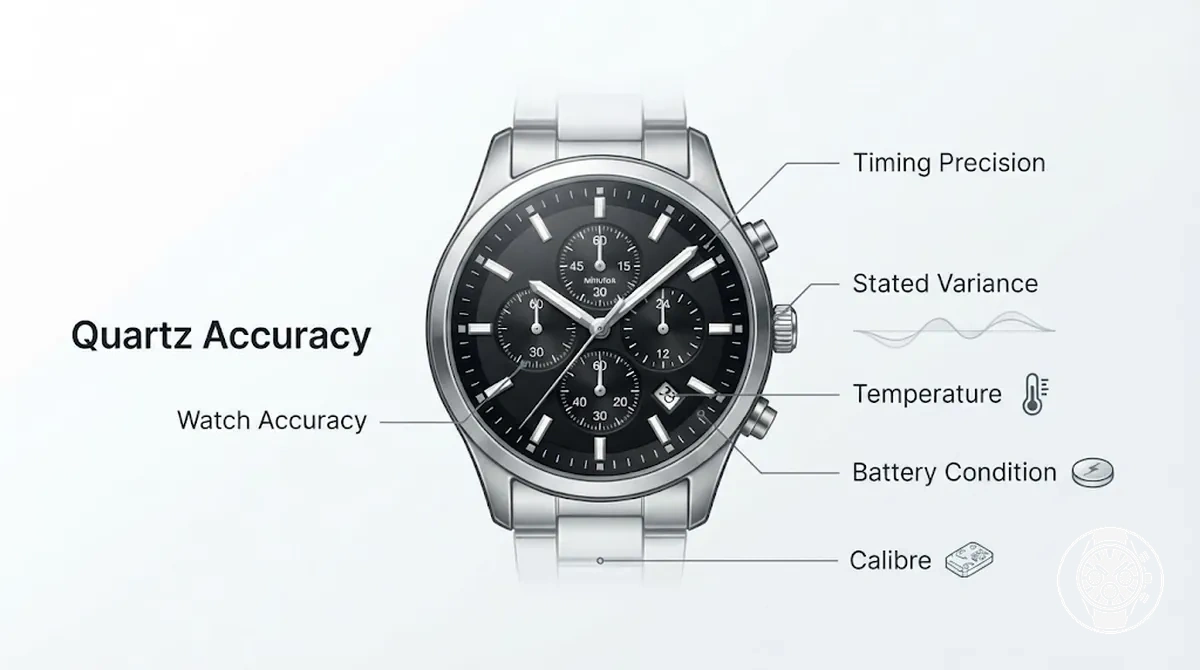
Watch accuracy and chronograph timing precision measure different attributes: watch accuracy describes normal drift of the regular time display over a stated period, whereas chronograph timing precision describes the increments and elapsed-time capacity of the stopwatch display. Seiko specifies Calibre 8T63 at ±15 seconds per month between +5°C and +35°C, while its chronograph measures up to 60 minutes in 1/5-second increments; the 1/5-second increment is therefore stopwatch resolution, not a ±0.2-second monthly timekeeping specification. Citizen specifies H50 at ±15 seconds per month between +5°C and +35°C and a chronograph measuring up to 59 minutes 59 seconds in 1-second units, further showing that elapsed-time measurement and stated variance must be interpreted separately. These model-specific specifications do not establish one universal accuracy promise for every quartz chronograph.
These model-specific specifications do not establish one universal accuracy promise for every quartz chronograph.
Accuracy expectations for quartz chronograph watches should also account for temperature sensitivity, battery condition, calibre differences, and apparent inaccuracy. The table organizes these criteria so normal drift can be distinguished from conditions that require checking the individual movement specification.
| Accuracy factor | What it affects | How to interpret it |
|---|---|---|
| Stated movement variance | Normal drift of the regular time display | Use the individual calibre specification as the baseline; Seiko specifies Calibre 8T63 at ±15 seconds per month between +5°C and +35°C. |
| Temperature | The conditions under which the stated watch accuracy applies | Temperature sensitivity should be interpreted against the manufacturer's specified range. Seiko rates the 8T63 accuracy figure within +5°C to +35°C and specifies an operating range of −10°C to +60°C; Citizen gives the same +5°C to +35°C accuracy condition and −10°C to +60°C operating range for H50. |
| Battery condition | Operation and apparent inaccuracy when available power becomes insufficient | Citizen specifies an insufficient-charge warning for H50 and approximately 5 days of remaining power reserve after that warning begins. The reviewed Citizen specification does not assign a separate seconds-per-month accuracy value to this low-charge state, so weak-battery behaviour should be checked against the calibre's warning indication rather than converted into an unsupported drift figure. |
| Calibre quality and specification | The applicable accuracy limit and measurement conditions | Use the named calibre's documented value rather than inferring performance from the quartz category alone; Seiko 8T63 and Citizen H50 are both specified at ±15 seconds per month under +5°C to +35°C conditions. |
| Chronograph timing use | Elapsed-time measurement rather than regular watch drift | Interpret stopwatch increments separately from watch accuracy. Seiko 8T63 measures up to 60 minutes in 1/5-second increments, whereas Citizen H50 measures up to 59 minutes 59 seconds in 1-second units. |
Typical Quartz Accuracy Ranges and Real-World Variation
The accuracy range for a quartz chronograph should be taken from its movement specification rather than treated as one universal figure: Seiko specifies its 8T63 quartz chronograph calibre at ±15 seconds per month between +5°C and +35°C, while Grand Seiko specifies its high-accuracy 9F85 quartz calibre at ±10 seconds per year. The two specifications represent different calibre classes and are not a combined category-wide range, so expected accuracy remains model- and condition-dependent.
Real-world variation should be interpreted against temperature, battery state, calibre quality, and hand alignment.
Real-world variation should be interpreted against temperature, battery state, calibre quality, and hand alignment. Seiko conditions the 8T63's ±15-seconds-per-month specification on +5°C to +35°C, while Grand Seiko states that its 9F quartz system measures temperature 540 times per day and uses temperature compensation to reduce temperature-related timing variation. Battery state can also change the visible seconds-hand behaviour: Citizen specifies that its H50 chronograph uses two-second interval movement as an insufficient-charge warning while continuing to display the time, so this warning should not be interpreted as a two-second timekeeping error. Hand alignment can likewise create apparent inaccuracy at the dial without establishing the same amount of actual timekeeping drift, so displayed hand position and measured rate should be assessed separately.
The criteria below separate stated accuracy from conditions and symptoms that affect its practical interpretation.
The criteria below separate stated accuracy from conditions and symptoms that affect its practical interpretation.
| Condition | Accuracy effect | Interpretation |
|---|---|---|
| Movement specification | Sets the documented timekeeping limit for the named calibre. | Seiko specifies 8T63 at ±15 seconds per month between +5°C and +35°C; use the specification for the actual movement rather than applying this value to every quartz chronograph. |
| Temperature change | Can change quartz-oscillator timing and therefore contribute to real-world variation. | Grand Seiko states that its 9F quartz system measures temperature 540 times per day and applies temperature compensation; this control is specific to that movement system rather than a feature to assume for every calibre. |
| Battery state | Can change visible hand behaviour when the movement provides a low-power warning. | Citizen specifies two-second interval movement as the H50 insufficient-charge warning; this visible change is a power-state indication rather than a stated two-second timing-drift value. |
| Calibre quality | Changes the applicable stated accuracy and the mechanisms used to control timing variation. | Grand Seiko specifies 9F85 at ±10 seconds per year, while Seiko specifies the chronograph 8T63 at ±15 seconds per month under its stated temperature condition; keep these model-specific specifications separate rather than merging them into a universal range. |
| Hand alignment | Can create apparent inaccuracy in the displayed hand position. | No universal hand-alignment tolerance for quartz chronographs is established by the reviewed specifications; compare the hand position with measured timekeeping drift before interpreting a display-position issue as movement-rate error. |
Quartz Accuracy Compared with Mechanical Chronographs
Quartz accuracy is usually more stable than mechanical chronograph accuracy for everyday timekeeping because quartz regulation uses an electronic timing signal, whereas a mechanical balance responds to changes in its physical operating conditions. Seiko specifies its quartz chronograph Calibre 8T63 at ±15 seconds per month between +5°C and +35°C, while Grand Seiko specifies a normal-use target of -1 to +8 seconds per day for its applicable mechanical chronograph calibre; these model-specific values clarify accuracy behavior rather than define universal limits for either movement type.
This local accuracy comparison is one part of the broader quartz versus automatic chronographs comparison.
Mechanical daily accuracy can change with mainspring winding state, temperature, position and condition because these factors alter the mechanical balance system, while movement-specific quartz monthly accuracy is regulated against a quartz oscillator; Seiko specifies the 8T63 oscillator at 32,768 Hz. Grand Seiko therefore recommends assessing its applicable mechanical movement over approximately 7 to 10 days rather than from one day's rate, showing why mechanical timekeeping has greater condition and maintenance sensitivity. Chronograph timing behavior is a separate attribute: Seiko specifies the 8T63 stopwatch at up to 60 minutes in 1/5-second increments, so its 0.2-second display increment is not the same measure as its ±15-seconds-per-month watch accuracy. This local accuracy comparison is one part of the broader quartz versus automatic chronographs comparison.
The comparison below is limited to accuracy behavior and maintenance sensitivity, not prestige, repair culture, or overall purchase preference.
The comparison below is limited to accuracy behavior and maintenance sensitivity, not prestige, repair culture, or overall purchase preference.
| Quartz chronograph accuracy | Mechanical chronograph accuracy |
|---|---|
| Regulation: Seiko specifies the 8T63 quartz chronograph with a 32,768 Hz crystal oscillator and an electronic circuit, providing the timing reference for quartz regulation. | Regulation: Grand Seiko states that mechanical accuracy is affected by mainspring winding state, temperature and watch position, so mechanical balance behavior can produce day-to-day rate variation. |
| Accuracy expectation: Seiko specifies Calibre 8T63 at ±15 seconds per month between +5°C and +35°C. | Accuracy expectation: Grand Seiko specifies -1 to +8 seconds per day as the normal-use target for its applicable mechanical chronograph calibre and recommends evaluating the mean daily rate over approximately 7 to 10 days. |
| Maintenance sensitivity: The 8T63's documented monthly accuracy is conditional on its specified +5°C to +35°C temperature range; the reviewed Seiko specification does not establish this value for every quartz chronograph. | Maintenance sensitivity: Grand Seiko states that long-term component deterioration can prevent an aged mechanical movement from being adjusted to the desired accuracy, while winding state, temperature and position can alter its measured daily rate. |
| Chronograph timing: Seiko specifies the 8T63 stopwatch at up to 60 minutes in 1/5-second increments; this 0.2-second increment measures elapsed-time display resolution rather than monthly timekeeping drift. | Chronograph timing: Grand Seiko's mechanical chronograph standard uses daily gain or loss for movement accuracy; the reviewed source does not establish one stopwatch-resolution value that applies to all mechanical chronographs. |
Battery Life Expectations in Quartz Chronographs
Battery life in a quartz chronograph is movement-specific rather than a universal year count; Seiko specifies approximately 3 years for Calibre 8T63 with an SR936SW battery when stopwatch use is less than 60 minutes per day. Because that duration is stated for a particular battery type, movement design, and use condition, realistic battery life should be treated as a movement-specific range of outcomes rather than a fixed replacement interval.
Battery capacity and movement load determine how long the available energy can support normal timekeeping and chronograph functions, while use frequency and complications change that load.
Battery capacity and movement load determine how long the available energy can support normal timekeeping and chronograph functions, while use frequency and complications change that load. Seiko specifies two step motors for Calibre 8T63 and states that its approximately 3-year battery life can be shorter when stopwatch use exceeds 1 hour per day; for Calibre 7T84, Seiko specifies approximately 3 years only when yacht-timer use remains below 6 hours per week, timer use below 15 minutes per day, stopwatch use below 60 minutes per day, and alarm use below 40 seconds per day. These model-specific conditions show that frequent stopwatch use or additional complications can shorten battery duration by increasing functional demand, but the reviewed manufacturer specifications do not provide a universal numerical reduction applicable to every quartz chronograph or battery type.
Storage and battery age also affect replacement timing even when a quartz chronograph is not being actively worn.
Storage and battery age also affect replacement timing even when a quartz chronograph is not being actively worn. Seiko states that the battery installed in Calibre 8T63 at the factory is used to check the watch's functions and performance, so its remaining life after purchase can be shorter than the specified approximately 3 years; the reviewed specification does not provide a separate numerical extension for long-term storage. Light stopwatch use within the stated 60-minutes-per-day limit therefore retains the approximately 3-year model-specific expectation, frequent use above that limit has a manufacturer-stated shorter but numerically unspecified duration, and prolonged storage should not be interpreted as restarting or preserving the full nominal battery-life period.
| Use condition | Battery-life effect | Interpretation |
|---|---|---|
| Normal timekeeping with light chronograph use | Seiko specifies approximately 3 years for Calibre 8T63 when stopwatch use is less than 60 minutes per day. | The approximately 3-year value applies to this movement and stated use condition, not to every quartz chronograph. |
| Frequent stopwatch use | Seiko states that Calibre 8T63 battery life can be shorter than approximately 3 years when stopwatch use exceeds 1 hour per day; the reviewed specification gives no numerical value for the shortened duration. | Higher chronograph use increases movement load, but its effect on replacement timing must be taken from the individual movement specification. |
| Extra complications | Seiko specifies approximately 3 years for Calibre 7T84 under combined limits of less than 6 hours per week of yacht-timer use, 15 minutes per day of timer use, 60 minutes per day of stopwatch use, and 40 seconds per day of alarm use. | The stated duration is conditional on the combined functional load, so it should not be generalised to chronographs with different complications or movement designs. |
| Storage while unused | The reviewed Seiko 8T63 specification provides no separate numerical battery-life extension for storage. | Storage does not establish a new nominal battery-life period; remaining duration must be interpreted from the battery's existing age and the applicable movement specification. |
| Older factory-installed battery | Seiko specifies approximately 3 years for the 8T63 battery but states that remaining life after purchase can be shorter because the battery is installed at the factory for function and performance checks. | Battery age before purchase can make replacement timing earlier than the movement's nominal approximately 3-year specification. |
How Chronograph Use Affects Battery Drain
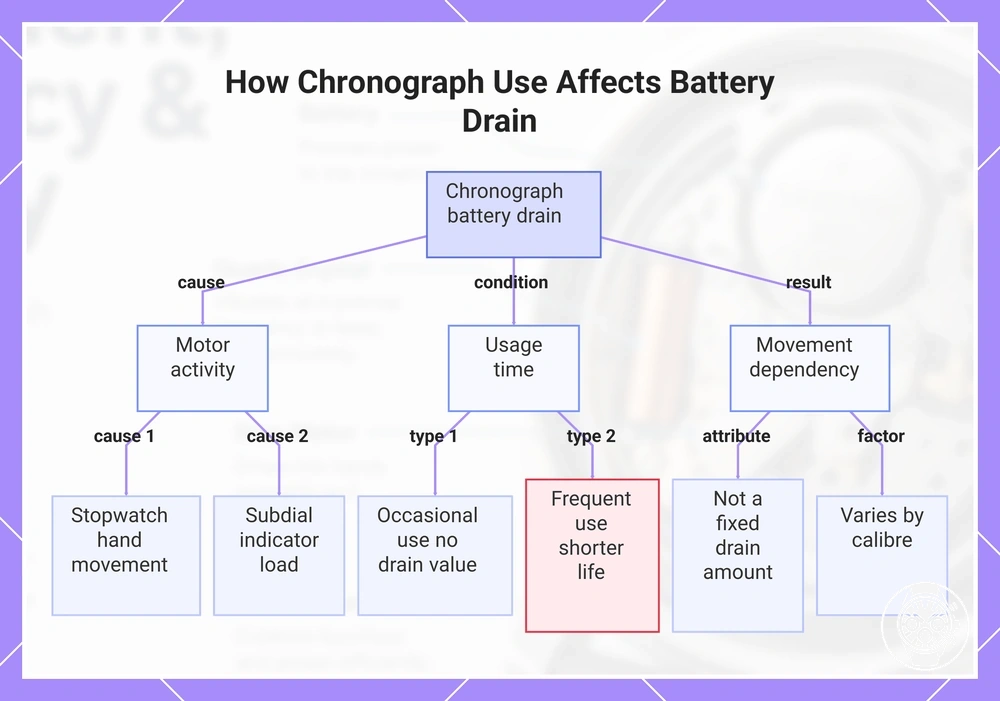
Chronograph use can increase battery drain in a quartz chronograph because stopwatch use adds motor activity and circuit load beyond normal timekeeping, including movement of a central seconds or other stopwatch hand and, depending on the calibre, a subdial indicator. Seiko specifies Calibre 8T63 with two step motors and approximately 3 years of battery life, while stating that battery life can be shorter when stopwatch use exceeds 1 hour per day; Seiko does not specify the resulting battery duration or percentage drain. The battery effect is therefore movement-dependent rather than a fixed drain amount.
The battery effect is therefore movement-dependent rather than a fixed drain amount.
User behavior changes power demand according to how long the stopwatch is active and which indicators the movement drives. For example, Seiko specifies that the 8T63 stopwatch measures up to 60 minutes with a 1/5-second stopwatch hand, and its battery guidance identifies more than 1 hour of stopwatch use per day as a condition that can reduce the approximately 3-year battery life; this provides a model-specific boundary between occasional timing and heavier stopwatch use without establishing an exact drain assumption for other quartz chronographs.
- Occasional timing: Stopwatch use that stays below the 8T63 manufacturer's identified heavier-use condition of more than 1 hour per day does not have a separately specified battery-drain value, so no percentage or hourly drain can be assigned from the reviewed Seiko specification.
- Frequent timing: Seiko states that more than 1 hour per day of 8T63 stopwatch use can shorten its approximately 3-year battery life, establishing a model-specific user-behavior threshold without specifying how many days or months are lost.
- Continuous running: The 8T63 stopwatch automatically stops after 60 minutes, according to Seiko, so this calibre cannot support an indefinitely running chronograph; other movements require their own specifications before a continuous-running battery effect can be quantified.
- Extra indicators: Seiko specifies two step motors for the 8T63 and separate stopwatch minute and 1/5-second hands; moving central seconds or subdial indicators during chronograph use can add motor activity and circuit load, but the reviewed specification does not assign a separate current-consumption value to each indicator.
- Movement variation: The number of motors, active indicators, circuit design, and stopwatch behavior differ by calibre, so the supported battery-drain value ranges from a manufacturer-stated shorter battery life under a defined use condition to an unspecified drain amount where the manufacturer publishes no separate consumption figure.
This chart shows the causes, usage conditions, and movement-dependent nature of battery drain in quartz chronographs.
Battery Life Signals and Replacement Timing
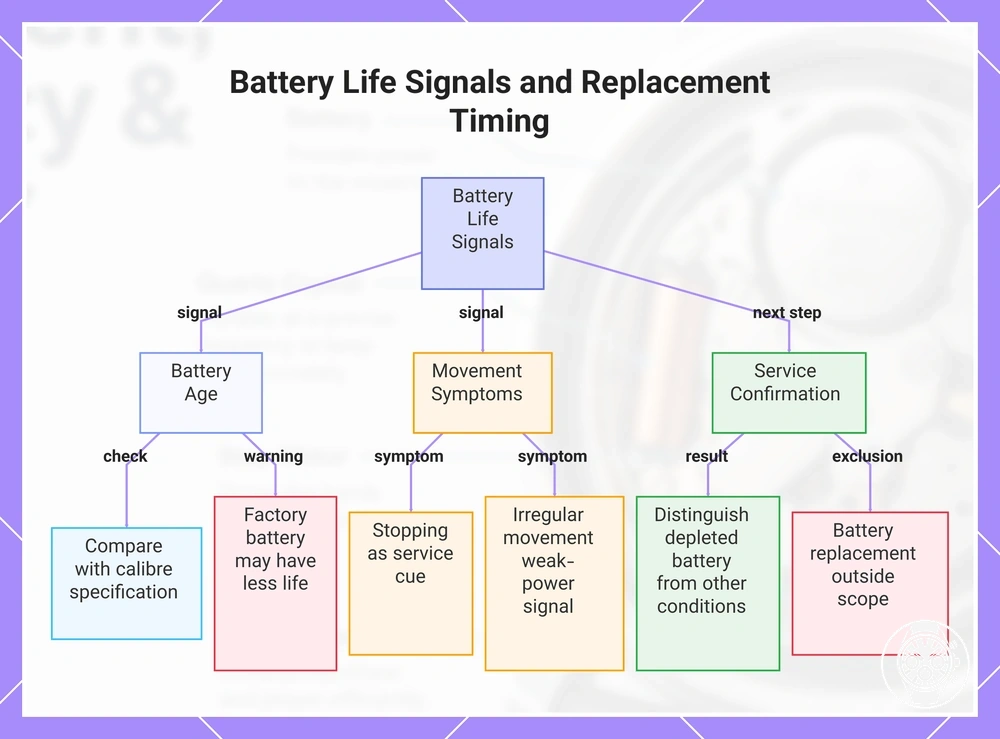
Battery life signals and replacement timing in a quartz chronograph should be judged from the movement's expected battery age together with stopping, irregular movement, or reduced chronograph response. Seiko specifies approximately 3 years of battery life for Calibre 8T63 when stopwatch use is less than 60 minutes per day, while noting that the factory-installed battery may have less remaining life because it is installed before purchase for function and performance checks. A watch approaching its model-specific battery-life expectation or showing weak battery symptoms therefore has a service cue, but these symptoms are signals rather than proof that the battery is the only cause.
Condition-to-action logic means comparing battery age, chronograph response, and seconds-hand behavior with the documentation for the actual calibre before treating a symptom as a battery diagnosis.
Condition-to-action logic means comparing battery age, chronograph response, and seconds-hand behavior with the documentation for the actual calibre before treating a symptom as a battery diagnosis. Citizen specifies that Calibre H50 changes to 2-second interval movement when its insufficient-charge warning activates and provides approximately 5 days of remaining operation after that warning begins, making this behavior a model-specific weak-power signal rather than a universal quartz-chronograph threshold. When stopping, irregular movement, or reduced chronograph response cannot be matched confidently to a documented power indication, service confirmation is the appropriate next diagnostic step; the actual battery replacement process is outside this timing-signals boundary.
Use these battery life signals as condition-to-action clues rather than a complete diagnosis:
- Battery age: Compare elapsed age with the named calibre's specification; Seiko's 8T63 reference is approximately 3 years when stopwatch use is less than 60 minutes per day, with potentially less remaining life for the factory-installed battery.
- Stopping: Treat a stopped quartz chronograph as a service cue when the battery may be exhausted, but do not treat stopping alone as confirmation of a dead battery.
- Irregular movement: Compare unusual seconds-hand behavior with the calibre documentation; Citizen identifies 2-second interval movement specifically as the H50 insufficient-charge warning, with approximately 5 days of operation remaining after the warning starts.
- Chronograph response: Reduced or abnormal chronograph response is a condition for checking documented power indications and obtaining service confirmation when the movement documentation does not identify that behavior as a weak battery signal.
- Service confirmation: When battery age and observable symptoms do not establish a model-specific power condition, service confirmation can distinguish a depleted battery from another watch or movement condition without assuming that every symptom proves battery exhaustion.
This chart shows the key battery life signals for quartz chronographs and how to use them as condition-to-action clues before seeking service confirmation.
Solar Quartz Chronograph Power Expectations
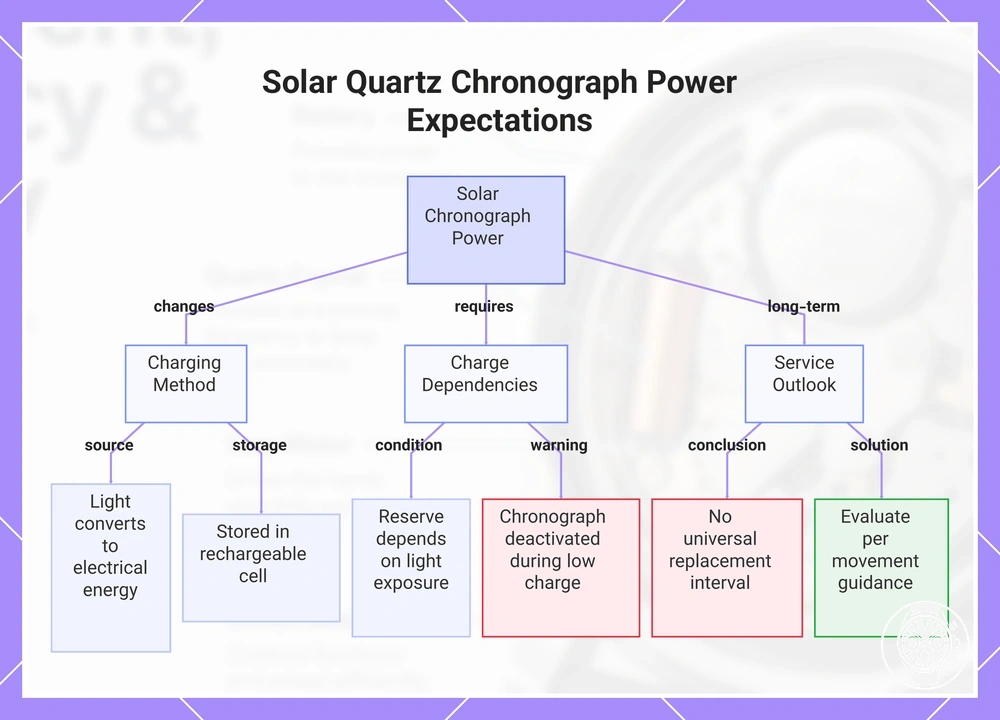
A solar quartz chronograph uses light charging to convert light into electrical energy and store it for operation in a rechargeable cell, so its battery expectations shift from routine disposable-battery replacement toward maintaining sufficient charge and cell condition. Seiko specifies that its solar Calibre V192 converts light at a solar cell beneath the dial into electrical energy, while Citizen states that Eco-Drive movements store solar-generated power in a built-in rechargeable cell. Solar power therefore changes the charging method and stored-energy behavior, not the basic quartz timing principle.
Solar power therefore changes the charging method and stored-energy behavior, not the basic quartz timing principle.
Light exposure determines available charge reserve, while chronograph use adds a function that can depend on sufficient stored energy for stable operation. Seiko specifies approximately 6 months of operation for a fully charged V192 without further light exposure, and its chronograph measures up to 60 minutes in 1/5-second increments before stopping automatically. Seiko's V192/V194 instructions also specify that the stopwatch cannot be activated while the seconds hand is moving at 2-second intervals as an energy-depletion warning, providing a concrete link between charge state, chronograph use, and power stability. Citizen likewise states that its rechargeable-cell watches require light exposure and advises against prolonged storage in darkness, so reserve duration and service need should be assessed from the individual calibre's charging specification and rechargeable cell condition.
Solar quartz chronographs can therefore require fewer routine battery replacements while still retaining an eventual rechargeable-cell service need.
Solar quartz chronographs can therefore require fewer routine battery replacements while still retaining an eventual rechargeable-cell service need. The reviewed Seiko V192 and Citizen Eco-Drive documentation does not establish one universal replacement interval for rechargeable-cell degradation, so a category-wide service-life figure cannot be supported; persistent charging or reserve problems after appropriate light exposure should be evaluated against the specific movement's service guidance rather than treated as a fixed-age battery event.
What changes: Light charging replenishes stored energy instead of relying on periodic replacement of a conventional disposable battery; for example, Seiko specifies approximately 6 months of V192 operation after a full charge without additional light exposure.
What does not change: The solar quartz chronograph still requires sufficient stored electrical energy and a serviceable rechargeable cell; inadequate light exposure can reduce available reserve, while the reviewed manufacturer documentation provides no universal number of years before rechargeable-cell service becomes necessary.
This chart shows how solar charging shifts battery expectations from disposable replacement to charge maintenance, and outlines the key dependencies and service considerations.
This chart shows how solar charging shifts battery expectations from disposable replacement to charge maintenance, and outlines the key dependencies and service considerations.
Light Charging, Reserve Behavior, and Battery Change Limits
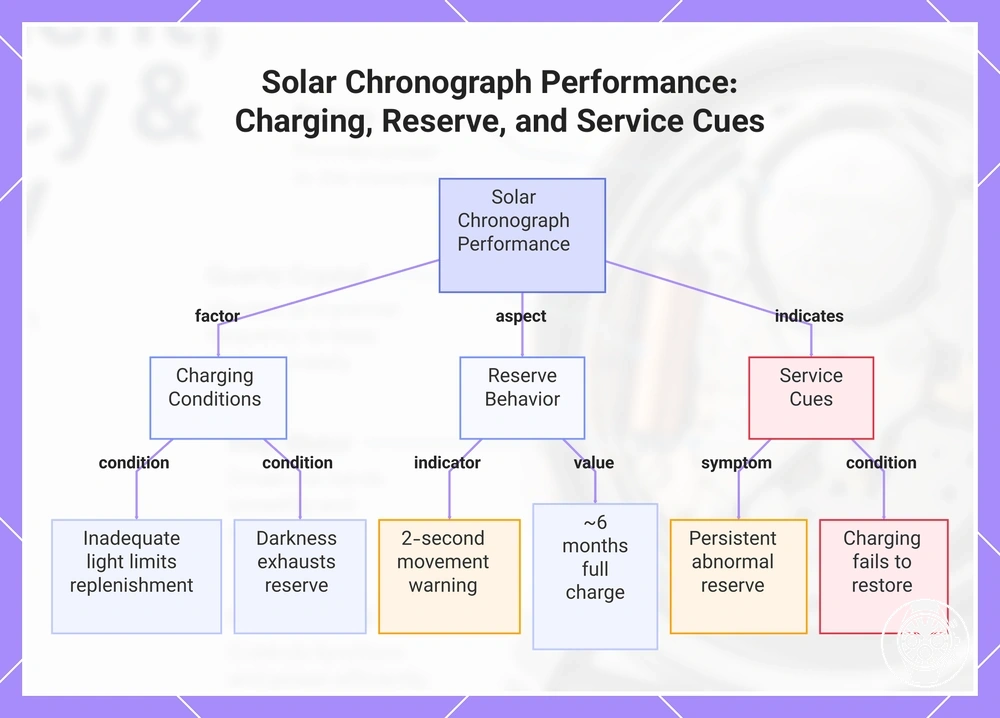
Reliable solar quartz chronograph performance depends on sufficient light charging, usable power reserve, and a rechargeable cell that can retain charge. Seiko specifies approximately 6 months of operating duration for Calibre V192 from a full charge when the stopwatch is used for 1 hour per day, so reserve behavior must be treated as model- and condition-dependent rather than as one duration for all solar chronographs.
Storage darkness can exhaust the available power reserve without, by itself, proving movement or rechargeable cell failure.
Storage darkness can exhaust the available power reserve without, by itself, proving movement or rechargeable cell failure. Seiko instructs V192 users to charge the watch when the small seconds hand moves at 2-second intervals or has stopped; persistent abnormal reserve behavior after appropriate light exposure is a service cue, but these symptoms alone do not identify the underlying cause.
Use these criteria as a condition check for light-powered chronograph performance:
- Light exposure: Seiko specifies that V192 generates electrical energy when light reaches its solar cell; inadequate light exposure therefore limits replenishment of the rechargeable cell and available power reserve.
- Storage darkness: A V192 stored without light can eventually consume its stored charge; Seiko's approximately 6-month full-charge duration, specified with 1 hour of stopwatch use per day, provides a model-specific example of why stopping after sufficiently prolonged darkness does not by itself establish movement failure.
- Charge indicator: Where a charge indicator is present, interpret its behavior using the specific calibre instructions. Seiko V192 uses a power-reserve indicator and 2-second small-seconds movement as an energy-depletion warning, giving an observable condition for restoring light exposure rather than a universal threshold for other solar chronographs.
- Power reserve: Use the documented value for the individual movement. Seiko specifies approximately 6 months for a fully charged V192 under its stated 1-hour-per-day stopwatch-use condition; the reviewed evidence does not establish that duration for other solar quartz chronograph calibres.
- Cell age: Rechargeable cell age has no universal replacement threshold in the reviewed Seiko V192 documentation, so age alone does not establish that the cell has reached its service limit; retained charge behavior under the model's documented charging conditions is the relevant observable criterion.
- Cell limits: If appropriate light charging does not restore the calibre's documented charge or reserve behavior, treat the condition as a service cue rather than assuming that a battery change is required; the reviewed evidence provides no universal rechargeable-cell replacement interval applicable to all solar quartz chronographs.
This chart shows the key factors affecting solar quartz chronograph performance and the conditions that indicate when service is needed, using Seiko Calibre V192 as an example.
Maintenance Cues for Movement and Battery Performance
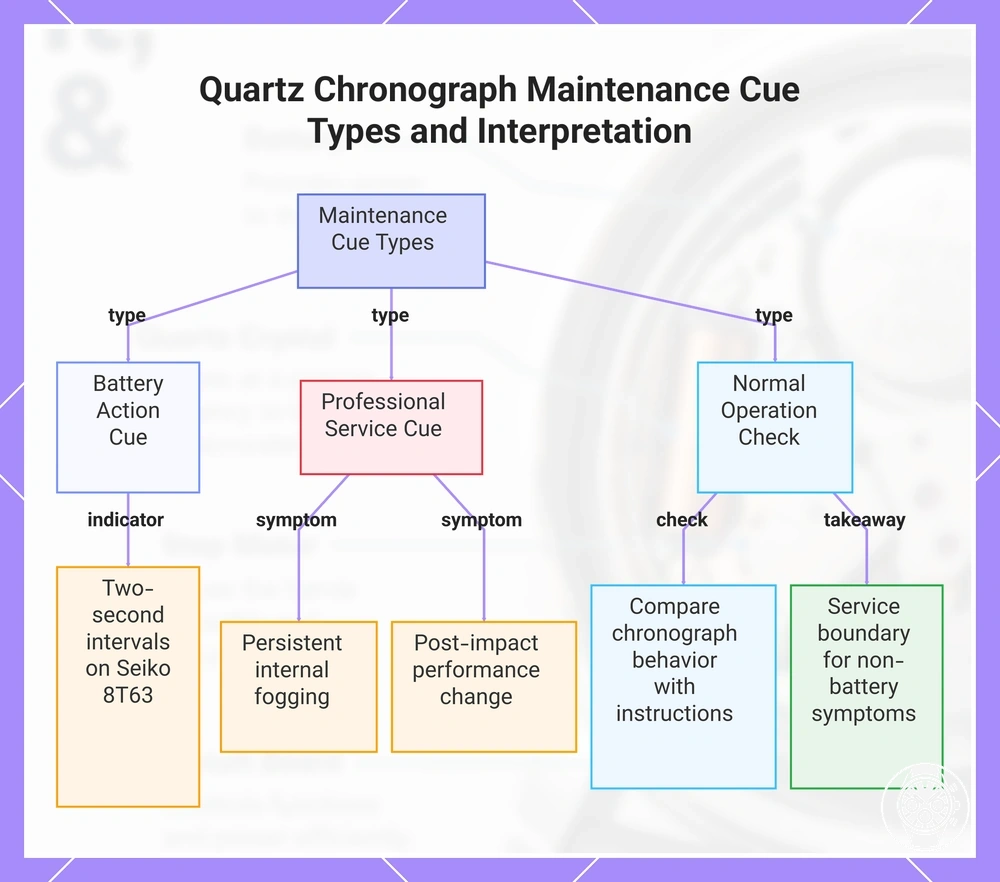
Maintenance cues for movement and battery performance help distinguish normal care, battery-related action, and professional service signals in a quartz chronograph. Seiko specifies that Calibre 8T63 changes from one-second to two-second small-seconds intervals when its battery nears the end of its life, while Citizen states that strong impact can cause malfunction or performance deterioration; these conditions can affect battery health, movement performance, or chronograph reliability without identifying the cause with certainty. The cues establish a care direction rather than repair steps.
The cues establish a care direction rather than repair steps.
For example, an 8T63 showing two-second intervals has Seiko's defined weak battery signal, whereas an applicable Citizen chronograph's central chronograph seconds hand remaining stationary when elapsed-time measurement is not running is normal operation rather than a battery symptom. Persistent internal fogging belongs to a different service boundary because Citizen advises inspection when fogging does not clear after an extended period, indicating possible water entry. A new chronograph irregularity after shock exposure also points toward professional service rather than an assumed battery cause because Citizen identifies strong impact as a possible source of malfunction or performance deterioration. For preventive care beyond these cue-level distinctions, see how to maintain a quartz chronograph.
- Weak battery: On Seiko Calibre 8T63, two-second small-seconds intervals are the specified battery-life indicator. Seiko specifies approximately 3 years of battery life when stopwatch use is less than 60 minutes per day and states that use above 60 minutes per day can shorten that duration, so the documented indicator is the battery-related action cue rather than elapsed age alone.
- Moisture risk: Persistent internal fogging is a professional service cue rather than normal care. Citizen states that fogging that does not clear after an extended period can indicate water entry and advises inspection because moisture can affect internal watch components.
- Shock exposure: A strong impact becomes a service cue when movement performance or chronograph behavior changes afterward. Citizen states that dropping a watch or subjecting it to strong impact can cause malfunction or performance deterioration, so a post-impact symptom should not be classified automatically as a weak battery.
- Chronograph irregularity: Compare the observed response with the named calibre's documented operating state before treating it as a performance symptom. Citizen specifies for applicable chronographs that the central chronograph seconds hand moves during elapsed-time measurement and otherwise remains stationary, so stationary behavior outside timing is normal care territory while behavior inconsistent with the calibre instructions is a service cue.
- Storage: Limited use during storage does not establish a fresh battery-life period for a conventional quartz chronograph. Seiko states that the factory-installed 8T63 battery is used for function and performance checks before sale, so remaining battery life after purchase can be less than its approximately 3-year specification even when subsequent stopwatch use is limited.
- Service timing: Battery health should be interpreted from the named calibre's documented indicator and operating conditions, while persistent moisture, changed performance after shock exposure, or unexplained chronograph irregularity belongs to the professional-service boundary. For Seiko 8T63, the manufacturer-defined weak battery cue is two-second small-seconds movement and the stated battery-life reference is approximately 3 years with stopwatch use below 60 minutes per day; the reviewed manufacturer evidence does not establish one universal service interval for all quartz chronographs.
This chart shows the three main categories of maintenance cues for quartz chronographs: battery action cues, professional service cues, and normal operation checks, helping you distinguish between normal care, battery replacement, and professional service needs.
Water Resistant Versus Waterproof Chronograph Wording
Water resistant and waterproof should not be treated as identical chronograph wording: a water-resistant claim describes protection qualified by a tested rating and applicable conditions, whereas waterproof-style wording can create an expectation of absolute protection that the rating does not establish. ISO 22810:2010 specifies requirements, test methods, and permitted marking for watches described as water resistant, so the practical distinction is to rely on the stated water-resistance rating and manufacturer limitation rather than the word “waterproof.”
The comparison below connects wording cues with rating labels and user expectations without treating either phrase as an unlimited guarantee.
Water resistant versus waterproof chronograph wording clarifies the difference between a qualified protection claim and an assumption of unrestricted wet use. The comparison below connects wording cues with rating labels and user expectations without treating either phrase as an unlimited guarantee.

| Wording | Rating or limitation | User expectation |
|---|---|---|
| Water resistant | Protection is qualified by the stated rating and manufacturer guidance. For example, Citizen specifies “W. R. 5 bar” as water-resistant to 5 atmospheres and “W. R. 10/20 bar” as water-resistant to 10 or 20 atmospheres, with permitted wet-use conditions differing between those ratings. | Interpret the claim through the actual rating value and stated conditions rather than assuming that every water-resistant chronograph supports the same wet use. |
| Waterproof-style wording | No single universal depth or activity limit follows from the word itself. In its review of watch-industry guidance, the U.S. Federal Trade Commission reported industry concern that “proof” suggests absolute protection and found insufficient evidence to formulate a general test or definition for a waterproof watch claim. | Do not convert waterproof-style language into an expectation of unrestricted protection; check the chronograph's stated water-resistance rating and manufacturer limitations instead. |
Myth to truth: A waterproof-style claim does not make a chronograph independent of its rated conditions. For example, Citizen's current guidance distinguishes a 5-atmosphere rating from 10- or 20-atmosphere ratings by the types of water-related use permitted, demonstrating that the numerical rating and manufacturer conditions define the practical expectation rather than stronger-sounding wording alone.
When Servicing Moves Beyond Normal Battery Care
Servicing moves beyond normal battery care when a quartz chronograph has a persistent issue after the correct battery has been fitted, or when moisture exposure, a failed chronograph reset, or damaged pushers indicates a condition that battery replacement alone does not address. CASIO specifies that an incorrect battery type can cause malfunction and recommends a water-resistance check when a battery is replaced, while Citizen identifies persistent internal fogging and chronograph hands that do not return to their specified zero positions as separate conditions requiring attention. These conditions separate routine battery expectations from professional service signals.
These conditions separate routine battery expectations from professional service signals.
Repeated battery drain becomes a service need when replacement batteries repeatedly fall short of the named calibre's documented battery-life specification under comparable use, but the reviewed manufacturer guidance provides no universal number of premature replacements that defines repeated drain across quartz chronographs. Citizen specifies for Calibre H50 that persistent fogging or water entry warrants inspection or repair, and that its chronograph hands should reset to 0 minutes and 0 seconds; CASIO also identifies visible cracking or other abnormal damage during battery servicing as a condition requiring separate assessment. Inconsistent operation that persists after battery change, failed reset behavior, moisture inside the case, or damaged pushers therefore warrants broader assessment when it cannot be matched to the movement's documented battery condition. Diagnosis and deeper repair guidance remain outside this movement-accuracy and battery-life scope.
Diagnosis and deeper repair guidance remain outside this movement-accuracy and battery-life scope.
The checklist separates normal battery care from broader servicing signals:
- Repeated battery drain: Compare battery life with the specification for the exact calibre and the same use conditions. If correctly specified replacement batteries repeatedly fall materially short of that documented value, treat the pattern as a service signal; the reviewed manufacturer evidence establishes no universal replacement-count threshold.
- Moisture exposure: Persistent internal fogging or visible moisture crosses the normal-care boundary. Citizen advises inspection or repair when fogging does not clear after an extended period or water has entered the watch.
- Failed chronograph reset: A chronograph that does not return to its documented zero position needs assessment beyond a battery-life assumption. For Citizen Calibre H50, the specified reset position is 0 minutes and 0 seconds.
- Inconsistent operation after battery change: Persistent irregular operation after the specified battery is fitted is a broader decision signal rather than evidence that another routine battery change will resolve the condition; CASIO states that using a battery type other than the specified type can itself cause malfunction.
- Damaged pushers: A pusher that is visibly damaged or no longer provides its documented chronograph response should be treated as a professional service signal rather than a battery diagnosis. The reviewed manufacturer evidence provides no universal amount of allowable pusher damage before assessment is appropriate.
- Service boundary: Persistent drain, moisture exposure, failed chronograph reset, inconsistent operation after battery change, or damaged pushers can move a quartz chronograph beyond normal battery care; identifying the internal fault and repair pathway belongs outside this movement-attribute page.