Men’s Quartz Chronograph Watch Prices and Value
A men’s quartz chronograph watch offers stronger practical value when its price band matches the quartz movement, chronograph functions, materials, build quality, and ownership needs that matter for the intended use. Current Australian manufacturer listings reviewed from Citizen and Tissot place quartz chronographs across an observed A$299 to A$1,150 span, but this is a source-specific market illustration rather than a universal category price range.
A fair price-value comparison therefore needs to compare the attributes supplied within the relevant price band rather than assume that a higher price automatically produces a proportionate improvement.
Citizen Watches Australia currently lists quartz chronographs from A$299 in the reviewed examples, while Tissot Australia lists quartz chronographs from A$620 to A$1,150 in its current chronograph collection. The difference shows why affordable, mid-range, and premium are relative price-band labels rather than fixed quality thresholds: brand position, case construction, crystal type, strap or bracelet, finishing, water resistance, chronograph configuration, and included features can change independently of price. A fair price-value comparison therefore needs to compare the attributes supplied within the relevant price band rather than assume that a higher price automatically produces a proportionate improvement.
For practical ownership value, the useful criteria are explicit specifications rather than prestige alone.
For practical ownership value, the useful criteria are explicit specifications rather than prestige alone. Citizen Watches Australia specifies stainless steel construction, mineral crystal, a quartz chronograph movement, a two-year battery-life specification, 44 mm case size, and WR50/5 bar water resistance for one A$299 chronograph, while another A$425 model uses stainless steel and mineral crystal but changes to a 40 mm case and WR100/10 bar water resistance. These manufacturer-stated differences illustrate how two prices can correspond to different combinations of fit, water resistance, finishing, and usability without making price itself a measure of build quality.
Practical value and prestige value should therefore be judged separately.
Practical value and prestige value should therefore be judged separately. A higher-priced men’s quartz chronograph may add sapphire crystal, different case or bracelet construction, refined finishing, design details, packaging, or brand positioning, but those additions improve ownership value only when they match the wearer’s priorities. The useful next step is to compare price ranges with the materials, functions, and ownership characteristics normally associated with each price band.
Table of Contents
Typical Price Ranges for Men’s Quartz Chronograph Watches
Typical price ranges for men’s quartz chronograph watches span at least A$299 to A$1,150 across current Australian manufacturer examples reviewed in August 2026; these figures establish an observed pricing spread, not universal affordable, mid-range, or premium thresholds. Citizen Watches Australia lists its AN8168-51H quartz chronograph at A$299, while Tissot Australia’s chronograph collection lists quartz models from A$620 to A$1,150, so price should be judged against the materials, features, finishing, and value risk attached to each price point.
These are decision-support bands rather than market-wide classifications because the manufacturers price individual models according to different feature sets, materials, and finishing.
men’s quartz chronograph watches can therefore be organised into affordable, mid-range, and premium comparison bands only within the observed examples: A$299 for the reviewed affordable example, A$620–A$805 for the reviewed mid-range examples, and A$855–A$1,150 for the reviewed premium examples. These are decision-support bands rather than market-wide classifications because the manufacturers price individual models according to different feature sets, materials, and finishing.
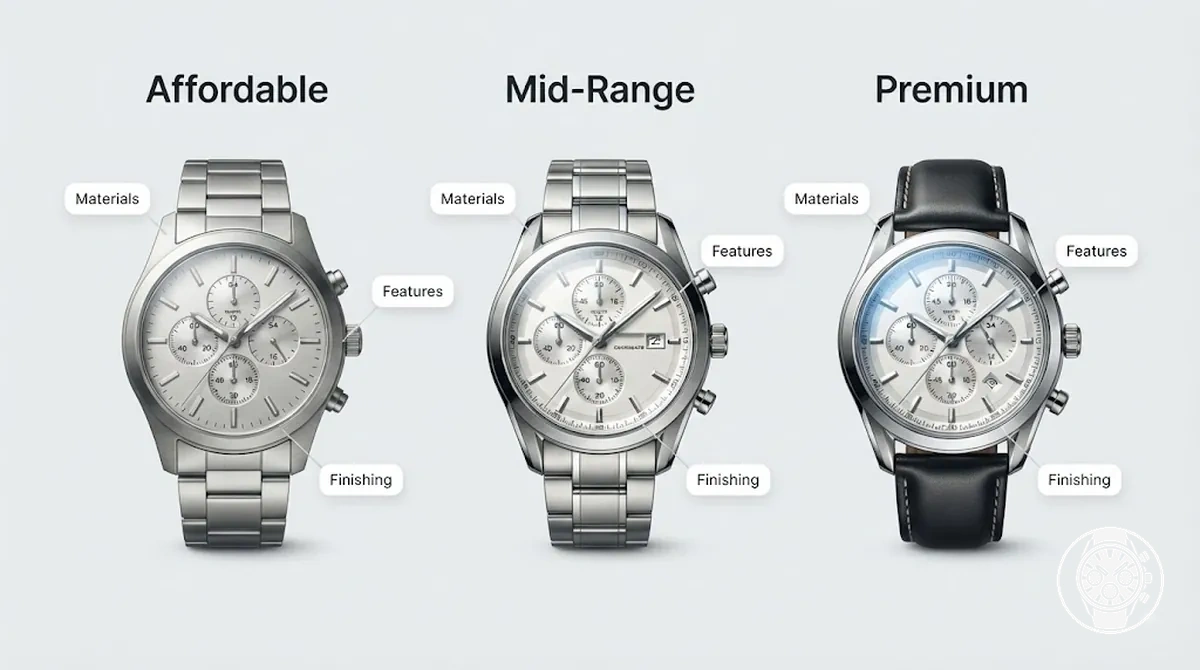
| Price band | Expected features | Value signals | Watch-out points |
|---|---|---|---|
| Affordable: A$299 in the reviewed Citizen Australia example | Citizen Watches Australia specifies the A$299 AN8168-51H with a quartz chronograph movement, stainless-steel case and bracelet, mineral crystal, 44 mm case and WR50/5 bar water resistance. | Core chronograph functionality and stainless-steel construction are present at this observed price point, so functional specifications are the clearest value signals. | This single model does not establish a universal affordable range; crystal, water resistance and finishing require model-level comparison. |
| Mid-range: A$620–A$805 in the reviewed Tissot Australia examples | Tissot Australia’s chronograph collection lists quartz models including the 42 mm Chrono L at A$620 and other quartz chronographs through A$805 within this illustrative band. | The buyer decision should test whether changes in materials, crystal, bracelet, chronograph features or finishing provide a useful ownership benefit over the lower-priced example. | Brand positioning or special-edition design can influence a price point, so price alone does not quantify functional improvement. |
| Premium: A$855–A$1,150 in the reviewed Tissot Australia examples | Tissot Australia specifies an A$855 PR516 quartz chronograph with a 40 mm 316L stainless-steel case, sapphire crystal with antireflective coating and 100 m/10 bar water resistance; its chronograph collection also lists a 38 mm ceramic T-Race quartz model at A$1,150. | Sapphire crystal, case treatments, ceramic components or more elaborate finishing are identifiable value signals when those attributes matter to the intended ownership scenario. | Value risk increases when the added material or finishing does not provide a benefit the wearer values. |
A numerical comparison shows why the price range needs specification context. Citizen Watches Australia lists the AN8168-51H at A$299 with mineral crystal and 50 m/5 bar water resistance, while Tissot Australia lists the PR516 at A$855 with sapphire crystal with antireflective coating and 100 m/10 bar water resistance; the calculated A$556 price difference accompanies identifiable changes in crystal specification, water resistance and brand positioning, but it does not measure a universal A$556 increase in practical value.
A numerical comparison shows why the price range needs specification context.
For daily wear, an affordable model can represent sufficient value for money when its stated chronograph features, materials and use conditions meet the wearer’s requirements; for gifting or higher-finish expectations, the mid-range or premium bands can add value when features such as sapphire crystal, case treatments or differentiated finishing are specifically wanted. The practical decision is therefore to compare the feature gained at each price increase rather than treat a premium price band as a product ranking.
Affordable Quartz Chronograph Price Expectations
An affordable quartz chronograph can still be adequate for everyday use when its low price includes clearly stated usable features and consistent specifications. In the current Australian example reviewed, Citizen Watches Australia lists the AN8168-51H at A$299 and specifies a stainless-steel case and bracelet, mineral crystal, WR50/5 bar water resistance, a two-year battery-life specification, and a 1-second chronograph measuring up to 60 minutes.
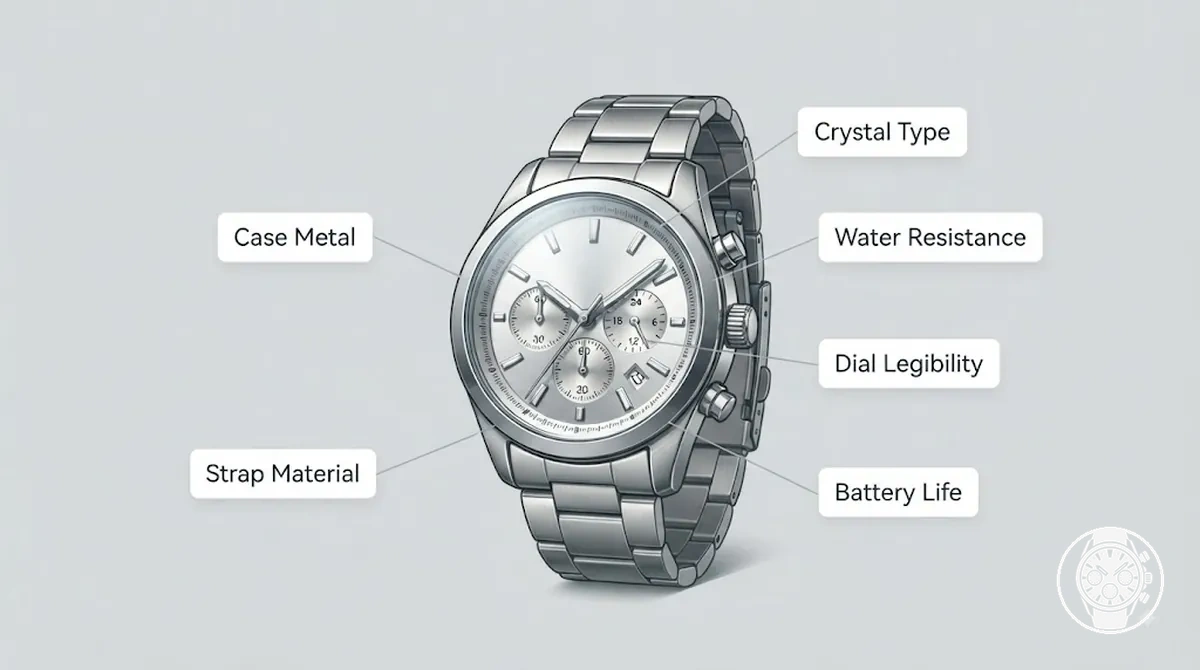
Affordable Quartz Chronograph Price Expectations should therefore be checked against the attributes the watch actually provides rather than the price point alone. The checklist separates acceptable compromises from warning signs by verifying case metal, strap material, crystal, water resistance, dial legibility, battery expectations, and chronograph usability.
- Case metal: An identified case metal is a positive value signal; Citizen Watches Australia specifies stainless steel for the A$299 AN8168-51H. An unspecified case material is a warning sign because its material and finish cannot be compared reliably.
- Strap material: Look for an explicitly identified strap material and clasp type. Citizen Watches Australia specifies a stainless-steel bracelet with a push-button clasp on the AN8168-51H, so an affordable option does not inherently require an unspecified strap or bracelet.
- Crystal: Mineral crystal is an acceptable documented compromise at this price point when it suits the intended ownership conditions. Citizen Watches Australia specifies mineral crystal on the A$299 AN8168-51H; if the crystal type is not stated, its material remains unverified.
- Water resistance: Require a stated rating with a defined use condition rather than relying on vague water-resistance wording. Citizen Watches Australia specifies WR50/5 bar for the AN8168-51H and identifies still-water swimming as its stated use condition, so the rating can be assessed against the wearer’s intended exposure.
- Dial legibility: The hour and minute hands, indices, and chronograph displays should remain distinguishable during the buyer’s normal reading conditions. The reviewed manufacturer specifications do not provide a universal numerical legibility threshold, so legibility should be checked on the specific dial rather than inferred from price.
- Battery expectations: Use the manufacturer’s model-specific duration where one is stated. Citizen Watches Australia specifies a two-year battery life for the AN8168-51H, while Casio specifies approximately three years on an SR920SW battery for the EFR-571D-1AV; the practical expectation therefore belongs to the individual movement and model rather than the affordable category as a whole.
- Chronograph usability: Match the measuring unit and capacity to the timing task. Citizen Watches Australia specifies 1-second measurement up to 60 minutes for the AN8168-51H, whereas Casio specifies a 1-second stopwatch with a 9-minute-59-second capacity for the EFR-571D-1AV, showing that usable timing capacity can differ substantially between quartz chronographs.
Affordability is therefore better judged by usable features and build consistency than by low price alone: clearly identified materials, an explicit water-resistance rating, usable dial legibility, a stated battery expectation, and sufficient chronograph capacity make the compromises assessable, while missing specifications are a warning sign because the corresponding value cannot be verified.
Mid-Range and Premium Price Expectations
Mid-range and premium quartz chronographs can justify a higher price point when the added cost corresponds to a functional upgrade or to perceived refinement that the wearer values; premium pricing is not a quality guarantee. Tissot Australia currently lists the 45 mm Chrono XL Classic quartz chronograph at A$620 and the 40 mm PR516 quartz chronograph at A$855, a calculated difference of A$235 between these two examples.
Mid-Range and Premium Price Expectations become clearer when durable specifications are separated from aesthetic or brand-positioning changes.
Mid-Range and Premium Price Expectations become clearer when durable specifications are separated from aesthetic or brand-positioning changes. Tissot Australia specifies sapphire glass, a 316L stainless steel case, 100 m/10 bar water resistance and a Swiss quartz chronograph movement on a reviewed A$620 Chrono XL Classic, while the A$855 PR516 adds sapphire glass with an antireflective coating and a stainless-steel bracelet with a safety-lock folding clasp and push-buttons. Tissot Australia also specifies an adjustable leather strap on an A$620 Chrono XL Vintage, so a leather strap or sapphire glass is not, by itself, evidence that a quartz chronograph belongs at a premium price point.
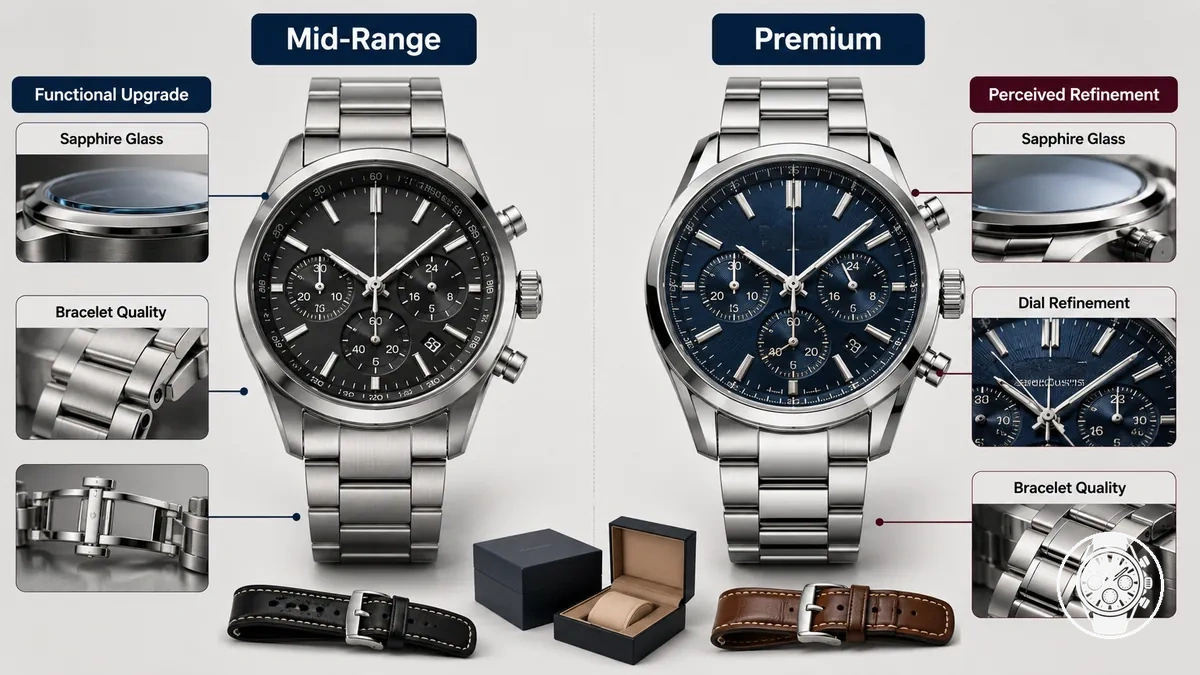
| Functional improvement | Perceived refinement |
|---|---|
| Sapphire glass: Both reviewed A$620 Chrono XL and A$855 PR516 examples use sapphire glass; Tissot Australia specifies an antireflective coating on the underside of the PR516 crystal. The functional difference in this comparison is therefore the coating specification, not a change from mineral to sapphire glass. | Dial refinement: Dial colour, index treatment, layout and finishing can contribute to perceived value, but Tissot Australia's reviewed specifications provide no numerical scale for dial refinement. Compare these details visually rather than treating refinement as a measured performance advantage. |
| Stainless steel and bracelet quality: Both cited models use 316L stainless steel cases. Tissot Australia specifies the A$855 PR516 bracelet as stainless steel with a safety-lock folding clasp, push-buttons and a quick-release system, providing explicit construction criteria for assessing bracelet quality. | Leather strap: Tissot Australia specifies an adjustable leather strap on the A$620 Chrono XL Vintage. Because leather is present at the A$620 price point, its contribution to perceived value should be judged through the specific strap construction and finish rather than the material name alone. |
| Movement reliability signals: Tissot Australia specifies a Renata 394 battery and an end-of-life indicator for the reviewed Chrono XL Classic and PR516 quartz chronographs. The reviewed manufacturer specifications provide no comparative failure-rate or service-life figure showing that the A$855 PR516 movement is more reliable, so movement reliability cannot be ranked from these prices alone. | Packaging: Packaging can affect presentation and gifting value, but the reviewed Tissot Australia product specifications do not provide a comparable packaging grade, material specification or measured durability benefit for these two models. Packaging therefore remains a perceived-value contributor unless the specific watch includes documented packaging features that matter to the intended use. |
For these two sourced examples, paying A$235 more changes identifiable details such as the PR516's antireflective crystal coating and bracelet construction, while both watches already provide sapphire glass, a 316L stainless steel case and 100 m/10 bar water resistance. Value for money therefore depends on whether those additional functional details, dial refinement or packaging provide a useful ownership benefit rather than on the premium label itself.
What Makes a Quartz Chronograph More Expensive
A quartz chronograph can have a higher price point when its cost drivers include a different movement module or greater chronograph complexity, different case construction and crystal, a more developed strap or bracelet, additional finishing, a different water resistance specification, design refinement, or included accessories. These attributes can affect price, but no reviewed manufacturer source assigns a universal monetary increase to any one cost driver, so the value-for-money decision is conditional on whether the changed attribute benefits the intended use.
Current Australian manufacturer examples show how multiple attributes can change together.
Current Australian manufacturer examples show how multiple attributes can change together. Citizen Watches Australia specifies the AN8168-51H at A$299 with calibre 0520 quartz movement, 1-second chronograph measurement to 60 minutes, stainless-steel case and bracelet, mineral crystal and WR50/5 bar water resistance; Tissot Australia specifies the PR516 quartz chronograph at A$855 with calibre G10.212, 30-minute and 1/10-second counters, ADD and SPLIT functions, a 40 mm 316L stainless-steel case, sapphire crystal with antireflective coating, stainless-steel bracelet and 100 m/10 bar water resistance. The calculated A$556 price difference covers the complete configurations and cannot be attributed to the movement module, chronograph complexity, crystal, case construction, finishing, strap or bracelet, or water resistance individually.
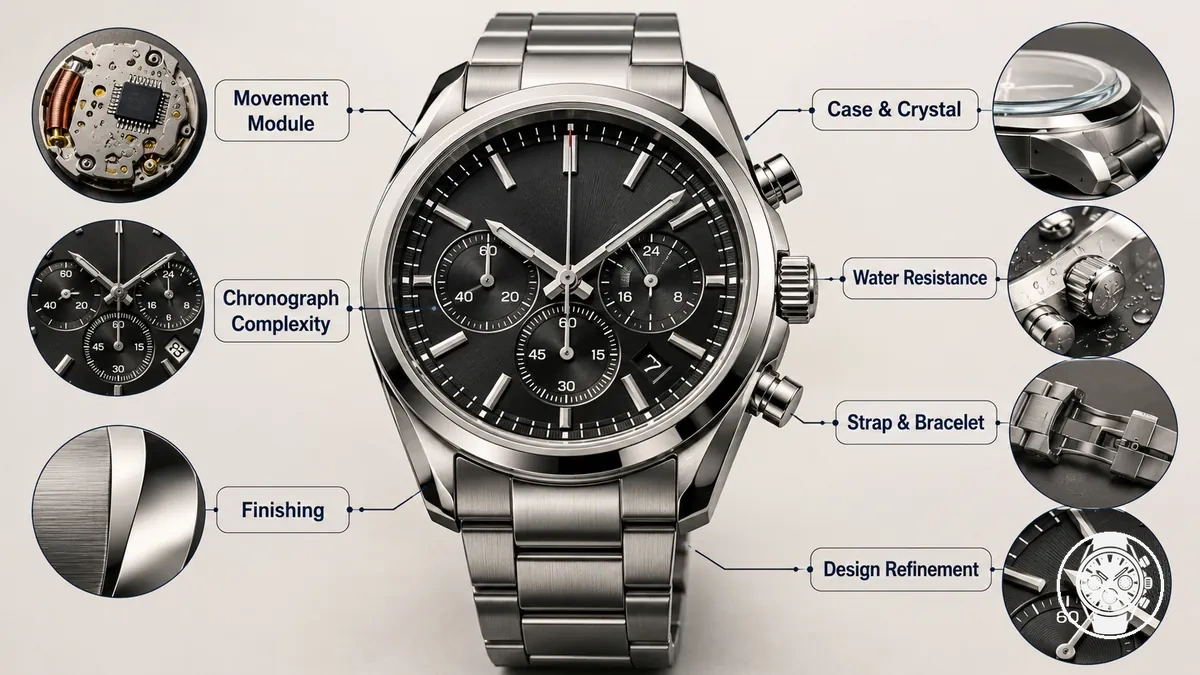
For movement-related criteria, compare the chronograph functions and movement and battery expectations that the wearer will use rather than treating a different movement module as sufficient evidence of greater ownership value. The same rule applies to case construction, crystal, finishing and strap or bracelet construction: Tissot Australia specifies its A$700 Chrono XL Classic with a 45 mm 316L stainless-steel case, sapphire crystal and 100 m/10 bar water resistance, while its A$855 PR516 has a 40 mm 316L stainless-steel case, sapphire crystal with antireflective coating, 100 m/10 bar water resistance and an interchangeable bracelet with a safety-lock folding clasp and push-buttons. The calculated A$155 difference compares the complete feature sets rather than the price effect of one component, so a cost driver is worth paying for only when its specific condition or function matters to the wearer.
The calculated A$155 difference compares the complete feature sets rather than the price effect of one component, so a cost driver is worth paying for only when its specific condition or function matters to the wearer.
The main cost-driver families can therefore be separated before making the value judgment:
- Movement module and chronograph complexity: Compare explicit functions such as timing capacity, counter resolution, ADD or SPLIT operation and battery-status features. Citizen Watches Australia specifies a 60-minute, 1-second chronograph on the A$299 AN8168-51H, while Tissot Australia specifies 30-minute and 1/10-second counters plus ADD and SPLIT functions on the A$855 PR516; the sources do not isolate a monetary price effect for any individual function.
- Case construction and crystal: Compare the stated case material, dimensions, coatings and crystal specification. The cited Citizen uses stainless steel and mineral crystal, while the cited Tissot PR516 uses a 40 mm 316L stainless-steel case and sapphire crystal with antireflective coating; these are explicit configuration differences, but the reviewed sources do not quantify an individual manufacturing-cost or durability difference between them.
- Strap or bracelet and finishing: Compare material, clasp construction, interchangeability and stated surface treatment. Tissot Australia specifies the A$855 PR516 with an interchangeable stainless-steel bracelet, safety-lock folding clasp and push-buttons, giving concrete construction attributes to compare; the reviewed source does not assign a separate price amount to those bracelet features.
- Water resistance: Compare a stated pressure rating rather than relying on an unqualified water-resistance description. Citizen Watches Australia specifies WR50/5 bar for the A$299 AN8168-51H, while Tissot Australia specifies 100 m/10 bar for the cited A$700 Chrono XL Classic and A$855 PR516; the higher stated rating is relevant when the intended water exposure requires that specification, but its individual contribution to price is not stated.
- Design refinement and included accessories: Dial treatment, case detailing, interchangeable components and presentation accessories can contribute to perceived value when they are specified for the model. The reviewed manufacturer evidence does not provide a separate monetary value for design refinement or accessories, so these attributes should be assessed model by model rather than treated as proof that a higher-priced quartz chronograph provides greater functional value.
Movement Type and Chronograph Complexity
A quartz movement provides electronic timekeeping, while the chronograph module adds elapsed-time functions; within this cost-driver frame, the relevant value is the module's specified timing functions rather than mechanical complexity. Citizen Watches Australia specifies calibre 0520 with 1-second chronograph measurement up to 60 minutes for the AN8168-51H, while Tissot Australia specifies the G10.212 in the PR516 with a 30-minute counter, 1/10-second counter, central 60-second chronograph hand, ADD and SPLIT functions. These different configurations can affect the feature set and price point, but neither manufacturer assigns a separate monetary value to chronograph-module complexity.
The movement attributes therefore need model-level comparison rather than a complexity ranking.
The movement attributes therefore need model-level comparison rather than a complexity ranking. Tissot Australia specifies the PR516 G10.212 with a Renata 394 battery, a 1.55 V battery specification on reviewed variants, and an end-of-life indicator, while Citizen Watches Australia identifies calibre 0520 as quartz and specifies its chronograph capacity separately. For detailed movement and battery expectations, the relevant specifications should remain tied to the individual movement because the reviewed manufacturer pages do not provide comparable numerical timekeeping-accuracy tolerances for these two models. This leaves accuracy as an evidence limitation in this price comparison rather than a supported basis for ranking their ownership cost.
This leaves accuracy as an evidence limitation in this price comparison rather than a supported basis for ranking their ownership cost.
The movement-related differences can be separated into four attributes:
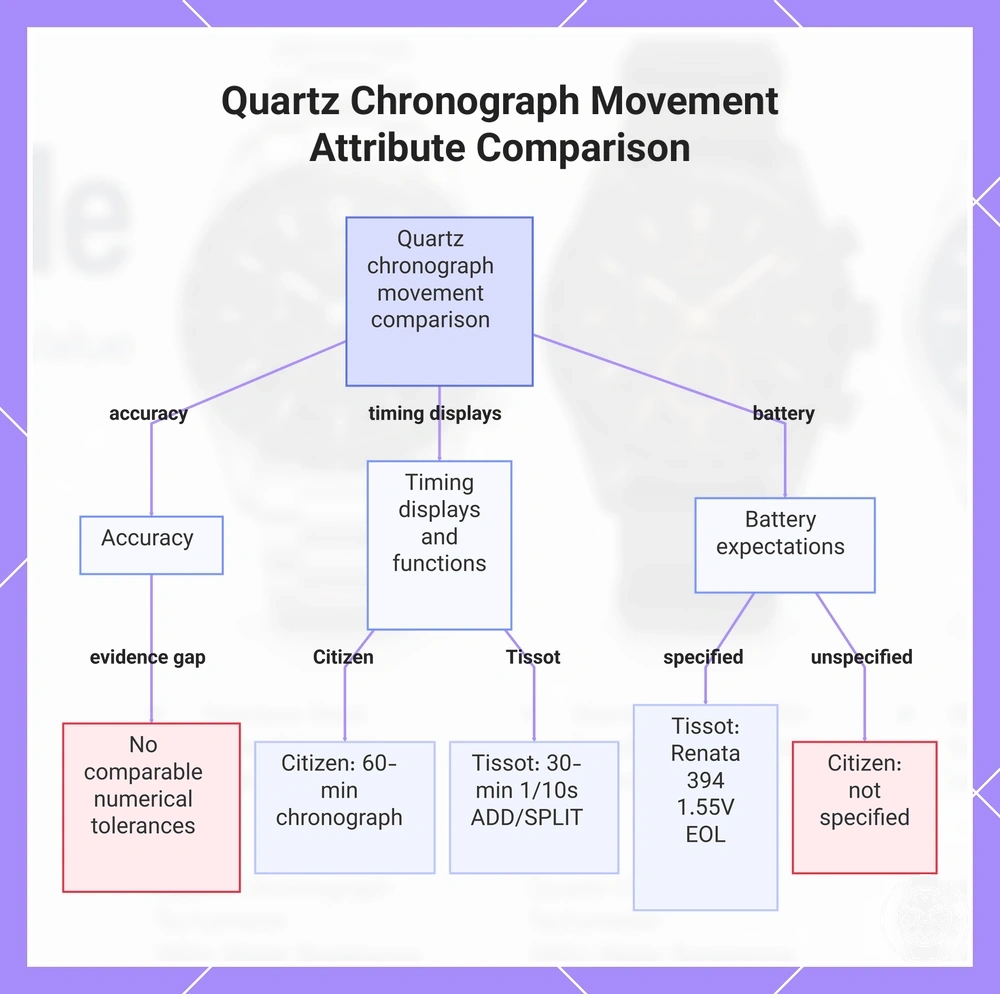
- Accuracy: Both cited models use a quartz movement, but the reviewed Citizen Watches Australia and Tissot Australia specifications do not state comparable numerical timekeeping tolerances. A numerical accuracy advantage, and any corresponding price implication, therefore remains unspecified by these sources.
- Subdial layout: Citizen Watches Australia specifies the calibre 0520 as a multi-dial chronograph measuring up to 60 minutes, while Tissot Australia specifies 30-minute and 1/10-second counters for the G10.212. The layouts support different displayed timing information, but neither manufacturer isolates a price amount for an additional counter.
- Battery expectations: Tissot Australia specifies a Renata 394 battery, 1.55 V on reviewed PR516 variants, and an end-of-life indicator for the G10.212. A directly comparable battery-duration value is not stated across the reviewed specifications, so a numerical ownership cost difference cannot be established from these sources.
- Stopwatch function: Citizen Watches Australia specifies 1-second measurement up to 60 minutes for the AN8168-51H; Tissot's G10.212 documentation specifies measurement up to 30 minutes with standard, ADD and SPLIT functions, while the PR516 specification also identifies a 1/10-second counter. The additional timing modes expand the available stopwatch function, but the reviewed sources do not quantify a separate retail-price or ownership-cost premium for them.
Quartz chronographs are valued in this comparison for electronic accuracy, convenience and a battery-powered ownership model rather than the mechanical complexity of a mechanical chronograph. Greater chronograph-module complexity can justify a price difference when the added timing displays or functions are useful to the wearer, but the reviewed manufacturer evidence does not establish a universal price premium or ownership cost for adding those functions.
This chart compares the key movement attributes of the Citizen AN8168-51H and Tissot PR516 quartz chronographs, highlighting evidence limitations for cost comparison.
This chart compares the key movement attributes of the Citizen AN8168-51H and Tissot PR516 quartz chronographs, highlighting evidence limitations for cost comparison.
Case Materials, Crystal, Strap, and Finishing
Case materials, crystal, strap, and finishing affect a quartz chronograph's price and perceived value through identifiable material and construction differences, but a material name alone does not establish greater value for money. A meaningful material upgrade changes an ownership-relevant condition, such as crystal material, case construction, bracelet attachment, or clasp design, while a cosmetic upgrade changes appearance without a documented functional improvement.
The table compares material and finish signals by durability-related specification, appearance, comfort or fit condition, and likely value effect.
The table compares material and finish signals by durability-related specification, appearance, comfort or fit condition, and likely value effect. For a numerical example, Tissot Australia lists the 40 mm PR516 T1494171105100 at A$855 with a 316L stainless steel case, sapphire glass with an antireflective coating, and a stainless steel bracelet, while the 40 mm PR516 T1494172205101 is listed at A$930 with a PVD-coated 316L stainless steel case and PVD-coated stainless steel bracelet; the calculated A$75 difference applies to the complete configurations and is not a manufacturer-stated price for PVD finishing alone.
| Entity/part | Attribute/criterion | Value/condition | Effect/risk/decision |
|---|---|---|---|
| Case | Case material | Stainless steel: Tissot Australia specifies 316L stainless steel for the A$855 PR516. Plated alloy: the reviewed evidence does not establish one base alloy, plating material, coating thickness, or wear-life specification that applies across quartz chronographs. | Stainless steel provides an explicit case material for comparison. For a plated alloy case, verify both the base material and plating specification; without those values, its long-term wear characteristics and value effect remain unspecified. |
| Crystal | Crystal material | Mineral glass: Citizen Watches Australia specifies mineral crystal for the A$299 AN8168-51H. Sapphire glass: Tissot Australia specifies sapphire crystal with an antireflective coating on the underside for the A$855 PR516. | Mineral glass and sapphire glass are documented material alternatives, but the cited manufacturer specifications do not provide comparable scratch-test results or service-life measurements for these two watches. Sapphire is therefore a material change that can be valued explicitly without treating it as a quantified universal longevity advantage. |
| Strap | Leather construction and fit | Leather strap: Tissot specifies a PR516 configuration with embossed cow leather on the front, synthetic material on the back, 120 mm and 80 mm strap sections, and a standard buckle; this specification belongs to a 38 mm automatic PR516 configuration rather than the cited 40 mm quartz PR516. | A leather strap changes material, appearance, and fit conditions, but the cited manufacturer data provides no numerical comfort or wear-life result. For a quartz chronograph, verify the specific strap construction and dimensions rather than treating leather alone as a functional upgrade. |
| Bracelet | Material and attachment | Stainless steel bracelet: Tissot Australia specifies a stainless steel interchangeable quick-release bracelet for the A$855 PR516; the A$930 configuration specifies a stainless steel bracelet with PVD coating. | Bracelet material, coating, and attachment are separate decision attributes. A quick-release system provides a specified ownership function when strap changes matter, whereas a coating primarily changes the material finish unless the manufacturer documents another functional effect. |
| Finishing | Surface treatment and consistency | Uncoated versus PVD-coated steel: Tissot Australia specifies 316L stainless steel on the A$855 PR516 and PVD-coated 316L stainless steel on the A$930 PR516; the reviewed specifications do not state coating thickness, comparative wear-life data, or a numerical finishing-consistency measure. | PVD treatment is a documented finish difference, but the available specifications do not quantify a durability advantage between these configurations. Finishing consistency should therefore be assessed separately from colour treatment, and the calculated A$75 price difference should not be attributed solely to PVD coating. |
| Clasp or buckle | Closure construction | Bracelet clasp: Tissot Australia specifies a folding clasp with safety lock and push-buttons for the cited PR516 bracelet configuration. Leather buckle: Tissot specifies a standard buckle for the cited leather PR516 configuration. | Closure construction is a meaningful criterion when retention, adjustment, or ease of removal matters. The reviewed manufacturer specifications provide no comparable numerical retention-force, comfort, or service-life measurement for these closures, so clasp or buckle quality cannot be ranked from price alone. |
The price-value decision is therefore to separate documented material or construction changes from appearance-led finishing: sapphire glass, an identified case material, a defined bracelet attachment system, or a specified clasp provides a concrete attribute to compare, while plating colour and decorative finishing primarily contribute to perceived value when no measurable functional difference is documented.
Quality Signals That Support Better Value
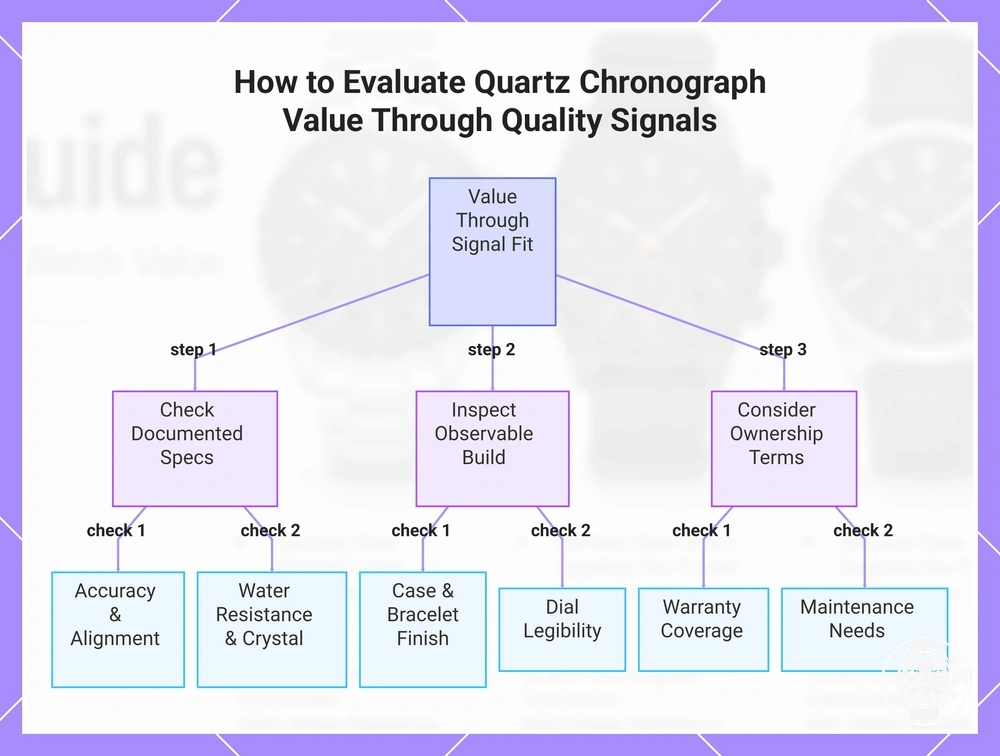
Quality signals support better value in a quartz chronograph when accuracy, alignment, case finishing, crystal, water resistance, dial legibility, warranty, and maintenance conditions collectively match the intended use; no single feature proves overall quality. The value decision should therefore compare the watch's documented specifications and observable construction with the conditions in which it will be worn.
A criteria check also helps judge whether quartz chronographs are good for a particular ownership condition.
A criteria check also helps judge whether quartz chronographs are good for a particular ownership condition. Tissot Australia specifies the PR516 T1494171105100 with a 40 mm 316L stainless-steel case, sapphire crystal with an antireflective coating, 10 bar (100 m/330 ft) water resistance, a two-year warranty, and a quartz chronograph with 30-minute and 1/10-second counters; these are model-specific reference values rather than universal thresholds for quartz chronograph quality.
- Accuracy and chronograph alignment: Treat accuracy as a verifiable quality signal when the manufacturer states a movement-specific tolerance; Tissot Australia's reviewed specification for the PR516 T1494171105100 does not state a numerical timekeeping tolerance, so an accuracy threshold for this model remains unspecified. For alignment, the chronograph indications should return to their designated zero positions after reset; where no manufacturer tolerance in degrees or marker deviation is published, visible alignment should be checked on the individual watch rather than assigned an invented numerical limit.
- Case finishing and bracelet or strap quality: Evaluate surface consistency, edges, attachment points, links, and closure construction under normal handling. Tissot Australia specifies the cited PR516 with a 316L stainless-steel case, interchangeable quick-release stainless-steel bracelet, and folding clasp with safety lock and push-buttons, but publishes no numerical finishing-consistency or bracelet-comfort threshold; those conditions therefore require model-level inspection.
- Crystal: Use the stated crystal material and treatment as the value criterion rather than assuming that crystal choice determines the whole watch's quality. Tissot Australia specifies sapphire crystal with an antireflective coating on the underside for the cited PR516, providing a defined material-and-coating condition to compare with the price point.
- Water resistance: Match a stated pressure rating to the expected exposure and maintenance condition. Tissot Australia specifies 10 bar (100 m/330 ft) water resistance for the cited PR516 and advises having water resistance checked once a year because seals can be affected by ageing or accidental shock; the rating therefore remains more useful when its maintenance condition is also considered.
- Dial legibility: Check whether the normal time display and chronograph indications remain distinguishable in the lighting conditions in which the watch will be used. Tissot Australia specifies Super-LumiNova on visible components of the reviewed PR516, but the reviewed model information provides no numerical luminance, readable-distance, or illumination-duration threshold, so low-light legibility remains an individual-use inspection rather than a quantified manufacturer claim.
- Warranty: Read both duration and exclusions before treating warranty coverage as a value signal. Tissot's Australian warranty provides 24 months of coverage from the purchase date for covered material and manufacturing defects and excludes battery life, normal wear and ageing, and specified accidental or improper-use damage, so the practical value is the defined coverage rather than the duration alone.
- Maintenance: A battery-powered quartz chronograph still has model-specific maintenance requirements. Tissot specifies a Renata 394 battery and an end-of-life indicator for the cited PR516 and recommends prompt replacement of an exhausted battery to reduce leakage risk; combined with its annual water-resistance-check guidance, this gives two identifiable ownership conditions to consider rather than treating quartz maintenance as zero.
A quartz chronograph therefore supports better value when the combined quality signals fit the use case: regular water exposure increases the relevance of the 10 bar rating and annual water-resistance check in this example, while frequent chronograph use increases the importance of alignment, dial legibility, and clear timing indications. Specification count alone does not resolve the value decision when the documented conditions do not match how the watch will be used.
Specification count alone does not resolve the value decision when the documented conditions do not match how the watch will be used.
This chart outlines three evaluation steps—checking documented specs, inspecting observable build, and considering ownership terms—to determine if a quartz chronograph's quality signals support better value for a specific use case.
Accuracy, Battery, and Low-Maintenance Ownership
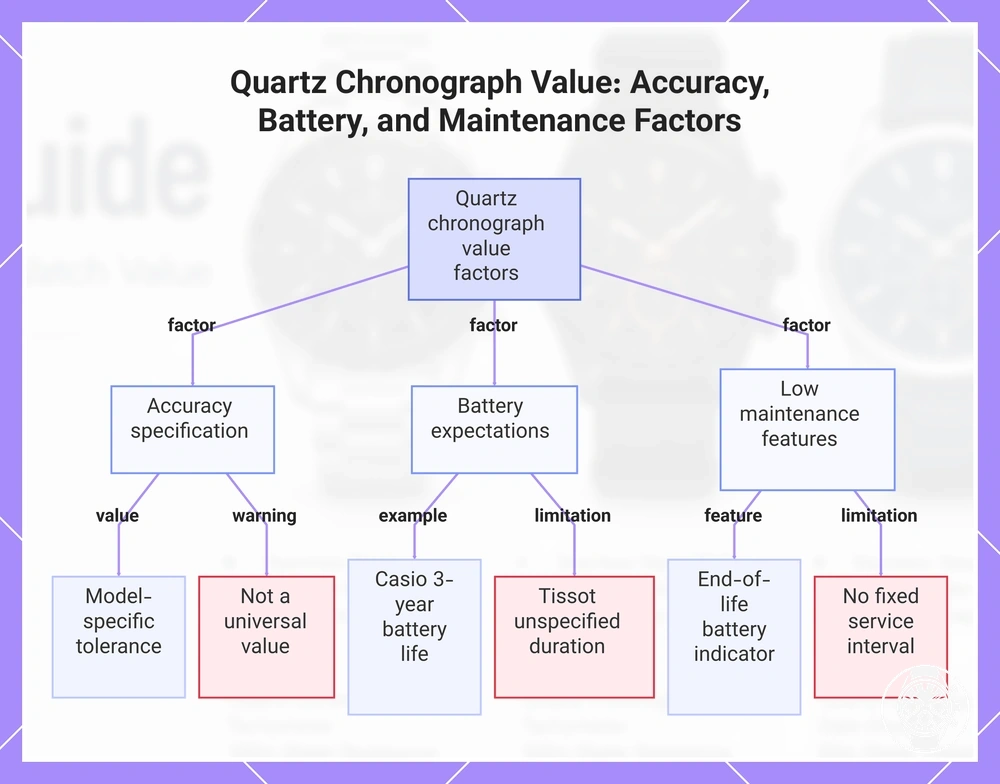
Accuracy, battery expectations, and low maintenance contribute to quartz chronograph value when the quartz movement provides predictable timekeeping and its battery and service needs suit the intended ownership pattern. Casio specifies the EFR-571D-1AV quartz chronograph at ±20 seconds per month, providing a model-specific accuracy value rather than a universal tolerance for quartz chronographs.
Battery expectations also need to remain model-specific because movement and design determine the manufacturer's stated battery specification.
Battery expectations also need to remain model-specific because movement and design determine the manufacturer's stated battery specification. In a usage comparison, Casio specifies approximately 3 years of battery life on an SR920SW battery for the EFR-571D-1AV, while Tissot Australia specifies a Renata 394 battery and an end-of-life indicator for the PR516 T1494171105100 but does not state a battery-life duration or numerical accuracy tolerance on the reviewed Australian product page. The relevant movement and battery expectations should therefore be checked for the individual model rather than applying Casio's 3-year duration or ±20-seconds-per-month tolerance to another quartz chronograph. The reviewed manufacturer specifications also do not quantify how chronograph usage frequency changes battery duration for these two models, so that ownership effect remains unspecified rather than supporting a numerical adjustment.
- Accuracy: Casio specifies ±20 seconds per month for the EFR-571D-1AV, giving its timekeeping accuracy a measurable model-specific boundary.
- Battery expectations: Casio specifies approximately 3 years on an SR920SW battery for the EFR-571D-1AV; Tissot Australia identifies a Renata 394 battery for the cited PR516 but does not state a comparable battery duration on the reviewed product specification.
- Usage frequency: The reviewed Casio and Tissot specifications do not provide a numerical relationship between chronograph usage frequency and battery duration for these models, so the effect should not be assigned an unsupported percentage or service interval.
- Low maintenance: Tissot Australia's PR516 specification includes an end-of-life battery indicator, providing a defined battery-status feature, but it does not state a fixed battery service interval for that model.
For value for money, published accuracy and battery values reduce uncertainty about day-to-day ownership, while an unspecified value should remain an evidence limitation rather than an assumed disadvantage. A quartz chronograph therefore provides clearer ownership expectations when its documented accuracy, battery expectations, usage conditions, and service needs match the wearer's intended use.
A quartz chronograph therefore provides clearer ownership expectations when its documented accuracy, battery expectations, usage conditions, and service needs match the wearer's intended use.
This chart shows the key factors that determine quartz chronograph ownership value, emphasizing that accuracy and battery specifications are model-specific and should be checked individually.
Build Details That Justify a Higher Price
Build details can make a higher quartz chronograph price easier to justify when multiple checkable conditions improve together, rather than when one decorative feature changes in isolation. The relevant conditions are case finishing, bracelet articulation, clasp security, strap stitching, crown and pusher feel, crystal specification, dial alignment, and water resistance confidence; appearance alone does not provide a measured durability value.
Build details can make a higher quartz chronograph price easier to justify when multiple checkable conditions improve together, rather than when one decorative feature changes in isolation.
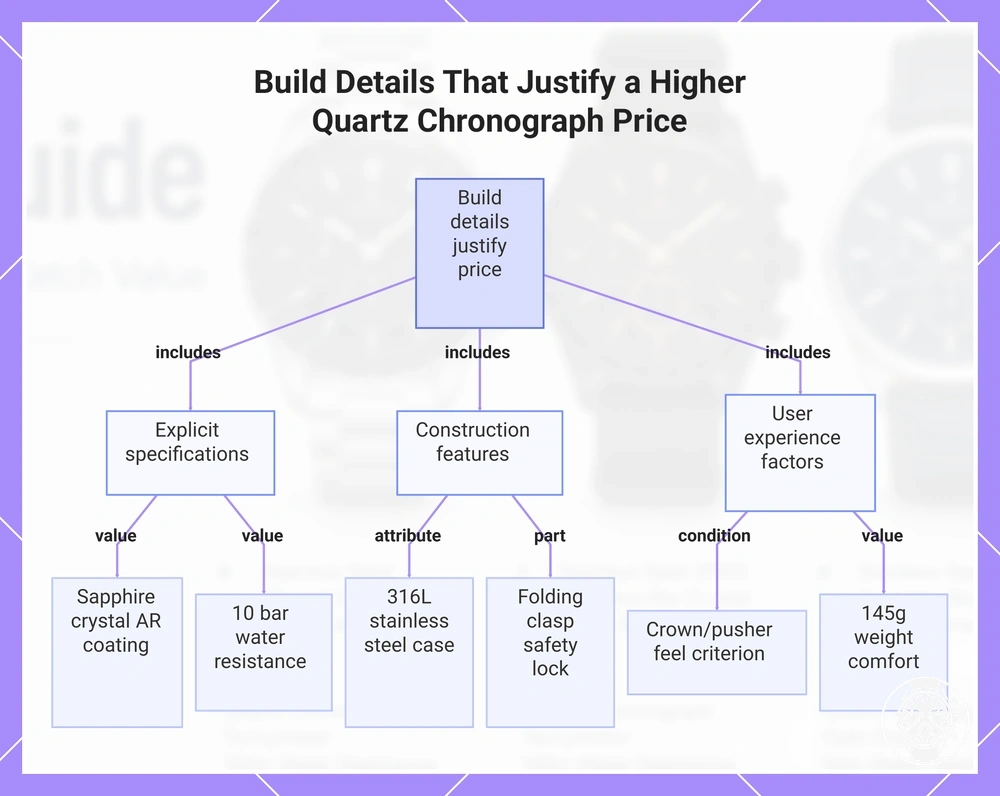
Tissot specifies the PR516 T1494171105100 with a 40 mm 316L stainless-steel case, sapphire crystal with an antireflective coating, an interchangeable quick-release stainless-steel bracelet, a folding clasp with safety lock and push-buttons, 10 bar (100 m/330 ft) water resistance, and a weight of 145 g. This configuration provides a sourced example of several build details occurring together, while Tissot does not assign a separate monetary value to the case finish, bracelet, clasp, crystal, or water-resistance specification; the contribution of each individual detail to the price therefore remains unspecified.
- Case finishing: Verify the stated case material and surface treatment separately from visual refinement. For the cited PR516, Tissot specifies 316L stainless steel; it does not publish a numerical surface-finish tolerance or a durability value attributable to appearance, so case finishing supports price justification as a construction and perceived-value condition rather than proof of longer service life.
- Bracelet articulation and clasp security: Bracelet articulation has a positive value implication when the links conform comfortably to the wearer's wrist, but Tissot publishes no articulation-angle or flexibility measurement for the cited PR516. Tissot does specify an interchangeable quick-release stainless-steel bracelet and a folding clasp with safety lock and push-buttons, giving clasp security a defined construction condition even though no clasp-retention force is stated.
- Strap stitching: For a stitched leather or textile strap, consistent stitching and secured edges are relevant finish conditions; for the cited bracelet-equipped PR516, strap stitching is not applicable. Where a quartz chronograph uses a stitched strap, the reviewed evidence provides no universal stitch count, spacing tolerance, or service-life threshold that would independently justify a higher price.
- Crown and pusher feel: Crown and pusher feel has value when operation is positive and usable for the wearer, but the reviewed Tissot specification provides no actuation-force, travel-distance, or tactile-feedback measurement for the PR516 chronograph pushers. Pusher feel should therefore remain a handling criterion, not an inferred durability rating.
- Crystal upgrade and dial alignment: Tissot specifies sapphire crystal with an antireflective coating for the cited PR516, providing an explicit material-and-treatment value for comparison. Tissot does not publish a numerical dial-index or chronograph-hand alignment tolerance for this model, so dial alignment remains a visible model-level condition rather than a quantified acceptable deviation.
- Water resistance confidence: Tissot specifies 10 bar (100 m/330 ft) water resistance for the cited PR516, giving this build detail a measurable model-specific value. A stated pressure rating provides a clearer basis for the price-value decision than judging water resistance from case thickness, crown appearance, or perceived solidity.
Comfort or use case can outweigh premium finishing in the final decision: Tissot specifies the cited 40 mm PR516 at 145 g, so that measurable weight may matter more to a wearer who prioritises a lighter wrist feel than decorative surface treatment or additional bracelet detailing. Build details justify the higher price most clearly when their documented construction, tactile conditions, fit, and intended use provide value that the wearer will actually use.
This chart shows the key build detail categories that together justify a higher price, using the Tissot PR516 as an example.
This chart shows the key build detail categories that together justify a higher price, using the Tissot PR516 as an example.
Budget Versus Premium Quartz Chronograph Trade-Offs
A budget quartz chronograph trades saved cost for possible feature or finish compromise, while a premium quartz chronograph adds cost for material gain, construction detail, or refinement; neither price position establishes better value by itself. The buyer-fit condition is whether the saved cost or added specification changes daily use, formal wear, gifting, or long-term ownership in a way that matters to the wearer.
| Trade-off | Budget versus premium decision |
|---|---|
| Saved cost versus added cost | Budget: Citizen Watches Australia lists the AN8168-51H at A$299, so it saves a calculated A$556 against the A$855 Tissot PR516 T1494171105100. Premium: Tissot Australia lists that PR516 at A$855; the additional A$556 applies to the complete watch configuration and cannot be attributed to one component alone. |
| Material gain and finish compromise | Budget: Citizen Watches Australia specifies stainless-steel construction, mineral crystal and WR50/5 bar water resistance for the AN8168-51H, making the finish compromise acceptable when those stated conditions meet the use case. Premium: Tissot Australia specifies a 40 mm 316L stainless-steel case, sapphire crystal with an antireflective coating, an interchangeable quick-release stainless-steel bracelet and 10 bar (100 m/330 ft) water resistance for the cited PR516; these are explicit material and construction gains rather than proof that the watch is universally better. |
| Daily-use buyer-fit condition | Budget: The lower-cost option remains a rational value-for-money choice when its crystal, water resistance, chronograph functions and fit satisfy routine wear. Premium: The higher-cost option has a clearer practical case when attributes such as sapphire crystal, bracelet construction or the 10 bar water-resistance specification solve an ownership requirement that the budget configuration does not. |
| Formal wear or gifting | Budget: A lower price does not make a quartz chronograph unsuitable for formal wear or gifting when its appearance, fit and construction meet the recipient's requirements. Premium: Material refinement and more developed finishing can add perceived value in these scenarios, but the reviewed manufacturer specifications provide no numerical threshold at which presentation or refinement alone justifies the additional cost. |
| Long-term ownership | Budget: The saved cost becomes a poor trade-off when an ownership-critical requirement exceeds the model's documented specification, such as needing water resistance beyond WR50/5 bar. Premium: The added cost becomes a weak trade-off when the additional material or refinement does not change the wearer's intended conditions, so long-term ownership value remains use-case dependent rather than price dependent. |
The sourced comparison shows the trade-off numerically: Citizen Watches Australia specifies the A$299 AN8168-51H with mineral crystal and WR50/5 bar water resistance, while Tissot Australia specifies the A$855 PR516 T1494171105100 with sapphire crystal with an antireflective coating and 10 bar (100 m/330 ft) water resistance. The calculated A$556 difference buys a different overall feature set, but neither manufacturer assigns that difference specifically to the crystal, water resistance, bracelet, finishing, or another single attribute.
The relevant trade-off is therefore saved cost versus usable improvement, not budget versus premium as fixed quality categories.
For daily use, the budget watch can be the better buyer-fit condition when its documented limits already match the wearer's routine; for formal wear, gifting, or long-term ownership, the premium watch can justify its added cost when its material gain or refinement has a specific practical or presentation value. The relevant trade-off is therefore saved cost versus usable improvement, not budget versus premium as fixed quality categories.
After defining those conditions, use the same fit, function, material, and ownership priorities to assess how to choose rather than selecting a quartz chronograph from its price position alone.
After defining those conditions, use the same fit, function, material, and ownership priorities to assess how to choose rather than selecting a quartz chronograph from its price position alone.
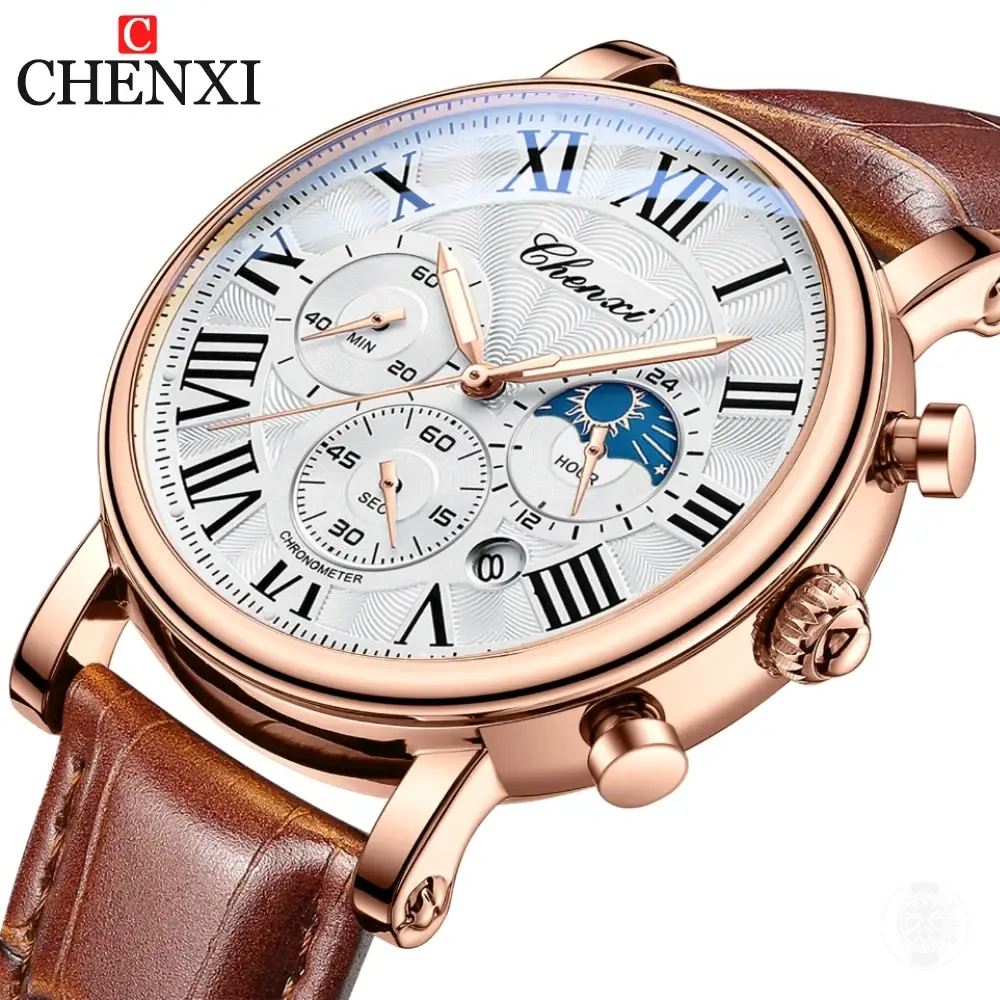
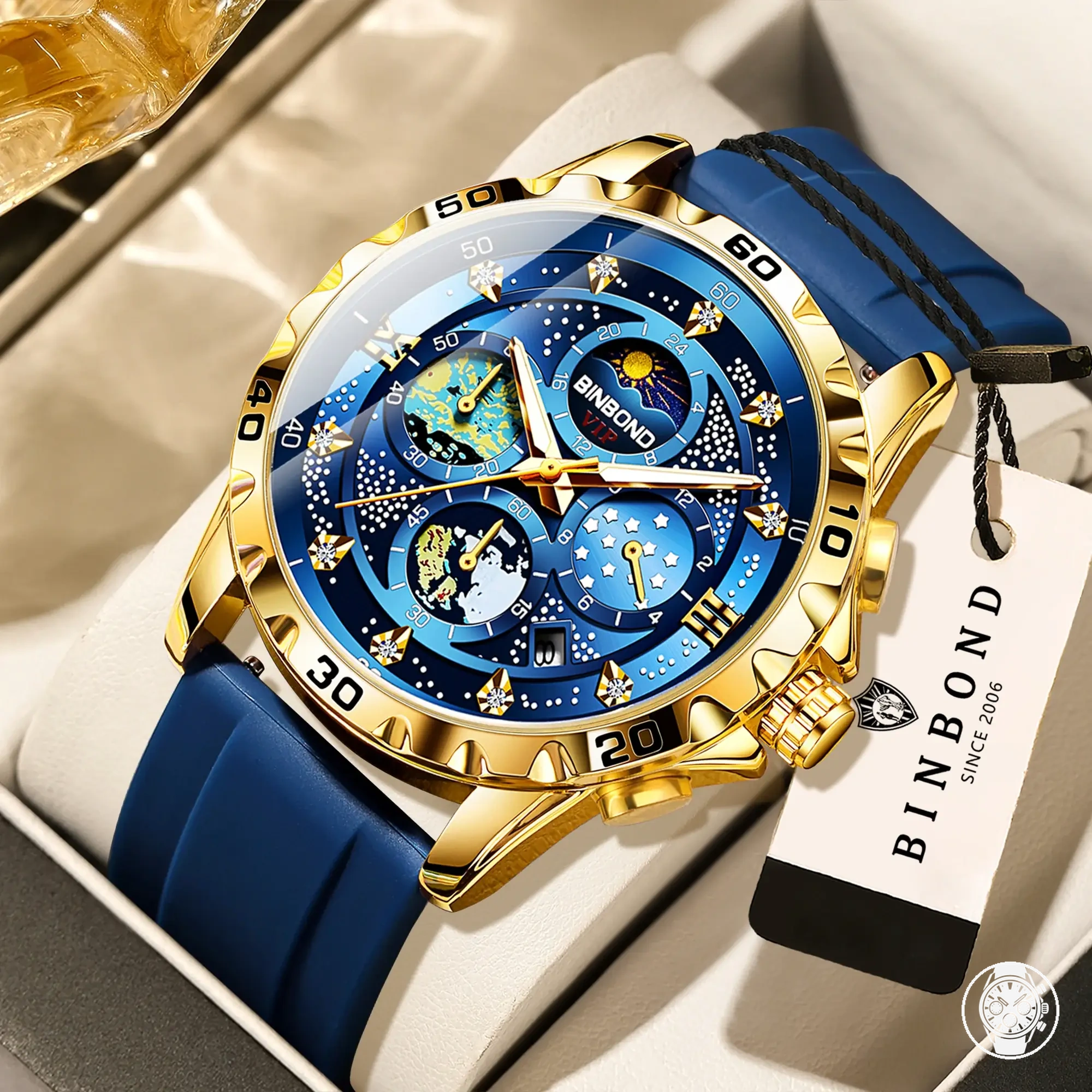
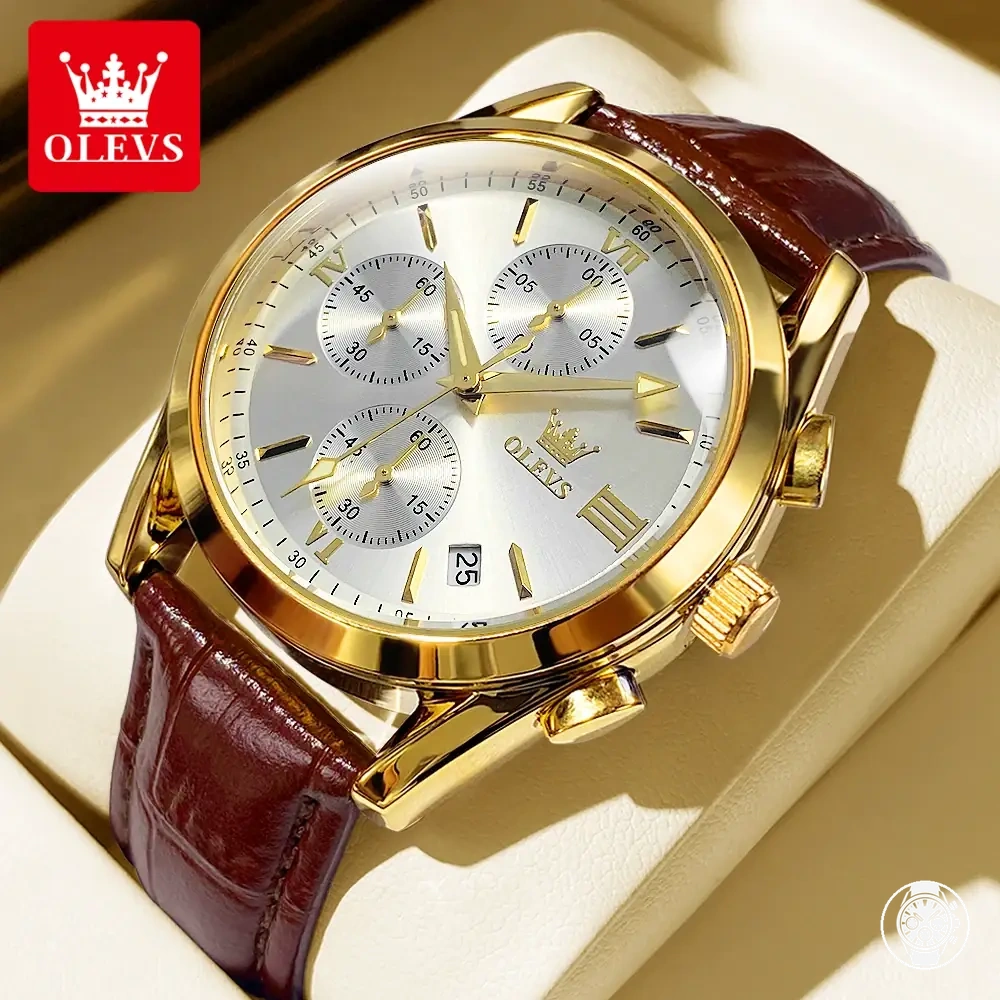
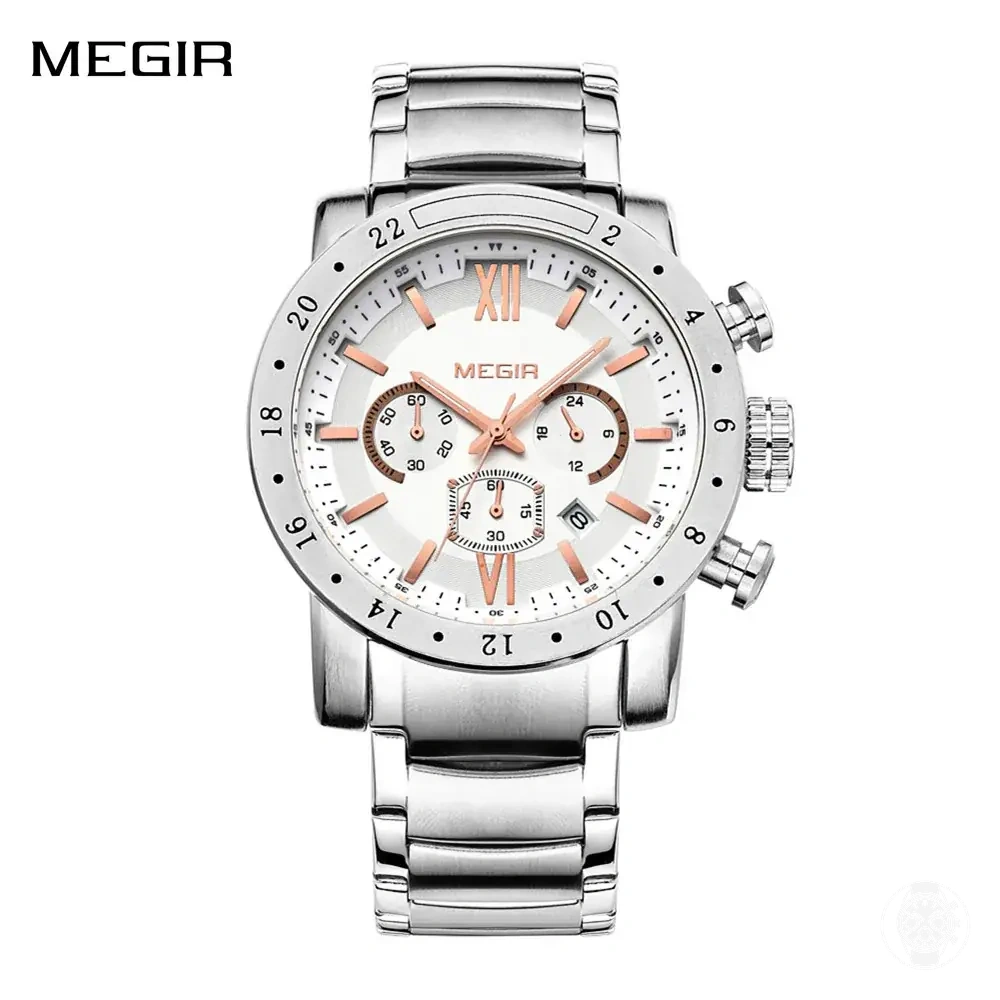
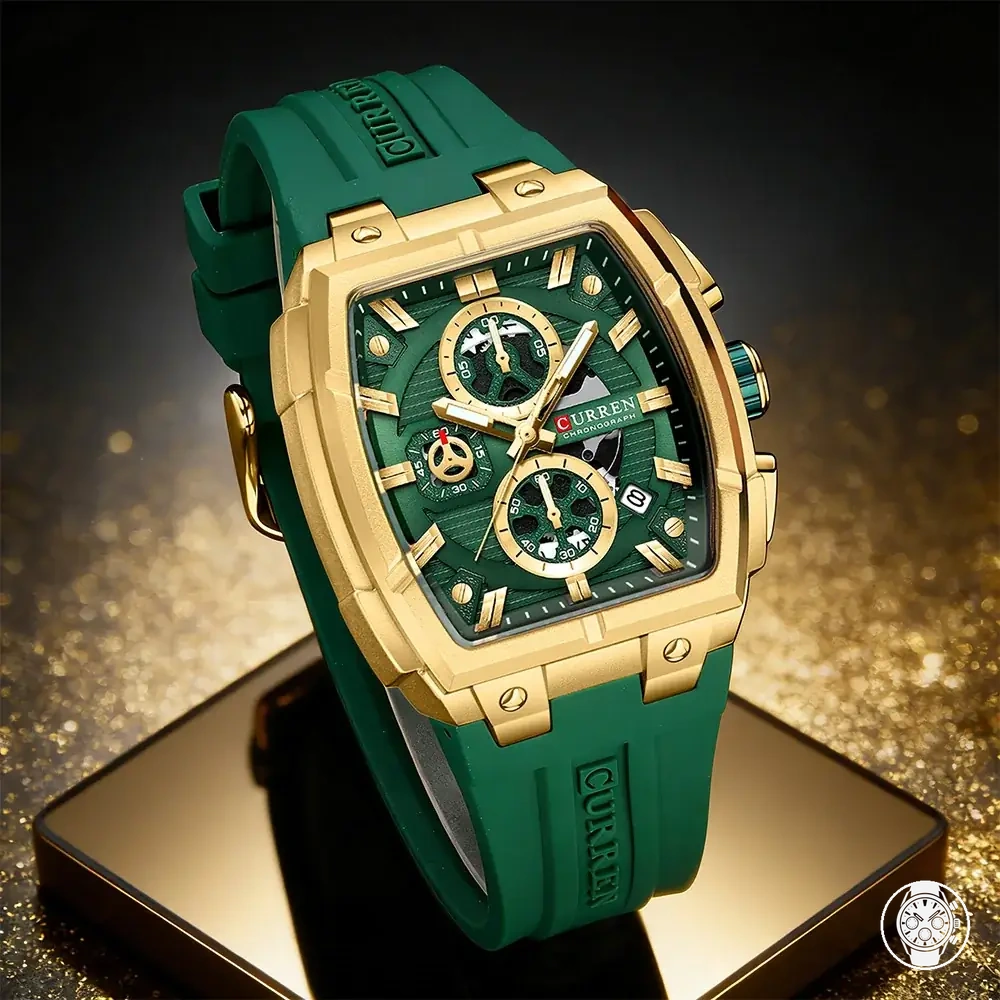
The products below are useful examples for comparing available options.
The products below are useful examples for comparing available options. Before buying, check that the compatibility criteria, key features, and product details match your needs.
When an Affordable Quartz Chronograph Is Enough
An affordable quartz chronograph is enough when its acceptable specification matches bounded buyer needs such as casual wear, a first chronograph, a gift budget, simple stopwatch needs, basic water resistance, and a comfortable strap or bracelet. Low price remains a value-for-money decision only when the model's timing capacity, water-resistance rating, dimensions, material, and fit cover the intended use rather than requiring features the buyer will miss.
These are model-specific values that show one affordable feature set; they are not minimum specifications that every affordable quartz chronograph must meet.
For a numerical reference, Citizen Watches Australia lists the AN8168-51H at A$299 and specifies a 44 mm stainless-steel case, stainless-steel bracelet with push-button clasp, mineral crystal, WR50/5 bar water resistance for still-water swimming, a 2-year battery-life specification, and a 1-second chronograph measuring up to 60 minutes. These are model-specific values that show one affordable feature set; they are not minimum specifications that every affordable quartz chronograph must meet.
The price fit is clearer when each buyer need is connected to a usable condition:
- Casual wear: An affordable quartz chronograph can fit casual wear when its material, finish, durability conditions, and dimensions suit routine use. In the A$299 Citizen example, the stated conditions are a 44 mm stainless-steel case, mineral crystal, stainless-steel bracelet, and WR50/5 bar water resistance; the practical decision is whether those specifications match the wearer's expected environment and wrist fit.
- First chronograph: A first chronograph can be sufficient when the buyer needs basic elapsed-time measurement rather than specialised timing functions. Citizen Watches Australia specifies 1-second measurement up to 60 minutes for the AN8168-51H, so a required timing session of 30 minutes falls within that model's stated capacity.
- Gift budget: A gift budget can favour an affordable quartz chronograph when the recipient's required feature set is already present at the chosen price point. Citizen Watches Australia's A$299 AN8168-51H provides a sourced example with stainless-steel construction, mineral crystal, date display, bracelet, and chronograph functionality; A$299 is this model's listed price, not a general spending threshold for gifts.
- Stopwatch needs: Simple stopwatch needs are satisfied when the required elapsed time does not exceed the model's stated chronograph capacity. The Citizen AN8168-51H measures up to 60 minutes in 1-second increments, according to Citizen Watches Australia, so it covers a 45-minute timing task but not a continuous 90-minute task.
- Basic water resistance: Basic water resistance is sufficient only when the stated rating covers the intended exposure. Citizen Watches Australia specifies WR50/5 bar for the AN8168-51H and associates that rating with still-water swimming; a buyer whose intended activity falls outside the manufacturer's stated condition should verify a model with a rating specified for that activity.
- Strap or bracelet comfort: Comfort has no universal numerical pass threshold in the reviewed manufacturer evidence, so the limiting condition is individual wrist fit. Citizen specifies a 44 mm case and stainless-steel bracelet with push-button clasp for the AN8168-51H; the buyer should therefore assess those model-specific dimensions and bracelet construction on the intended wrist rather than infer comfort from price alone.
An affordable quartz chronograph is therefore enough when its documented limits cover the actual use case and its case and band fit the wearer. The low-price decision stops matching the intended use when required stopwatch duration, water exposure, fit, material, finish, or durability conditions exceed what the specific model documents.
When Paying More Is Worth It
Paying a higher price for a quartz chronograph is worth considering when the extra cost buys an upgrade-worthy condition the wearer will use, such as sapphire glass, documented case finishing, specified bracelet quality or leather-strap construction, a water resistance rating suited to the intended exposure, or presentation details valued for gifting. Functional upgrades change a documented material, construction, or use condition; refined dial design and gift presentation are preference-led upgrades unless they also provide a specified functional benefit.
A current Australian example shows why the price difference should be judged against the feature set rather than branding alone.
A current Australian example shows why the price difference should be judged against the feature set rather than branding alone. Tissot Australia specifies the 40 mm PR516 T1494171105100 at A$855 with a 316L stainless-steel case, sapphire crystal with an antireflective coating, an interchangeable quick-release stainless-steel bracelet, a folding clasp with safety lock and push-buttons, and water resistance to 10 bar (100 m/330 ft); Tissot Australia lists the 40 mm PVD-coated PR516 T1494172205101 at A$930 with the same stated sapphire-crystal treatment and 10 bar water-resistance rating. The calculated A$75 difference applies to the complete configurations, so it does not establish that PVD case finishing alone contributes A$75 of functional value.
- Sapphire glass: Paying more has a documented material basis when the higher-priced quartz chronograph changes the crystal specification to sapphire glass. The value implication is a verifiable material upgrade; the reviewed Tissot specification does not provide a numerical service-life or scratch-resistance comparison that would justify treating sapphire alone as proof of longer watch life.
- Case finishing: Better case finishing supports extra spend when the buyer values a documented treatment or a visibly consistent finish. In the cited Tissot comparison, the A$930 configuration specifies PVD-coated 316L stainless steel while the A$855 configuration specifies 316L stainless steel without that PVD description; Tissot Australia does not state a comparative coating wear-life for these two models, so the PVD treatment is primarily a specified finish difference rather than a quantified durability gain.
- Bracelet quality or leather strap quality: A band upgrade has functional value when its material, attachment, closure, dimensions, or construction improves a required ownership condition. Tissot Australia specifies the cited A$855 PR516 with a quick-release stainless-steel bracelet and folding clasp with safety lock and push-buttons, but provides no numerical comfort or bracelet-articulation threshold; fit and comfort therefore remain wearer-specific conditions rather than benefits established by the higher price.
- Refined dial design: Refined dial design is preference value when the extra detail changes appearance without a measured functional result. Tissot Australia specifies index markers and Super-LumiNova on the hands of the cited PR516 but publishes no numerical luminance or readability threshold for that model, so visual refinement should justify extra spend only when the buyer values that presentation or the specified display treatment.
- Water resistance: Paying more has functional value when the chronograph's documented water resistance matches an exposure requirement that the alternative does not meet. Tissot Australia specifies 10 bar (100 m/330 ft) for the cited PR516, providing a measurable model-specific condition; price, case thickness, or appearance should not be used as substitutes for a stated pressure rating.
- Gift presentation: Gift presentation is a preference-led condition when packaging, finishing, dial appearance, or brand positioning matters to the recipient. The reviewed manufacturer information provides no numerical threshold connecting presentation quality with chronograph performance or durability, so additional spend for presentation should be treated as perceived value rather than an assumed functional upgrade.
- Long-term wear: A higher price is easier to justify for long-term wear when documented materials and construction match the expected ownership conditions. Tissot Australia specifies the cited A$855 PR516 with a 316L stainless-steel case, sapphire crystal, stainless-steel bracelet, 10 bar water resistance and a 2-year warranty, but the reviewed specification provides no numerical service-life expectancy for the complete watch; those attributes are therefore ownership criteria, not evidence that price alone predicts longevity.
A higher price represents stronger value for money only when a documented functional upgrade or deliberately valued preference-led upgrade resolves a real ownership condition. If the extra cost is driven mainly by branding or appearance that the buyer does not value, the reviewed evidence provides no basis for treating the higher price itself as a functional advantage.
Quartz Chronograph Value Compared with Mechanical Alternatives
A quartz chronograph offers a different value-for-money proposition from a mechanical chronograph or automatic alternative: quartz prioritises accuracy and simpler movement maintenance, while mechanical ownership can place more value on craftsmanship and the movement's physical construction. Longines states that quartz watches commonly deviate by only a few seconds per month, whereas a standard mechanical automatic watch can deviate by up to ±10 seconds per day; these are Longines' category-level reference values rather than specifications for every chronograph.
Movement type also changes the ownership expectation for maintenance.
Movement type also changes the ownership expectation for maintenance. Longines recommends a complete service every 6 to 8 years for its mechanical watches, while Tissot's G10 quartz chronograph documentation states that the battery generally lasts more than 2 years in continuous use and recommends inspection every 3 to 4 years for that movement family. For a numerical cost example, Longines' international service-price guidance lists complete service at CHF330 for a quartz chronograph and CHF460 for a mechanical chronograph or watch with major complications, a calculated CHF130 difference under that schedule; additional components can be charged separately.
| Quartz chronograph | Mechanical or automatic alternative |
|---|---|
| Accuracy: Longines describes quartz deviation as commonly a few seconds per month, supporting value when accurate everyday timekeeping is the priority. | Accuracy: Longines gives up to ±10 seconds per day for a standard mechanical automatic watch, so its value expectation is not centred on matching quartz accuracy. |
| Maintenance: Tissot states more than 2 years of battery operation in continuous use for its G10 quartz chronograph family and recommends inspection every 3 to 4 years. | Maintenance: Longines recommends complete maintenance every 6 to 8 years for its mechanical watches, creating a different service expectation from battery-powered quartz ownership. |
| Value logic: Accuracy and simpler movement upkeep provide the main ownership-value case when those attributes matter more than movement construction. | Craftsmanship: Longines describes mechanical movements as assemblies of components including gears, bridges, levers, springs and screws, so craftsmanship and mechanical construction can form part of the perceived value even without quartz-level accuracy. |
This is a comparison of value logic, not a complete comparison of quartz and mechanical movement categories. A quartz chronograph fits the price-value decision when accuracy and lower movement-maintenance demands are priority conditions; a mechanical chronograph or automatic alternative fits a different ownership expectation when craftsmanship and acceptance of its service requirements are part of what the buyer intends to value.
How to Judge Value Before Checking the Price
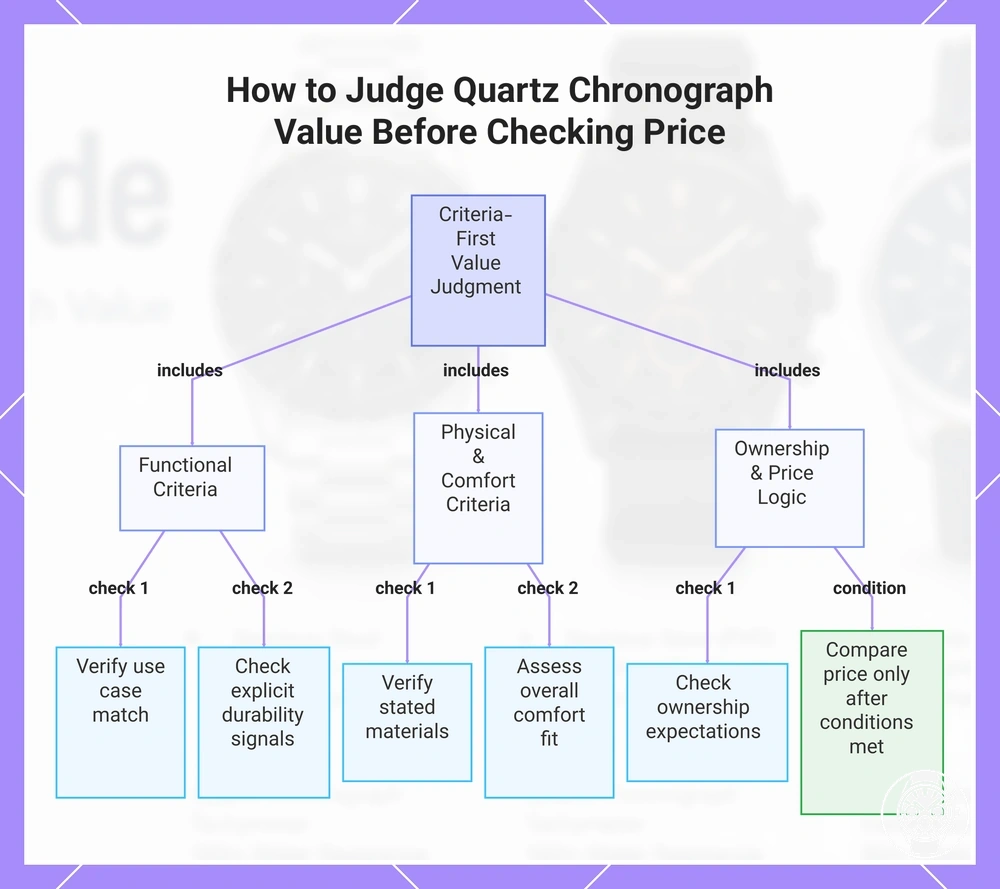
Judge a quartz chronograph's value before checking the listed price by testing each value signal against the buyer's use case, materials requirement, comfort condition, durability need, and ownership expectation. A watch represents value for money only when its attributes meet those defined conditions before price is used to compare otherwise suitable options.
Use the sequence buyer need → watch attribute → acceptable condition → value decision.
Use the sequence buyer need → watch attribute → acceptable condition → value decision. This criteria-first approach also supports how to choose: establish what the watch must do, wear like, and withstand before deciding whether its listed price is reasonable.
- Use case: Define the required task first, then verify the corresponding feature. For example, if the buyer needs to time a continuous 45-minute activity, an acceptable chronograph condition is a timing capacity of at least 45 minutes; a watch limited to 30 minutes fails that stated use case regardless of price.
- Materials: Verify the stated case, crystal, bracelet or strap, and clasp materials. The acceptable condition is that the documented materials match the buyer's wear environment and preferences; an unspecified material remains an unverified value signal rather than a reason to assume durability.
- Comfort: Assess case dimensions, watch weight, strap or bracelet adjustment, and wrist fit together. No universal case diameter or weight establishes comfort for every wearer, so the acceptable condition is a secure fit without unwanted pressure, excessive movement, or interference with normal wrist motion.
- Durability: Look for explicit durability signals such as crystal material, case construction, clasp design, surface treatment, and a stated water-resistance rating. The acceptable condition is that these documented attributes cover the expected daily environment; price or visual solidity is not a substitute for a specified durability attribute.
- Ownership expectation: Check battery expectations, service guidance, water-resistance maintenance requirements, and warranty scope where the manufacturer provides them. The acceptable condition is an ownership routine the buyer is willing to maintain rather than an assumption that every quartz chronograph has identical upkeep.
- Price reasonableness: Compare the listed price only after the preceding conditions are satisfied. A price premium adds functional value when it changes a required attribute from unacceptable to acceptable; when both watches already satisfy the same buyer need, the extra cost requires a separate material, comfort, durability, ownership, or perceived-value benefit to remain reasonable.
Daily wear, formal wear, and gifting change the weighting of the checklist rather than the underlying method. Daily wear can prioritise comfort and durability, formal wear can prioritise dimensions, materials, and finish, while gifting can give greater weight to presentation and recipient preference.
Daily wear, formal wear, and gifting change the weighting of the checklist rather than the underlying method.
For an illustrative numerical case, suppose a buyer requires a chronograph for 45-minute exercise sessions and a second candidate offers a 60-minute timing capacity while another stops at 30 minutes. The 60-minute option satisfies the stated timing condition with 15 minutes of unused capacity, while the 30-minute option falls 15 minutes short; the value decision can therefore be made on functional fit before either listed price is considered.
For an illustrative numerical case, suppose a buyer requires a chronograph for 45-minute exercise sessions and a second candidate offers a 60-minute timing capacity while another stops at 30 minutes.
After this pre-price evaluation identifies the buyer need, required watch attribute, and acceptable condition, use the buying checklist to verify the individual watch before making the final price-value decision.
Before buying, check that the compatibility criteria, key features, and product details match your needs.
The products below are useful examples for comparing available options. Before buying, check that the compatibility criteria, key features, and product details match your needs.
This chart shows the criteria-first method to evaluate a quartz chronograph's value by verifying functional, physical, and ownership conditions before comparing price.
Gift Sets, Strap Choices, and Perceived Value
A quartz chronograph gift set, strap choice, and packaging can increase perceived value without proving better core watch quality. An extra strap provides functional value when its material, fit, or style flexibility suits the recipient's use case, while packaging provides presentation value; neither changes movement, crystal, case, or water-resistance quality unless the watch specification itself also changes.
Functional value and presentation value should therefore be separated.
Functional value and presentation value should therefore be separated. Tissot Australia specifies the PR516 T1494171101100 with a 20 mm lug width, stainless steel bracelet, folding clasp with safety lock and push-buttons, and interchangeable quick-release system; Tissot also lists 20 mm leather and other strap materials among the strap choices shown for this model. Tissot describes the interchangeable system as supporting changes between business and casual use, so the measurable 20 mm attachment condition can provide style flexibility without changing the quartz chronograph's underlying specification.
| Functional value | Presentation value |
|---|---|
| An extra strap adds a second wearable configuration when it is compatible with the watch and useful to the recipient; inclusion alone does not establish better watch quality. | Gift set packaging can improve the presentation experience, but the reviewed evidence provides no verified numerical increase in watch quality or perceived value attributable to packaging alone. |
| A leather strap can provide a different fit and appearance, but the reviewed manufacturer evidence specifies no universal numerical comfort threshold; comfort remains conditional on recipient fit, strap dimensions, and material preference. | Decorative presentation can support gifting value when it matches the recipient use case, but it does not establish a material, movement, or durability improvement. |
| A stainless steel bracelet provides a defined metal construction when specified; for the cited PR516, Tissot Australia specifies stainless steel plus a folding safety clasp, but publishes no numerical bracelet service-life threshold, so durability should not be inferred from the accessory alone. | Style flexibility can increase perceived value when the recipient will use multiple configurations, but unused strap choices add no necessary functional benefit. |
For a numerical example, Tissot Australia specifies the cited 40 mm PR516 with a 20 mm lug width and quick-release bracelet, while its Australian strap selection includes 20 mm leather straps as well as a 20 mm stainless steel bracelet listed at A$175. These values show that one attachment size can support different material and presentation choices, but compatibility still requires verification against the watch reference; changing the strap does not by itself change the watch's core quality.
Perceived value should support, not replace, material and quality evaluation.
Perceived value should support, not replace, material and quality evaluation. A gift set has relevant value for money when its packaging suits the occasion and an extra leather strap or stainless steel bracelet provides a configuration the recipient will use; otherwise, the quartz chronograph's documented materials, finish, functions, and durability conditions remain the stronger basis for the price-value decision.