How to Set a Men’s Quartz Chronograph Watch
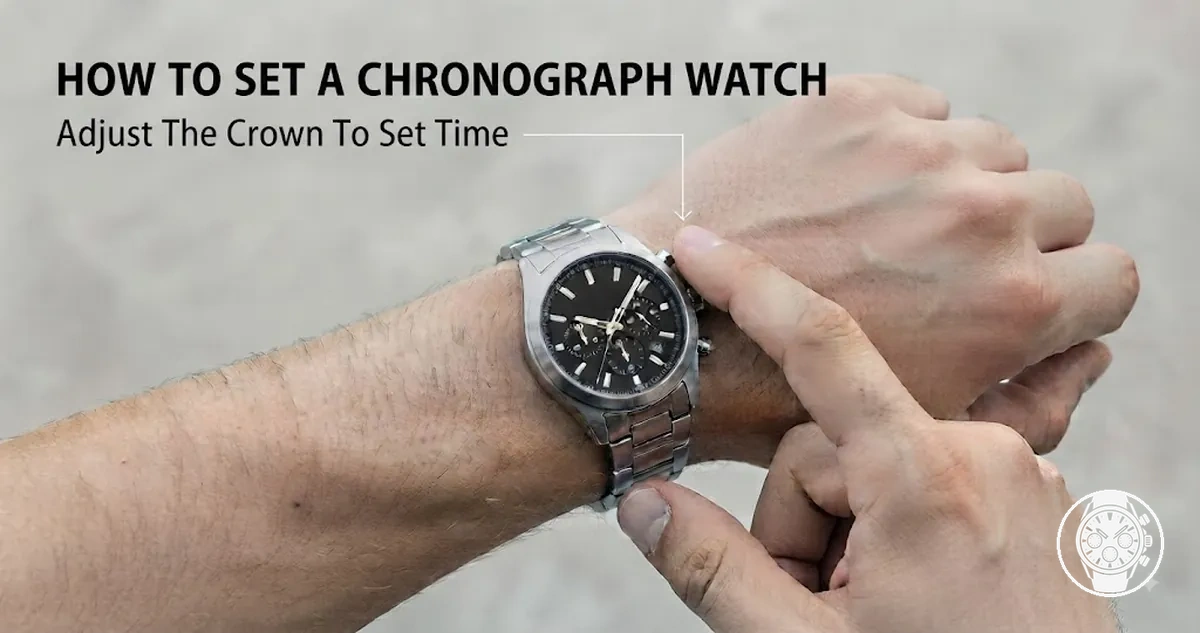
A men’s quartz chronograph watch is set by using the crown for the main time and date settings while the pushers control chronograph functions only when the movement design allows a setting adjustment. The correct setting position depends on the crown layout, pusher functions, and movement design, so the user should identify the controls before changing the time, date, or chronograph hands.
A men’s quartz chronograph watches guide covers the watch as a quartz timepiece with a stopwatch function, separate from using or repairing the chronograph mechanism.
A men’s quartz chronograph watches guide covers the watch as a quartz timepiece with a stopwatch function, separate from using or repairing the chronograph mechanism. The National Institute of Standards and Technology (NIST) explains that quartz oscillators use the stable vibration of quartz crystals to provide frequency control in electronic timing devices, while the exact crown positions, pusher actions, and chronograph hand adjustment methods are determined by the specific movement design.
Setting a men’s quartz chronograph watch safely starts with recognising the crown, pushers, and visible hand movements before making adjustments.
Setting a men’s quartz chronograph watch safely starts with recognising the crown, pushers, and visible hand movements before making adjustments. A crown position used for time setting may move the hour hand and minute hand, while a pusher may start, stop, or reset chronograph hands depending on the movement configuration.
This preparation separates normal time and date setting from chronograph hand calibration, which is a different adjustment process on movements that support it.
Before changing settings, check that the chronograph hands are in the reset or zero position when required, identify whether the watch includes a date window or 24-hour subdial, and confirm each control action through a visible display change. This preparation separates normal time and date setting from chronograph hand calibration, which is a different adjustment process on movements that support it.
Table of Contents
Crown Positions and Pushers Before Setting
Crown positions and pushers control different setting functions on a men’s quartz chronograph watch. The crown provides access to time and date settings through its available positions, while pushers control chronograph actions such as starting, stopping, resetting, or adjusting chronograph hands when the movement design supports those functions.
Crown positions and pushers control different setting functions on a men’s quartz chronograph watch.
The crown position and pusher behaviour depend on the watch movement because chronograph layouts are not identical across designs. The control map below organises the crown positions and pushers by their usual setting function before any adjustment is made.
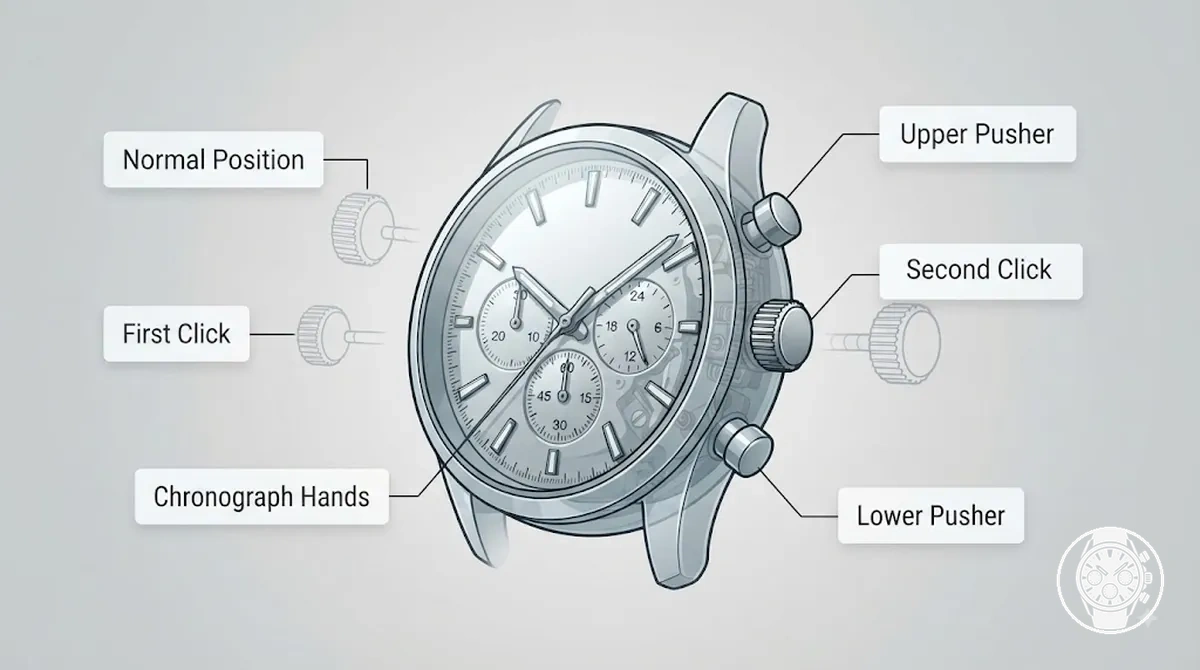
| Control | Usual setting role | What to watch for |
|---|---|---|
| Crown in normal position | Keeps the watch in its standard operating state and allows normal chronograph operation through the pushers. | The crown should be fully seated before normal use; a screw-down crown requires release before reaching setting positions. |
| First click | Usually provides access to date setting on movements that include a quickset date function. | Confirm that the date window changes rather than the main time hands before continuing. |
| Second click | Usually provides access to time setting by moving the hour hand and minute hand. | Check the displayed time and any linked 24-hour subdial indication when adjusting AM/PM. |
| Upper pusher | Usually starts and stops the chronograph stopwatch function during normal operation and may adjust chronograph hands in a setting position on some movements. | The visible effect depends on the crown position and movement configuration. |
| Lower pusher | Usually resets chronograph hands to the zero position during normal operation and may perform an adjustment function on some movements. | Do not assume the same pusher action applies to every chronograph movement. |
The main distinction is that crown positions select the setting function, while pushers usually control chronograph functions. A pusher that operates the stopwatch in normal use may have a different role when the crown is pulled into a setting position, so the visible hand movement should confirm the action before further adjustment.
Normal, Date, and Time-Setting Crown Positions
The crown positions on a men’s quartz chronograph watch separate normal operation, date setting, and time setting by changing which adjustment function is accessible. Crown clicks are recognition cues for identifying the setting effect, not universal guarantees of identical positions across different movement and case designs.
Before pulling the crown, identify the crown position and the visible effect it creates.
Before pulling the crown, identify the crown position and the visible effect it creates. Watches with a screw-down crown require the crown to be loosened before pulling it into a setting position.
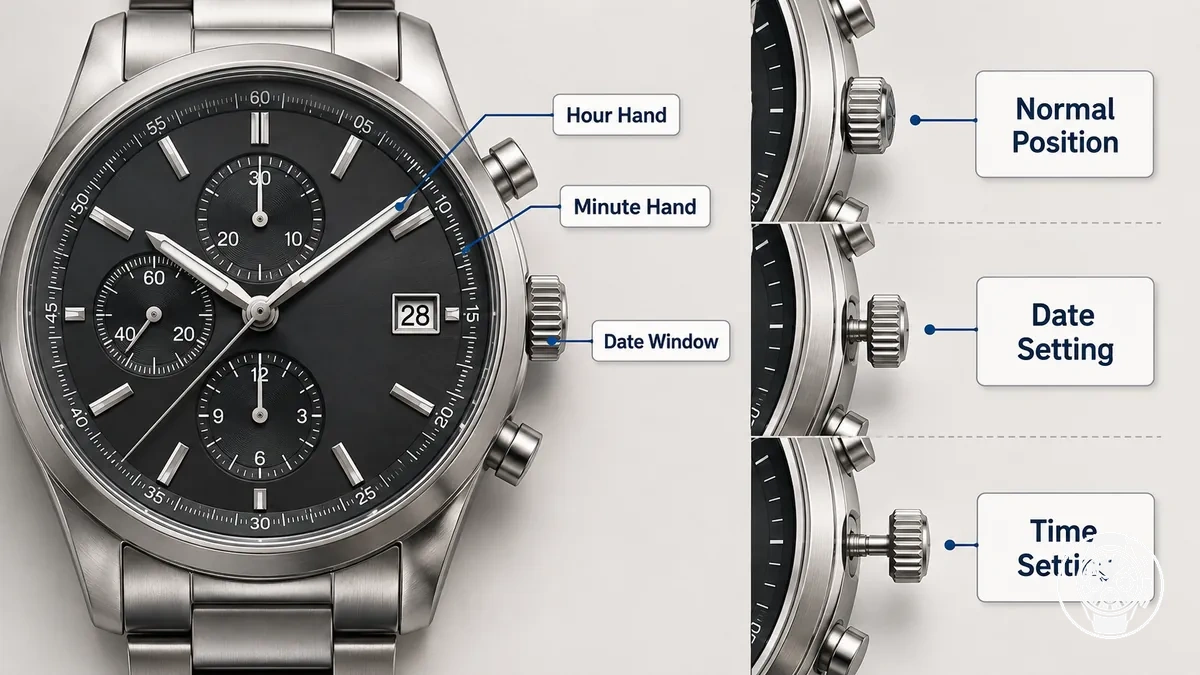
- Normal crown position: The crown remains seated against the case and keeps the watch in its standard operating state. The visible effect is that no date or time setting function is opened.
- Date-setting click: The first pulled crown position usually provides access to the date window on movements with a quickset date function. The visible effect is a changing date display rather than movement of the hour hand and minute hand.
- Time-setting click: The second pulled crown position usually provides access to the hour hand and minute hand adjustment. The visible effect is movement of the main hands and, on some watches, a linked change in the 24-hour subdial display.
Upper and Lower Pushers During Setting
The upper pusher and lower pusher on a men’s quartz chronograph watch can change their functions when the crown is pulled into a setting position. In normal operation, the pushers provide stopwatch control such as start, stop, and reset, while a crown-pulled setting mode may allow hand advancement or adjustment depending on the movement design.
The difference between normal stopwatch control and setting-mode adjustment is determined by the crown position and the movement configuration.
The difference between normal stopwatch control and setting-mode adjustment is determined by the crown position and the movement configuration. A pusher press should be judged by its visible effect, such as chronograph hand movement, rather than by assuming the same function applies across all quartz chronograph movements.
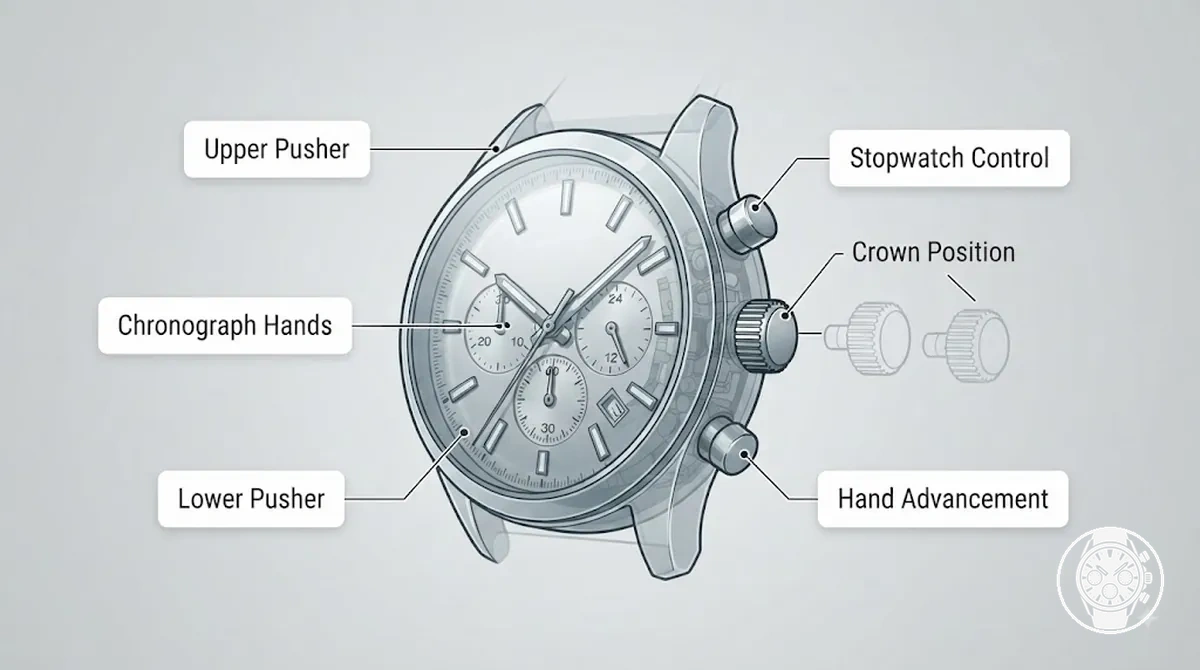
| Pusher | Normal mode | Setting-mode effect |
|---|---|---|
| Upper pusher (Pusher A) | Usually controls the chronograph stopwatch by starting or stopping the timing function. | May control hand advancement when the crown is in a setting position, depending on the movement design. |
| Lower pusher (Pusher B) | Usually controls chronograph reset by returning the chronograph hands toward the zero position. | May provide a different adjustment action in setting mode, depending on the movement design. |
Prepare the Watch Before Changing Settings
Preparing a men’s quartz chronograph watch before changing settings creates a stable state that helps prevent misreading the crown position or moving the wrong hand. A pre-setting check should confirm the chronograph status, crown type, and visible display condition before adjustment because preparation reduces setting errors.
Before changing settings, consider the watch state that affects control recognition.
Before changing settings, consider the watch state that affects control recognition. If the watch has a screw-down crown, loosen it before pulling, and if active chronograph hands or unclear subdial behaviour make the display difficult to interpret, confirm the starting state before using the crown or pushers.
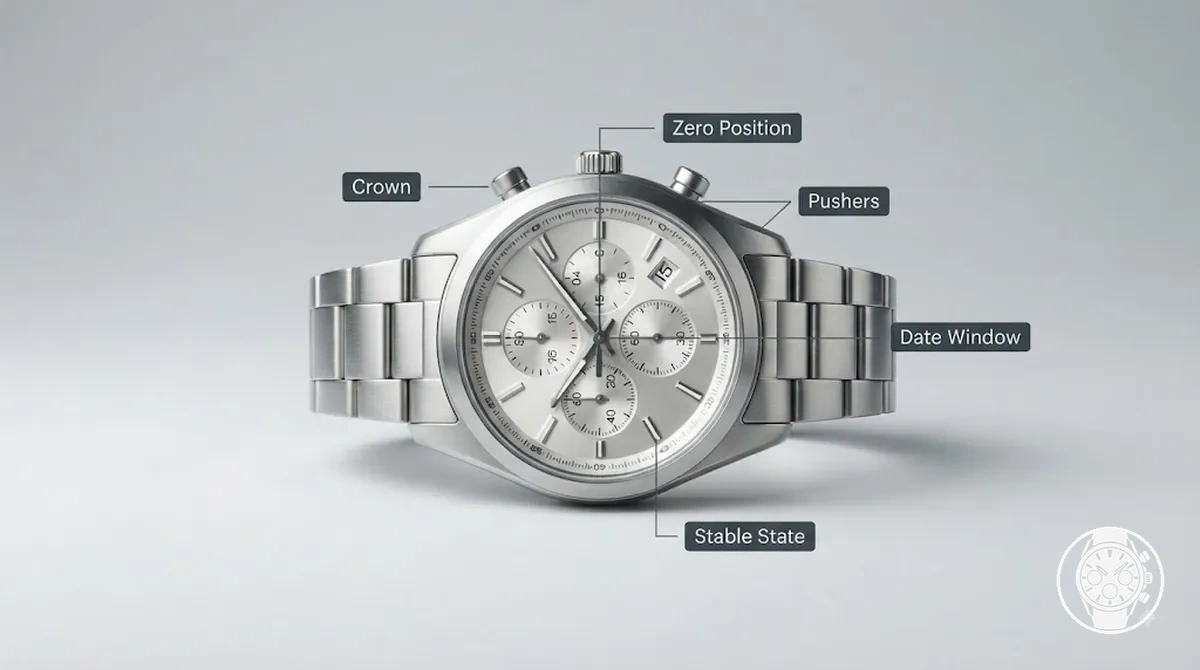
- Stop the chronograph: Stop the chronograph before changing settings so moving chronograph hands do not create confusion while identifying the setting state.
- Reset to zero: Check that the chronograph hands return to zero when the movement supports this function, creating a clearer starting position before adjustment.
- Identify crown type: Check whether the watch uses a standard crown or a screw-down crown. A screw-down crown should be loosened before pulling to avoid applying force against the crown mechanism.
- Check date position: Observe the date window and current date position before adjustment, especially when the date display is connected to the watch’s AM/PM cycle.
- Avoid force: Use gentle pressure on the crown and pushers. If a control resists normal movement, avoid force because the intended setting function may not be active.
Stop and Reset the Chronograph Before Adjustment
Stop and reset the chronograph before changing watch settings so the chronograph hands begin from a clear zero position. The normal reset function returns the stopwatch hands to zero when supported by the movement, but it does not correct misaligned hands that require a separate adjustment process.
When the stopwatch is active, confirm the start-stop state before using the crown for other settings.
When the stopwatch is active, confirm the start-stop state before using the crown for other settings. Use the chronograph controls only to reach a stable starting condition, then continue with adjustment once the visible hand position is clear.
- Stop the stopwatch: Press the chronograph stop control and confirm that the chronograph hands have stopped moving.
- Reset to zero: Press the reset pusher, commonly the lower pusher on many chronograph layouts, and confirm that the chronograph hands return to the zero position.
- Check the hand position: If the chronograph hands do not return to zero, treat the result as a misaligned hand condition rather than assuming the normal reset function corrects the position.
Use the Correct Crown Position for the Setting Task
The correct crown position depends on the setting task being performed, and the visible effect confirms whether the intended control state is engaged. Before turning the crown further, verify the visible sign that matches the task, such as which hand moves, whether the date window changes, or whether the seconds hand responds.
The correct crown position depends on the setting task being performed, and the visible effect confirms whether the intended control state is engaged.
Use the following criteria to match the setting task with the crown position and confirm the result before continuing:
- Time setting: Select the crown position used for moving the hour hand and minute hand, then confirm that the visible hands move as expected. If the seconds hand stops when the crown is pulled, use that visible sign as confirmation that the time-setting position is active.
- Date setting: Select the crown position used for changing the date window, then confirm that the date display changes rather than the main time hands. The available date-setting position can differ by movement design, so verify the visible effect before continuing.
- Crown clicks: Use crown clicks as recognition cues rather than assuming a universal click count. The correct setting position is identified by the visible effect, not by forcing the crown into a position that does not engage.
- Resistance check: Stop if the crown shows unexpected resistance or the expected display does not change. Avoid turning the crown further until the correct control state is confirmed.
Set the Main Time on a Quartz Chronograph
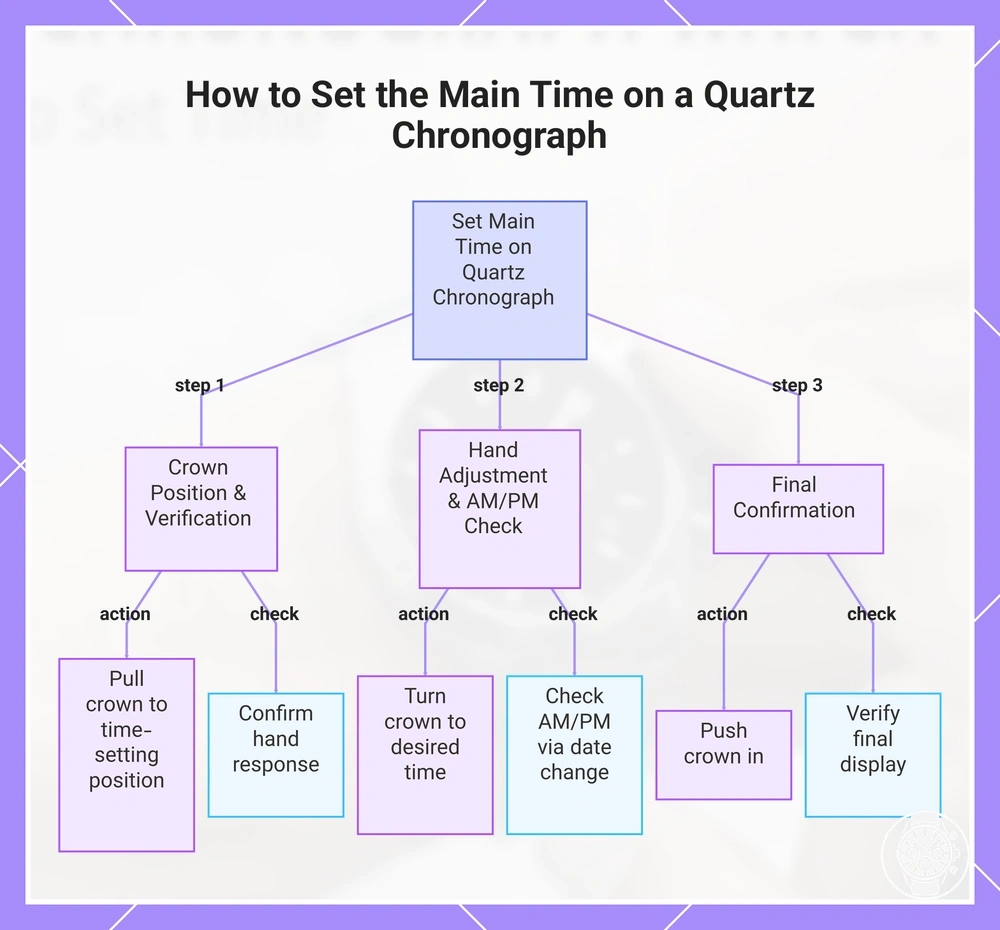
Set the main time on a quartz chronograph by pulling the crown to the time-setting position and turning it until the hour hand and minute hand match the desired time. The exact crown position, crown direction, and seconds hand behaviour can vary by movement design, so verify the visible effect before turning the crown further.
- Pull the crown to the time-setting position: Move the crown into the position that controls the main hands. Confirm that the hour hand or minute hand responds before continuing.
- Adjust the hour hand and minute hand: Turn the crown until the main hands display the required time. Confirm the visible hand movement matches the intended time-setting action.
- Check AM/PM through date change: If the watch has a date window, move the hands through midnight when needed to confirm whether the displayed time is AM or PM. A date change can indicate the day transition, but the exact behaviour depends on the movement design.
- Push the crown in: Return the crown to its normal position after setting the main time. Confirm that normal timekeeping resumes and the seconds hand moves if the movement provides this visible indication.
- Confirm the final display: Check the hour hand, minute hand, and date indication when relevant. Chronograph hand calibration or reset functions are separate adjustments and are not part of setting the main time.
This chart outlines the step-by-step process for setting the main time on a quartz chronograph, including crown position, hand adjustment, AM/PM verification, and final confirmation.
Set the Date on a Quartz Chronograph Watch
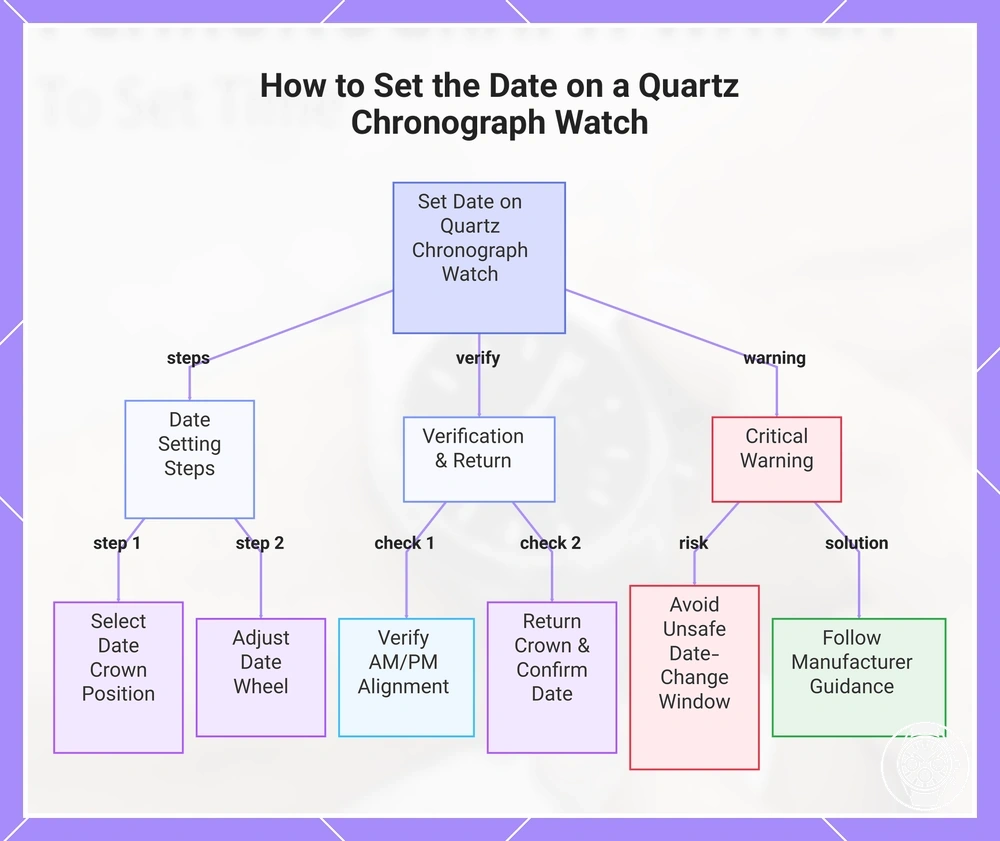
Set the date on a quartz chronograph watch by moving the crown to the date-setting position and adjusting the date display until the date window shows the correct day. The crown position, adjustment direction, and quickset behaviour depend on the movement design, so confirm the visible date change before continuing.
- Select the date crown position: Pull the crown to the date-setting position, often the first click on movements with a quickset function. Confirm that the date window responds rather than the main time hands.
- Adjust the date wheel: Turn the crown adjustment until the date wheel advances to the required day. Confirm the visible date window changes with each adjustment.
- Verify AM/PM alignment: Check the relationship between the date change and the main time. If the date changes around midnight, confirm that the hour hand corresponds with the correct AM/PM period.
- Return the crown: Push the crown back into its normal position after the date setting is complete. Confirm that the date display remains on the selected day during normal timekeeping.
- Confirm the final date result: Check the date window and main time together. Watches without a date window, or watches using a pusher or recessed corrector instead of a crown position, use a different setting method.
This chart shows the main steps, verification checks, and critical warning for setting the date on a quartz chronograph watch.
Avoid the Unsafe Date-Change Window
The unsafe date-change window is the period when a quartz chronograph watch date mechanism may be performing its automatic changeover. Changing the date during this period can interfere with the date gear engagement on some movements, so the safer approach is to follow manufacturer instructions rather than apply a universal hour range.
The date mechanism links the date gear, automatic changeover, and quickset function to the date window display. Because movement designs vary, the late evening and early morning period associated with date changes can differ between watches, so the crown and hands should be adjusted according to the applicable movement guidance.
Set or Interpret the 24-Hour Subdial
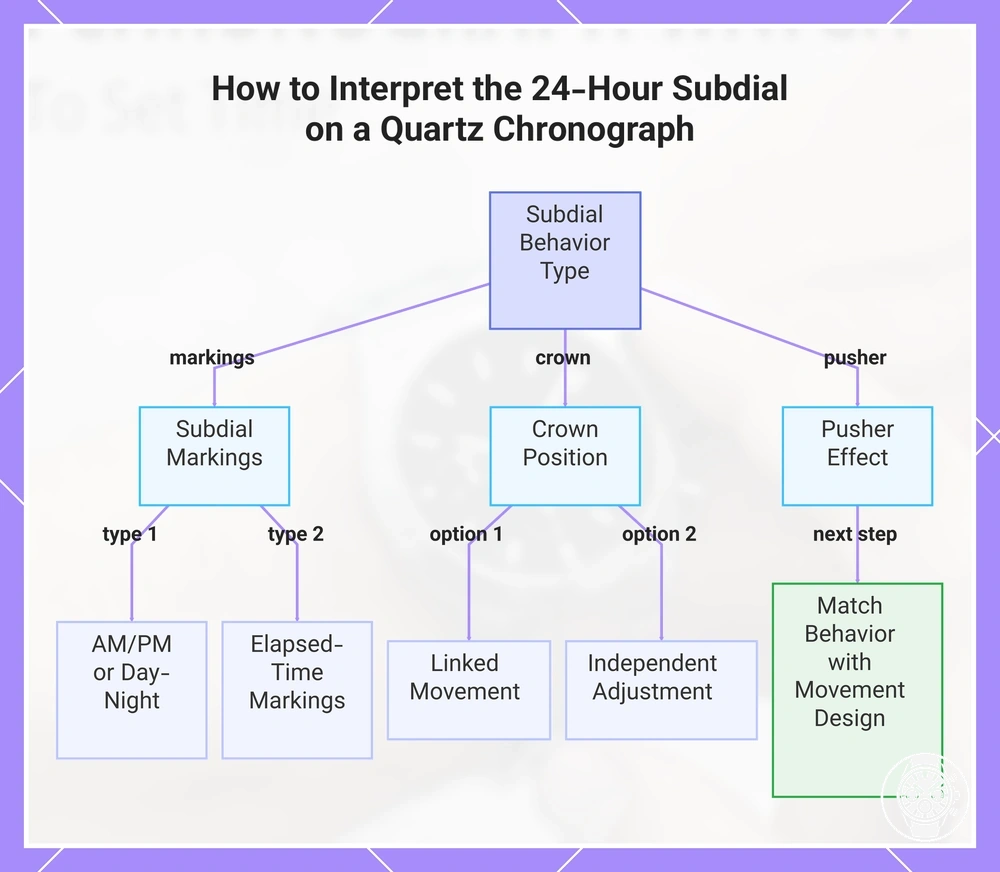
The 24-hour subdial on a quartz chronograph watch may be set with the main time or may simply mirror the current time, depending on the movement design. The 24-hour subdial provides an AM/PM indication when it functions as a linked display, while an independently adjustable subdial responds separately through its own crown position or pusher effect.
The 24-hour subdial on a quartz chronograph watch may be set with the main time or may simply mirror the current time, depending on the movement design.
When subdial markings are unclear, identify the relationship between the subdial hand, the crown position, and any pusher effect before changing settings. A true 24-hour display shows the day-night cycle, while a chronograph timing subdial uses markings intended for elapsed-time measurement when the movement supports that function.
When subdial markings are unclear, identify the relationship between the subdial hand, the crown position, and any pusher effect before changing settings.
Use these checks to separate linked behaviour from independently adjustable behaviour:
- Check the subdial markings: A 24-hour subdial uses AM/PM indication or day-night markings. A chronograph timing subdial uses elapsed-time markings when the movement assigns the small dial to timing functions.
- Check the crown position: If the 24-hour subdial moves together with the hour hand and minute hand during time setting, it is a linked subdial. If a separate crown position changes only the subdial hand, the subdial may be independently adjustable.
- Check the pusher effect: If a pusher changes the subdial hand, confirm whether the movement treats that action as a display adjustment or a chronograph timing function.
- Confirm the interpretation: Match the visible subdial behaviour with the movement design before making further setting changes.
This chart shows the three main checks to determine whether a 24-hour subdial is linked to the main time or independently adjustable, and how to confirm the interpretation.
Confirm the Chronograph Hands After Setting
Confirm the chronograph hands after setting by checking that the crown is pushed in, normal timekeeping continues, and the chronograph indicators behave correctly. This verification separates normal setting completion from usage or alignment issues that require a separate check.
This verification separates normal setting completion from usage or alignment issues that require a separate check.
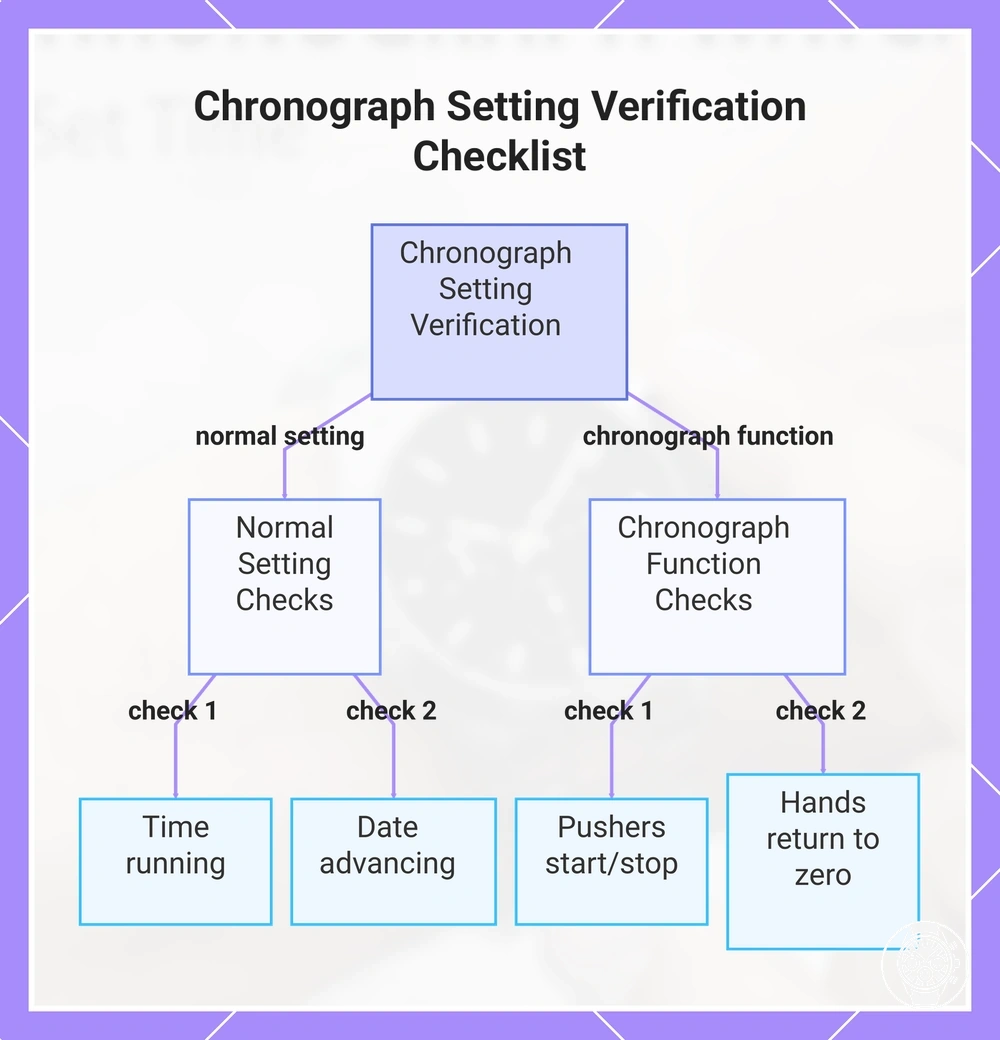
Use this checklist to confirm time, date, and chronograph behaviour separately:
- Crown pushed in: Check that the crown has returned to its normal position. This confirms the watch has exited the setting state.
- Time running: Verify that the seconds hand and main time display continue moving during normal operation. This confirms that timekeeping has resumed.
- Date advancing: Check that the date display advances correctly with the AM/PM cycle. This confirms that the date and main time relationship is set correctly.
- Pushers: Check that the pushers can start and stop the stopwatch function during normal use. This confirms that the chronograph controls respond after setting.
- Chronograph hands return to zero: Verify that the chronograph hands return to the zero position after reset. If a hand does not align with zero, treat it as a separate alignment condition rather than a normal setting result.
After confirming the indicators, continue with how to use the chronograph when the goal is operating the stopwatch function rather than checking the completed setting state.
This chart shows the key checks to confirm that the chronograph hands and timekeeping are set correctly after adjusting the watch.
This chart shows the key checks to confirm that the chronograph hands and timekeeping are set correctly after adjusting the watch.
When Setting Becomes Chronograph Hand Resetting
Setting changes the displayed time or displayed date, while chronograph hand resetting realigns stopwatch hands that do not return to the zero position. The distinction separates normal crown-based setting from calibration-type adjustment used for misaligned chronograph seconds or subdial hands.
When stopwatch hands do not return to the zero position after reset, the issue is no longer a normal time or date setting task.
When stopwatch hands do not return to the zero position after reset, the issue is no longer a normal time or date setting task. Use reset and calibrate hands as the next context for hand alignment, while conditions involving a battery, movement fault, or stuck pusher require broader diagnosis rather than ordinary setting changes.
| Ordinary setting | Chronograph hand resetting |
|---|---|
| Purpose: Changes the displayed time or displayed date through the crown and its setting positions. | Purpose: Realigns chronograph hands that do not return to the zero position after reset. |
| Control behavior: Uses the crown to adjust normal timekeeping or date display. | Control behavior: Uses a crown-pulled adjustment mode and pusher advancement when supported by the movement. |
| Visible problem: The displayed time or displayed date does not show the intended setting. | Visible problem: Misaligned chronograph seconds or subdial hands remain away from the zero position. |
| Next action: Confirm normal operation after returning the crown to its normal position. | Next action: Move to calibration-type adjustment guidance rather than repeating ordinary setting steps. |
Common Setting Mistakes to Avoid
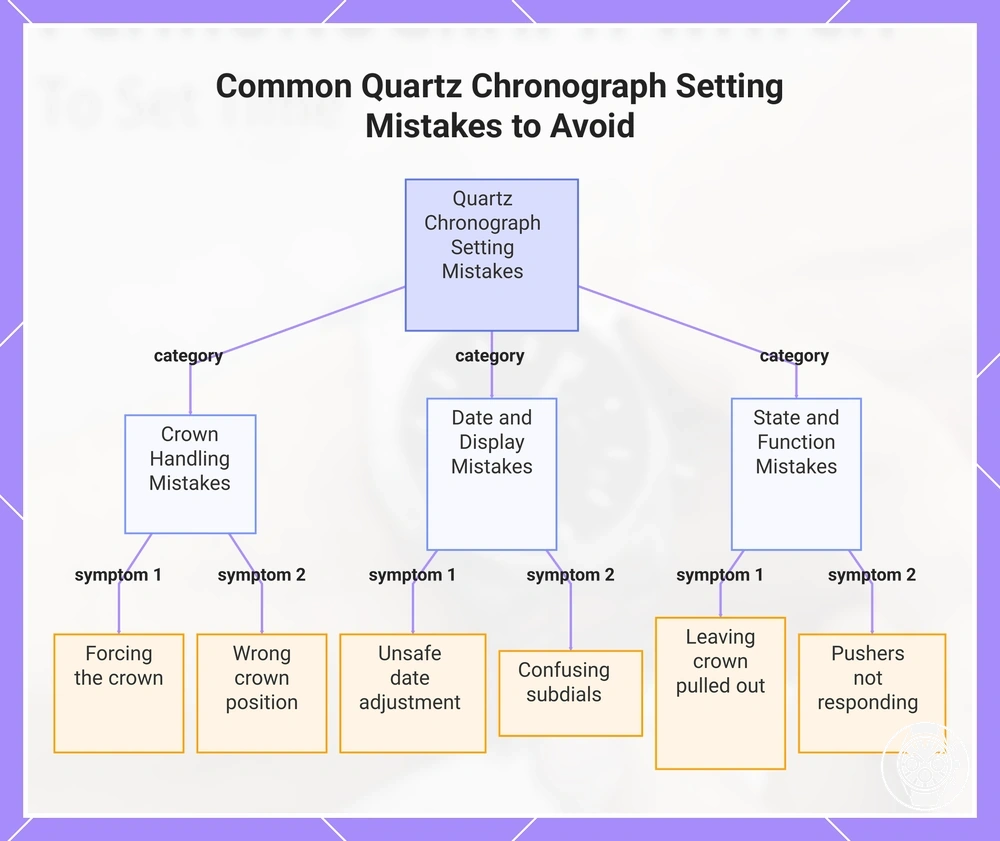
Setting mistakes can make a quartz chronograph appear incorrectly set after adjustment, but many visible symptoms come from selecting the wrong control state rather than a confirmed hardware issue. This checklist organizes setting problems by visible symptom and likely correction, focusing on setting-related mistakes rather than repairs.
- Forcing the crown: A crown that resists movement may indicate an incorrect setting position or a crown that has not been released correctly. Use the correct crown position and avoid force when the intended setting response is unclear.
- Using the wrong crown position: A visible symptom such as the displayed time changing when the goal was to adjust the date can indicate a wrong crown position. Return the crown to the correct position and confirm that the intended display changes.
- Adjusting the date at an unsafe date-change window: A date that changes incorrectly or appears offset from the main time can result from adjusting the date near the movement’s automatic changeover period. Follow the movement-specific guidance and confirm the date window after adjustment.
- Confusing subdials: A small dial that appears incorrect may be a 24-hour display or a chronograph register rather than the main time display. Check the subdial markings and movement function before changing settings.
- Leaving the crown pulled out: A crown left in a setting position can prevent normal operation. Push the crown back in and confirm that timekeeping resumes.
- Mistaking a calibration problem for a setting mistake: A chronograph hand that remains away from the zero position after reset may indicate a hand alignment condition rather than a normal setting issue. A separate calibration context may be needed if the visible symptom continues after correct setting.
- Pushers not responding: Pushers not responding can occur when the crown position or setting mode prevents normal chronograph operation. Confirm that the crown is returned to normal operation before considering causes beyond ordinary setting.
If these corrections do not explain the visible symptom, you can troubleshoot setting problems to separate setting-related issues from broader troubleshooting situations.
This chart organizes common quartz chronograph setting mistakes by visible symptom and likely correction.
This chart organizes common quartz chronograph setting mistakes by visible symptom and likely correction.